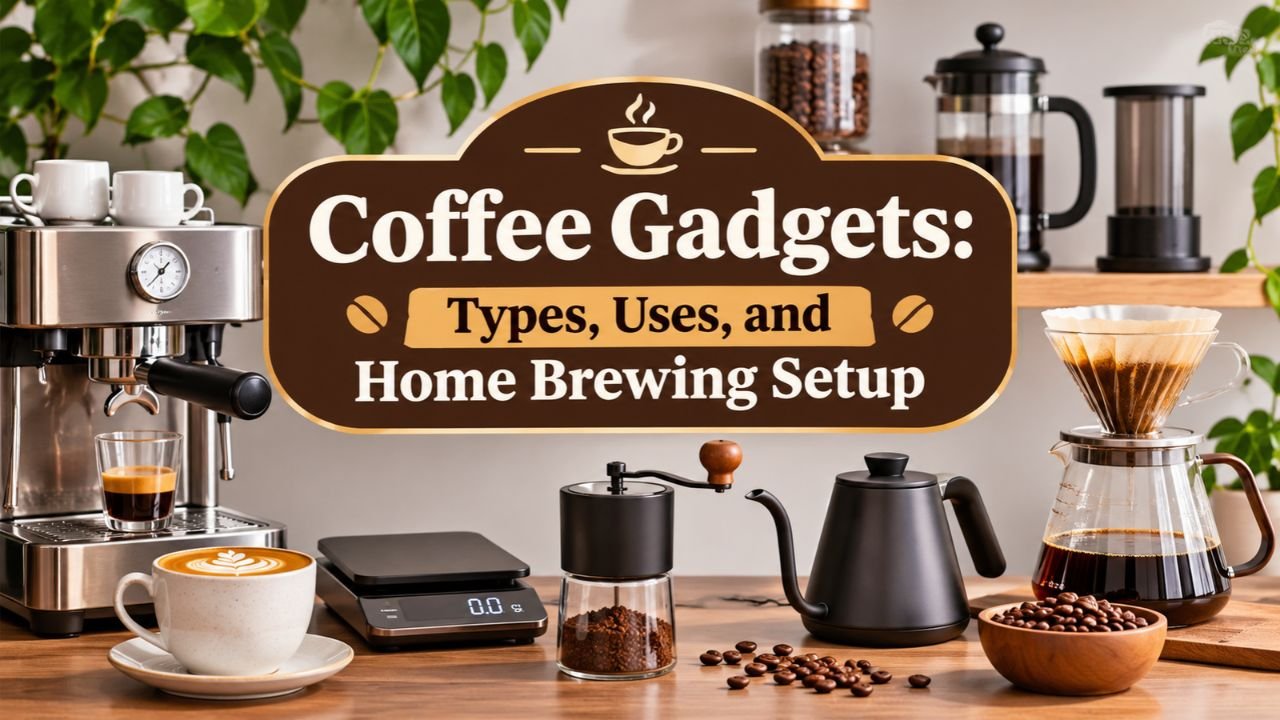
Coffee Gadgets: Types, Uses, and Home Brewing Setup
The most useful coffee-making tools include a quality grinder, digital scale, suitable brewer, and equipment for heating water. Espresso drinkers may also need tampers, dosing accessories, and milk frothers, while pour-over enthusiasts benefit from gooseneck kettles and drippers. The best setup combines tools that improve grind consistency, brewing control, convenience, and the quality of coffee in your cup.
Buying unnecessary coffee equipment can quickly become expensive. A kitchen filled with specialized accessories will not necessarily produce better coffee if the grinder creates uneven particles, the brewing ratio changes every morning, or the beans are poorly stored.
Choosing the right equipment gives you more control over coffee strength, extraction, temperature, and flavor. A few dependable tools can improve a simple French press or drip coffee routine without requiring an elaborate espresso station.
According to the National Coffee Association’s September 2026 National Coffee Data Trends report, 66% of American adults drank coffee during the previous day, and 83% of those coffee drinkers consumed coffee prepared at home. These figures highlight how much everyday coffee preparation happens in American kitchens.
What stood out to me while researching coffee gadgets was the difference between equipment that controls an important brewing variable and accessories that mainly add convenience. A burr grinder can change how consistently coffee extracts, while a decorative coffee station organizer may simply make the countertop look neater. Both can be useful, but they solve different problems.
Another detail worth understanding is that coffee equipment is not universally compatible. A grinder designed for drip coffee may lack the fine adjustment required for espresso, and a tamper that fits one portafilter basket may not fit another.
The following sections cover the main categories of coffee equipment, what each gadget does, how different brewing methods use them, which features deserve attention, and how to build a practical home coffee station. The goal is to identify the tools worth owning, the accessories worth considering later, and the purchases you can confidently skip.
What Are Coffee Gadgets and What Do They Actually Do?
Coffee gadgets are tools, devices, and accessories used to grind, measure, brew, serve, store, and maintain coffee. They range from simple manual accessories to electric machines with digital controls and wireless connectivity.
Some directly influence coffee flavor. Others make brewing cleaner, faster, or more comfortable.
Understanding their purpose is the first step toward choosing a sensible setup.
Coffee Brewing Equipment vs Coffee Accessories
Coffee brewing equipment includes the main devices responsible for preparing the drink.
Examples include espresso machines, drip coffee makers, French presses, pour-over drippers, and coffee grinders.
Coffee accessories are supporting tools used alongside those devices.
Examples include digital scales, tampers, dosing funnels, coffee filters, milk pitchers, and cleaning brushes.
The distinction is not based on price. A precision scale may cost more than a basic French press while still serving as an accessory.
For practical purposes, both categories belong under coffee gadgets.
What Makes a Coffee Gadget Worth Buying?
A useful gadget should solve a specific problem in your brewing routine.
The most meaningful improvements usually involve one of four areas:
- Consistency: Repeating the same coffee dose, grind setting, and brewing ratio.
- Control: Adjusting extraction, temperature, water flow, or beverage yield.
- Convenience: Reducing preparation time, spills, or repetitive work.
- Maintenance: Keeping equipment clean and operating correctly.
A gadget deserves priority when it addresses a limitation you regularly experience.
For example, a scale matters if coffee strength changes from one day to the next. A gooseneck kettle matters more if you prepare manual pour-over coffee than if you use an automatic drip machine.
Do You Need Expensive Coffee Gadgets?
No. Expensive equipment is not required to make good coffee.
A manual brewer, suitable ground coffee, clean water, and a consistent recipe can produce an enjoyable cup.
Higher-priced gadgets may provide tighter adjustments, stronger construction, automation, or easier handling.
Those features are useful only when they match your routine.
I recommend identifying your preferred brewing method before purchasing accessories. Buying a collection of tools without choosing a brewer often leads to unnecessary spending.
Key Takeaway: Coffee gadgets include both brewing machines and supporting accessories. Prioritize tools that improve consistency, control, and everyday convenience.
Essential Coffee Gadgets Every Home Brewer Should Know
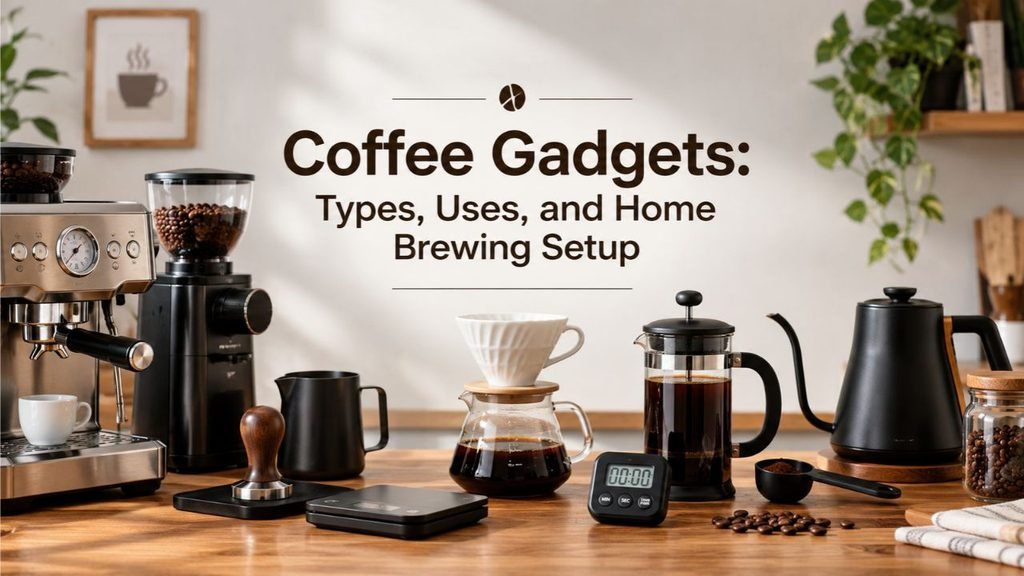
Some equipment works across nearly every brewing method.
These tools form the foundation of a home coffee setup and are often more useful than specialized accessories.
1. Burr Coffee Grinder
A burr grinder crushes coffee beans between two grinding surfaces called burrs.
The space between the burrs determines the approximate particle size.
Compared with a blade grinder, a suitable burr grinder provides more controlled and repeatable grind adjustment.
That matters because grind size influences how quickly water extracts soluble compounds from coffee.
Espresso requires fine grinding with small adjustments. French press and cold brew usually use coarser settings.
A grinder that accommodates your preferred brewing method is often one of the most meaningful equipment purchases.
If you buy preground coffee, a grinder can wait. Choose coffee ground appropriately for your brewer and use it while reasonably fresh.
2. Digital Coffee Scale
A digital coffee scale measures coffee grounds and brewing water by weight.
Unlike measuring with tablespoons or scoops, weighing provides consistent quantities.
For example, a starting filter-coffee recipe might use 20 grams of ground coffee and 320 grams of water.
Repeating that measurement makes it easier to identify why one cup tastes different from another.
For pour-over brewing, a scale that measures in 0.1-gram increments and includes a timer is convenient.
For larger French press or drip batches, a reliable kitchen scale displaying whole grams may be enough.
Espresso scales should be compact enough to fit beneath the portafilter while supporting the cup.
3. Coffee Kettle
A kettle heats the water used for brewing.
A regular electric kettle or stovetop kettle works for French press, AeroPress, and many other methods.
A gooseneck kettle has a narrow, curved spout that provides greater control over pouring speed and direction.
It is especially useful for pour-over brewing, where water distribution influences the coffee bed.
Some electric kettles allow you to select a target temperature.
Temperature control is convenient, but a basic kettle is sufficient for many brewing routines.
4. Coffee Brewer
The brewer determines how ground coffee interacts with water.
A French press uses immersion. A pour-over dripper uses gravity. An espresso machine forces water through a compact coffee bed under pressure.
These differences influence brewing time, grind requirements, beverage concentration, and cleanup.
Choose the brewer based on the coffee you enjoy drinking.
A person who prefers large cups of black coffee may be satisfied with an automatic drip brewer.
Someone who drinks cappuccinos regularly may prefer an espresso machine with a steam wand.
5. Coffee Filters and Measuring Accessories
Filters separate brewed coffee from spent grounds.
Paper, metal, and cloth filters produce different results because they retain different quantities of oils and fine particles.
Measuring accessories include coffee scoops, dosing cups, timers, and graduated containers.
A scoop is convenient, but coffee beans and grounds can have different densities. A scale is more consistent for measuring recipes.
Key Takeaway: A suitable brewer, controlled grinding, accurate measurement, and dependable water heating provide the foundation for most home coffee setups.
Coffee Grinders and Bean Preparation Gadgets
Coffee grinding has a direct influence on extraction.
A grinder breaks roasted beans into particles, increasing the surface area exposed to water.
The size and distribution of those particles affect how coffee tastes.
Manual vs Electric Coffee Grinders
A manual grinder uses a hand-operated crank.
It generally takes less counter space and does not require electricity.
Manual burr grinders are useful for travel, single-cup brewing, and kitchens where noise or storage space is a concern.
An electric grinder uses a motor to turn its grinding mechanism.
Electric models are convenient for preparing multiple servings or making espresso several times daily.
The choice involves more than speed.
Consider grind adjustment, capacity, noise, cleaning access, and the amount of effort required.
A quality manual burr grinder can produce more consistent results than a poorly constructed electric grinder.
Burr Grinder vs Blade Grinder
A blade grinder uses rotating blades to chop coffee beans.
The longer it runs, the finer the mixture generally becomes, but particle size can remain uneven.
Some pieces may be relatively coarse while others become powdery.
A burr grinder provides a more defined grinding mechanism with adjustable spacing.
This generally improves repeatability and gives greater control over extraction.
For someone interested in espresso or manual pour-over brewing, I would prioritize a burr grinder.
Blade grinders remain inexpensive and compact, but their limitations become more apparent when fine adjustments matter.
Conical Burr vs Flat Burr Grinders
Conical burr grinders use cone-shaped and ring-shaped grinding surfaces.
Flat burr grinders use two relatively flat, opposing grinding surfaces.
Both designs can produce suitable grounds for high-quality coffee.
Actual results depend on burr geometry, alignment, motor performance, and grinder construction.
It would be misleading to claim that every flat burr grinder produces more uniform particles than every conical burr grinder.
Conical grinders are common in home and commercial products.
Flat burr designs are also widely used in espresso and specialty filter grinding.
Choose according to the grinder’s intended brewing range and adjustment control rather than burr shape alone.
Single-Dose Grinders, Hoppers, and Dosing Cups
A single-dose grinder is intended to grind a measured portion of beans rather than storing a large supply in its hopper.
For example, you weigh 18 grams of beans, add them to the grinder, and collect the grounds.
This arrangement is useful when switching between different coffees.
A hopper-fed grinder stores beans above the grinding mechanism.
It is convenient for households that use the same coffee repeatedly.
A dosing cup collects ground coffee before transferring it to a filter basket or brewer.
For espresso, the dosing cup must fit the chosen workflow and portafilter arrangement.
Grinder Retention, Static, and Cleaning Tools
Grind retention refers to coffee grounds remaining inside the grinder after a grinding cycle.
Some grinders retain material in the burr chamber or exit chute.
That can affect dose consistency and introduce older grounds into a later brew.
A small brush helps remove dry coffee residue from accessible areas.
Some coffee enthusiasts use the Ross Droplet Technique (RDT), adding a very small amount of water to beans before grinding to reduce static.
Follow the grinder manufacturer’s guidance before using this method. Excess water can damage equipment or contribute to corrosion.
A bellows attachment may help clear retained grounds on grinders specifically designed to support it.
Key Takeaway: Grinder quality, adjustment range, and retention matter more than appearance. Select a grinder that can produce repeatable settings for your brewing method.
Types of Coffee Makers and Brewing Gadgets
Brewing devices differ in how they bring water and coffee together.
No single method produces the best drink for every person.
Each has strengths related to flavor, serving size, preparation time, and convenience.
Automatic Drip Coffee Maker
An automatic drip coffee maker heats water and distributes it over ground coffee held in a filter basket.
Brewed coffee passes through the filter into a carafe or serving container.
This method is convenient for households preparing several cups.
Useful features include consistent water heating, even water distribution, removable brewing components, and a carafe that maintains serving temperature.
The Specialty Coffee Association operates a Certified Home Brewer program that evaluates qualifying machines for brewing performance.
Certification is a helpful reference when comparing automatic brewers, although noncertified machines can also produce good coffee.
Pour-Over Coffee Maker
A pour-over brewer uses gravity to draw water through a bed of ground coffee.
The brewer commonly contains a paper or reusable filter.
Popular designs include cone-shaped and flat-bottom drippers.
Examples include the Hario V60 and Kalita Wave.
Pour-over brewing provides direct control over water quantity, pouring pattern, and contact time.
It is attractive for people who enjoy preparing one or two cups and exploring differences between coffee beans.
The trade-off is the need for more attention during brewing.
French Press Coffee Maker
A French press is an immersion brewer consisting of a container, lid, and plunger with a mesh filter.
Ground coffee steeps in hot water before the plunger separates much of the grounds from the liquid.
French press coffee often has a fuller mouthfeel because its metal filter permits more oils and fine particles to remain in the beverage.
The method requires no paper filters or specialized pouring kettle.
It is suitable for beginners and for brewing multiple servings.
A consistent coarse-to-medium-coarse grind is a practical starting point, adjusted to the recipe.
AeroPress Coffee Maker
An AeroPress combines immersion and pressure-assisted filtration.
Ground coffee and water mix inside a chamber, then a plunger pushes the brewed coffee through a filter.
It is compact, lightweight in its standard form, and useful for single servings.
Different recipes can produce concentrated or more diluted coffee.
AeroPress provides relatively fast cleanup because the used grounds can be pushed out as a compact puck.
Its manufacturer recommends gentle, steady pressure rather than forcing the plunger.
Despite producing concentrated coffee, a standard AeroPress does not operate like a conventional high-pressure espresso machine.
Moka Pot Coffee Maker
A moka pot is a stovetop coffee maker that uses steam pressure to push hot water upward through ground coffee.
It usually contains a bottom water chamber, a funnel-shaped coffee basket, and an upper collection chamber.
Moka coffee is concentrated and often tastes stronger than ordinary filter coffee.
It is popular for making coffee that will be served with milk.
Moka pots require attention to heat control and proper assembly.
Do not tamp the grounds or block the safety valve. Follow the manufacturer’s instructions for filling and operating the pot.
Cold Brew Coffee Maker
A cold brew coffee maker holds coffee grounds in contact with cool or cold water for an extended brewing period.
Common designs use immersion containers with removable filters.
Cold brewing produces a different flavor profile from hot brewing because temperature changes extraction.
Some devices produce concentrate intended for dilution.
Others make ready-to-drink coffee.
The main advantages are simple preparation and the ability to brew a larger batch.
The disadvantages include longer brewing time and the need for refrigerated storage.
Espresso Machine
An espresso machine forces hot water through finely ground coffee under pressure.
The result is a concentrated beverage used for espresso, cappuccinos, lattes, Americanos, and other drinks.
Machines range from manual lever systems to automatic bean-to-cup products.
Many home models use a pump to generate brewing pressure.
Other important features include temperature control, portafilter design, steam capability, and serviceability.
Espresso machines require more precise grinding and preparation than many filter methods.
A suitable grinder is an important part of the setup.
Capsule and Pod Coffee Makers
Capsule machines use preportioned coffee containers.
They offer convenient preparation with relatively little measuring or grinding.
Different systems use different capsule shapes and brewing methods.
Some are designed for concentrated espresso-style beverages, while others prepare larger cups.
The main trade-offs are ongoing capsule costs, waste, and compatibility.
A reusable capsule may reduce some waste in supported systems, but it must be approved for the machine and used correctly.
Siphon and Vacuum Coffee Makers
A siphon brewer uses heat and pressure changes to move water between two chambers.
As the brewer cools, pressure changes draw brewed coffee through a filter into the lower chamber.
The process is visually distinctive and offers considerable control over brewing time.
Siphon brewers require more setup and cleaning than simpler methods.
They are generally better suited to coffee enthusiasts who enjoy hands-on preparation.
Electric Percolators and Specialty Brewers
An electric percolator repeatedly circulates hot water through a coffee basket.
This differs from automatic drip brewing, which typically passes water through the grounds once.
Percolators can produce a strong, traditional flavor, but extended cycling may increase bitterness.
Other specialty brewers include manual lever devices, vacuum-assisted systems, automatic pour-over machines, and hybrid brewers.
Their usefulness depends on the specific brewing process they provide.
Key Takeaway: Choose a brewer according to the coffee you enjoy, serving capacity, preparation effort, and cleaning requirements. A simple brewer can be as satisfying as a complicated machine.
Pour-Over Coffee Gadgets and Accessories
Pour-over brewing benefits from tools that control water flow and support consistent filtration.
You do not need every accessory sold for this method.
A dripper, matching filter, kettle, grinder, and scale form a practical foundation.
Gooseneck Kettles and Pouring Control
A gooseneck kettle uses a narrow spout to direct water toward specific areas of the coffee bed.
This helps you wet the grounds evenly and manage the pouring rate.
Electric models may offer selectable temperatures, hold functions, and digital displays.
Stovetop models offer a simpler design without electronic controls.
A good kettle should pour smoothly, feel balanced when filled, and provide enough capacity for your usual serving size.
Temperature control is convenient, but predictable pouring is the main advantage for manual drippers.
Coffee Drippers and Filter Shapes
Drippers come in cone-shaped, flat-bottom, and other designs.
Their shape, drainage openings, ribs, and filter fit influence how water flows through the coffee bed.
Cone drippers are commonly used for single-cup brewing.
Flat-bottom drippers may provide a different flow pattern and coffee-bed geometry.
Neither shape guarantees a better cup.
The filter must match the brewer.
Using an incorrectly sized paper filter can cause folding, collapse, or irregular drainage.
Paper, Metal, and Cloth Coffee Filters
Paper filters retain much of the coffee oil and fine particles, often producing a cleaner cup.
Metal filters allow more oils and small particles into the beverage, creating a fuller mouthfeel.
Cloth filters fall between these styles in some respects but require careful washing and storage.
For ordinary home use, paper filters are convenient and predictable.
Reusable filters reduce disposable filter use but require regular cleaning.
A poorly maintained reusable filter can develop unpleasant odors or restrict flow.
Coffee Servers, Carafes, and Dripper Stands
A coffee server collects brewed coffee beneath a dripper.
Glass servers make it easy to see the coffee level.
Thermal servers help retain heat when coffee will not be consumed immediately.
A dripper stand can provide clearance and improve the visual arrangement of a coffee station.
It is not necessary if the dripper already sits securely on a compatible mug or carafe.
Choose serving accessories that fit the brewer’s dimensions and provide stable support.
Key Takeaway: Pour-over equipment should support controlled pouring, proper filtration, and stable brewing. A good gooseneck kettle and matching filters matter more than decorative stands.
Espresso Gadgets Every Home Barista Should Understand
Espresso accessories are among the most specialized coffee tools.
Many are designed to improve how ground coffee is prepared inside the portafilter.
These tools can be useful, but not all are required.
Portafilters and Filter Baskets
A portafilter is the handled component that holds the filter basket during espresso extraction.
The basket contains the ground coffee.
Common espresso machine basket diameters include nominal 51 mm, 54 mm, and 58 mm designs, but actual accessories must match the specific machine and basket.
Pressurized baskets restrict flow to help produce espresso-style beverages with less demanding grinding.
Nonpressurized baskets rely more directly on grind size and puck preparation.
Precision filter baskets are designed with carefully controlled hole patterns and dimensions.
Before buying a replacement basket, confirm the portafilter type, basket depth, and intended coffee dose.
Espresso Tamper
A tamper compresses ground coffee into a relatively level puck inside the filter basket.
A suitable tamper should fit the basket closely without binding.
Consistent, level tamping is generally more important than attempting to apply an extreme amount of force.
Handheld tampers are simple and inexpensive.
Spring-assisted and calibrated tampers may help some users repeat a similar motion.
A heavy premium tamper is not automatically superior to a properly fitting standard model.
WDT Tools and Coffee Distribution Accessories
A Weiss Distribution Technique (WDT) tool uses thin needles to break apart clumps and distribute ground coffee inside the filter basket.
This can be useful when the grinder produces clumpy grounds.
A dosing funnel prevents grounds from spilling over the basket while distributing coffee.
A rotating distributor is another accessory used to level the surface before tamping.
Its usefulness depends on the actual preparation routine and tool adjustment.
I would start with a properly fitting tamper and a simple WDT tool before buying elaborate distribution equipment.
Dosing Funnels, Cups, and Puck Screens
Dosing funnels attach to or sit around the filter basket, helping contain coffee grounds.
Dosing cups collect grounds from a grinder and transfer them to the portafilter.
Puck screens are thin metal screens placed above the tamped coffee bed.
They may help distribute incoming water and keep some residue off the group-head shower screen.
Their thickness can reduce available headspace, so compatibility matters.
Puck screens also require thorough cleaning.
They are optional accessories, not replacements for correct grinding and puck preparation.
Knock Boxes and Tamping Mats
A knock box is a container with a durable bar used to remove spent espresso pucks from a portafilter.
It keeps used coffee grounds contained and reduces mess around the machine.
A tamping mat protects the countertop and provides a stable place to prepare the portafilter.
Both are convenience accessories.
A small espresso station may benefit from a compact knock box, while a larger household may prefer a removable bin.
Choose designs that are easy to empty and wash.
Bottomless Portafilters and Shot Mirrors
A bottomless portafilter has an open underside that exposes the basket during extraction.
It can make uneven flow, spraying, and other visual signs of extraction problems easier to observe.
A shot mirror provides another viewing angle.
These are diagnostic tools.
They do not automatically improve espresso flavor.
Spraying from a bottomless portafilter can occur for several reasons, including uneven puck preparation, grind issues, and basket behavior.
Use visual observations alongside taste, dose, yield, and extraction time.
Espresso Scales and Shot Timers
An espresso scale measures the liquid coffee collected in the cup.
A compact model with 0.1-gram display increments is practical for monitoring beverage yield.
Many scales include shot timers and automatic taring modes.
A starting espresso recipe is 18 grams of ground coffee producing 36 grams of espresso, a 1:2 beverage ratio.
This is a starting point rather than a rule for every coffee.
Some connected scales communicate with compatible machines or apps.
Automatic stopping by weight requires specific machine support; ordinary Bluetooth connectivity alone does not provide that function.
Key Takeaway: The most useful espresso accessories are a suitable basket, accurate scale, properly fitting tamper, and simple tools for clean puck preparation. Specialized upgrades can follow later.
Coffee Gadgets for Milk Frothing, Lattes, and Cappuccinos
Milk-based coffee drinks introduce another equipment category.
These gadgets change milk temperature, texture, or presentation.
Some use steam, while others use mechanical agitation.
Espresso Machine Steam Wand
A steam wand introduces steam into milk, heating and aerating it.
With suitable technique, it produces microfoam, a fine mixture of milk and tiny air bubbles.
Microfoam is commonly used for lattes, flat whites, and cappuccinos.
Steam wands vary in power, control, and tip design.
Some machines provide automatic milk steaming, while others require manual positioning and temperature control.
The steam wand should be wiped and purged according to the manufacturer’s instructions after every milk preparation session.
Dried milk residue can obstruct the wand and create hygiene problems.
Electric Milk Frothers
An electric milk frother uses a whisking mechanism to introduce air into milk.
Some models also heat the milk.
These devices are convenient for people who use French press, drip coffee, or concentrated coffee instead of an espresso machine.
They can prepare foam for cappuccinos, flavored coffees, and other milk-based drinks.
Foam texture varies among devices.
A standalone frother generally does not reproduce every characteristic of steam-textured milk.
Choose one that matches your preferred drink and is easy to clean.
Handheld Milk Frothers
A handheld frother is a small battery-powered or rechargeable whisk.
It is compact and relatively inexpensive.
Handheld frothers work well for creating foam in warm or cold milk and mixing some powdered drink ingredients.
They do not normally heat milk.
For hot drinks, milk must be warmed separately using an appropriate method.
Avoid using a whisk in a container that is too full, since splashing is common.
Milk Pitchers, Thermometers, and Latte Art Tools
A stainless steel milk pitcher is used for steaming, swirling, and pouring textured milk.
Pitchers come in different capacities and spout shapes.
A thermometer may be useful for beginners who are developing temperature control.
For many milk drinks, a serving temperature around 130–150°F is a practical reference, adjusted for preference and milk type.
Avoid excessive heating, which can alter flavor and create a scalding risk.
Latte art pens, stencils, and cocoa shakers are decorative accessories.
They are fun additions but do not improve the underlying extraction or milk texture.
Key Takeaway: Choose a steam wand for traditional espresso milk texture or a standalone frother for convenience. Milk pitchers and thermometers support preparation, while art tools are optional.
Coffee Gadgets for Iced Coffee and Cold Brew
Cold coffee preparation requires fewer specialized devices than many people expect.
The choice depends on the difference between cold brew, iced filter coffee, and chilled espresso drinks.
Cold Brew Pitchers and Immersion Containers
A cold brew pitcher holds ground coffee and water during steeping.
Some include a removable mesh filter.
Others use disposable filter bags or separate strainers.
Glass, stainless steel, and food-contact-suitable plastic are common construction materials.
Choose a container that fits inside the refrigerator and can be cleaned thoroughly.
A wide opening makes it easier to remove wet grounds.
The brewer should have enough capacity for the intended batch without becoming difficult to lift or pour.
Cold Brew Filters and Concentrate Tools
Cold brew can produce a ready-to-drink beverage or a concentrate that is diluted before serving.
A common starting point for concentrate is around 1 part coffee to 5–8 parts water by weight, depending on the intended strength and brewing method.
That ratio is not universal.
A fine filter is useful for removing sediment after steeping.
Some brewers use metal mesh, while others benefit from a second filtration step through paper.
A measuring jug or scale helps dilute concentrate consistently.
Flash-Brew Iced Coffee Accessories
Flash brewing involves brewing hot coffee directly over a measured amount of ice.
The ice cools the beverage rapidly while contributing to the total recipe water.
For example, a recipe might use 20 grams of coffee, 200 grams of hot brewing water, and 120 grams of ice.
The coffee and water ratio must account for the melting ice.
A pour-over dripper, scale, suitable server, and ice are enough for this method.
Flash brewing often preserves a different aroma profile from slow cold brewing.
Coffee Shakers, Ice Trays, and Nitro Devices
A cocktail-style shaker can mix cooled espresso with ice, milk, or flavorings.
Large ice cubes may melt more slowly than small cubes of equal total weight under some serving conditions, but the result also depends on drink temperature and movement.
Nitro coffee devices introduce nitrogen gas to create a creamy-looking texture.
These systems require compatible cartridges and equipment designed for food beverages.
Do not substitute unrelated gas cartridges or improvise with pressurized containers.
Cold coffee should be prepared using clean equipment and stored according to applicable food-safety guidance. Refrigeration is a sensible default for homemade batches, especially when milk or other perishable ingredients are added.
Key Takeaway: A basic cold brew container, reliable filter, and scale cover most cold coffee needs. Shakers and nitro equipment serve more specialized drink styles.
Smart Coffee Gadgets and Automatic Brewing Technology
Connected coffee equipment can automate parts of the brewing process.
These features may improve convenience and repeatability, but they also introduce software, connectivity, and compatibility requirements.
Smart Coffee Scales
Smart scales transmit weight measurements to compatible apps or brewing systems.
Depending on the product, features may include:
- Live weight tracking
- Brew timers
- Automatic taring
- Flow-rate displays
- Shot history
- Brew-by-weight control with supported machines
Bluetooth compatibility does not mean every scale can control every espresso machine.
Acaia and other manufacturers offer connected scales, while certain La Marzocco and Decent systems provide machine-specific integration.
Check the supported device list before buying.
For most home coffee preparation, a reliable nonconnected scale is sufficient.
Programmable Kettles and Coffee Makers
Programmable kettles allow users to choose a water temperature.
Some provide temperature-hold functions or presets.
Automatic coffee makers may offer scheduled brewing, adjustable batch sizes, and programmable settings.
More advanced systems may control preinfusion, water flow, or brewing stages.
The Specialty Coffee Association tests qualifying home brewers for performance characteristics such as brewing temperature and consistency.
When evaluating an automatic machine, I would prioritize repeatable brewing and practical cleaning over an extensive list of digital features.
Grind-by-Weight and Grind-by-Time Systems
A grind-by-time grinder runs for a programmed number of seconds.
A grind-by-weight grinder uses weighing technology to target a specified coffee dose.
Both can reduce repetitive measuring.
Grind-by-time output may vary as bean characteristics and hopper conditions change.
Grind-by-weight systems can offer more direct control of the delivered dose.
These features are attractive for frequent espresso preparation.
They are less important for someone who weighs individual portions of beans before grinding.
Refractometers and Advanced Extraction Tools
A coffee refractometer measures how light passes through a coffee sample to estimate the concentration of dissolved solids.
The resulting measurement is often expressed as total dissolved solids (TDS).
When paired with the beverage mass and coffee dose, TDS data can help estimate extraction yield.
These devices are commonly associated with advanced brewing analysis and coffee quality work.
They require appropriate sample preparation, calibration, and interpretation.
A refractometer is not necessary for ordinary home coffee brewing.
Taste, grind adjustment, and consistent recipes remain more practical starting points.
Key Takeaway: Smart gadgets can automate weighing, timing, temperature, and brewing controls. Buy connected equipment only when its supported features solve a real problem.
Coffee Storage, Serving, and Travel Gadgets
Good coffee preparation does not end when brewing finishes.
Storage affects freshness, serving equipment influences temperature and convenience, and portable tools make brewing possible away from home.
Airtight Coffee Bean Containers
An airtight container limits exposure to air, moisture, and unwanted odors.
This helps protect roasted coffee during storage.
Some containers use valves or mechanisms that reduce the air space around the beans.
Others have vacuum-sealing features.
No ordinary household container can stop all chemical changes associated with coffee aging.
Store beans in a cool, dry location away from direct sunlight and heat.
Buying quantities that match normal consumption is often more useful than purchasing an expensive storage container for very old beans.
Vacuum Canisters and Freezer Storage Accessories
Vacuum coffee canisters reduce pressure inside the container, although their ability to maintain that pressure varies by product.
A well-sealed ordinary container remains a reasonable option for daily use.
For longer storage, some coffee enthusiasts freeze roasted coffee in airtight, portioned packages.
Portioning reduces repeated exposure to warm, humid air.
If freezing beans, use suitable airtight packaging and prevent condensation from reaching the coffee during handling.
The freezer is a storage option, not a requirement for every household.
Thermal Carafes, Mugs, and Serving Accessories
A thermal carafe keeps brewed coffee warm without continuously heating it on a hot plate.
An insulated travel mug provides similar convenience for individual servings.
Some mugs include electronic temperature-control systems.
These may appeal to people who drink slowly and want coffee held near a preferred temperature.
Ordinary insulated mugs are often sufficient.
Choose serving containers that are comfortable to handle, easy to clean, and suitable for the intended beverage temperature.
Portable Coffee Gadgets for Travel
Travel-friendly tools include manual burr grinders, compact immersion brewers, portable pour-over drippers, and insulated mugs.
An AeroPress-style brewer is a common example of compact coffee equipment.
A collapsible dripper may take even less luggage space.
Portable espresso devices vary considerably in their pressure systems, heating requirements, and compatible coffee formats.
Before buying one, confirm how it heats water and the amount of effort required.
For camping or road trips, prioritize durability, safe water handling, and simple cleanup.
Key Takeaway: Airtight storage, thermal serving equipment, and compact travel brewers solve practical needs outside the brewing process. Expensive storage technology is optional.
Coffee Cleaning and Maintenance Gadgets
Coffee equipment collects oils, fine particles, milk residue, and mineral deposits.
These substances can affect flavor, water flow, and equipment condition.
Regular cleaning matters more than owning a large collection of maintenance products.
Grinder Brushes and Cleaning Accessories
A soft grinder brush removes loose grounds from accessible areas.
Some grinders permit removal of an upper burr for cleaning.
Others require specific procedures and tools.
Always disconnect powered equipment before opening parts intended for user maintenance.
Do not place water inside the grinder unless the manufacturer specifically permits it.
Grinder cleaning tablets are available for compatible machines, but they are not a substitute for checking the manufacturer’s instructions.
A clean grinder reduces stale coffee buildup and possible blockages.
Espresso Cleaning Tablets and Backflush Tools
Espresso machines may require cleaning tablets, powders, or backflush procedures to remove coffee oils.
A blind basket or cleaning disc may be used on machines that support backflushing.
Not every espresso machine is designed for the same cleaning process.
Follow its manual before blocking water flow or running a cleaning cycle.
Breville’s maintenance guidance distinguishes cleaning coffee pathways from descaling internal water systems.
That distinction matters because the two processes address different deposits.
Descaling Solutions and Water Filters
Descaling removes mineral deposits from the internal water system.
Calcium-containing deposits can build up over time, depending on water composition and machine operation.
A compatible descaling product may be required.
Some espresso machines need a specific procedure or restrict certain chemicals.
Do not assume that household vinegar is suitable for every machine.
Water filtration can reduce unwanted flavors or certain minerals.
The correct filter depends on the water supply and machine requirements.
Extremely low-mineral water may also be unsuitable for some espresso systems, so follow the manufacturer’s water specifications.
Milk System Brushes, Cloths, and Cleaning Products
Milk residue can dry inside steam wand tips, automatic frothing tubes, and removable milk containers.
Clean milk-contact components promptly.
A soft cloth is useful for wiping a steam wand after preparation.
Dedicated milk-system cleaning products may be required for automatic machines.
Use the cleaning solution and rinsing procedure specified by the manufacturer.
Keep separate cloths for milk equipment and general countertop cleaning.
This reduces the chance of transferring coffee grounds or unrelated residue to freshly cleaned milk components.
Key Takeaway: Grinder brushes, compatible cleaning products, descalers, and milk-system tools support reliable operation. Follow the machine’s maintenance instructions rather than using one cleaning method for every device.
Which Coffee Gadgets Do You Need for Each Brewing Method?
The required equipment changes with the brewing method.
Buying tools based on the coffee you actually drink prevents unnecessary purchases.
| Brewing method | Main equipment | Useful additional gadgets | Usually unnecessary |
| Automatic drip | Drip brewer, filters, coffee | Burr grinder, scale, thermal carafe | Espresso tamper, WDT tool |
| Pour-over | Dripper, filters, kettle | Burr grinder, scale, gooseneck kettle | Knock box, milk pitcher |
| French press | French press, hot water | Grinder, scale, timer | Gooseneck kettle, puck screen |
| AeroPress | Brewer, filters, hot water | Grinder, scale, travel case | Espresso tamper, knock box |
| Moka pot | Moka pot, stove, coffee | Grinder, scale, serving cup | Tamper, pressure profiling tools |
| Espresso | Machine, suitable grinder, basket, tamper | Scale, WDT tool, dosing funnel | Pour-over dripper |
| Cold brew | Container, filter, coffee, water | Scale, storage bottles | Temperature-control kettle |
| Capsule coffee | Compatible capsule machine and capsules | Milk frother, capsule organizer | Separate grinder for standard sealed capsules |
| Travel coffee | Portable brewer and suitable coffee | Manual grinder, compact scale, thermos | Large electric coffee station |
This comparison highlights an important buying principle: accessories are often method-specific.
A gooseneck kettle may be worth owning for pour-over coffee, but it adds little to a capsule-based morning routine.
Likewise, a precision espresso basket has no function in a French press.
For a household using several brewing methods, shared accessories such as a grinder, scale, and kettle can serve multiple purposes.
How to Build a Home Coffee Gadget Setup by Budget
A home coffee station does not need to be completed in one shopping trip.
The most sensible buying order starts with the main brewing method and adds accessories as practical problems appear.
Simple Beginner Coffee Setup
A beginner can start with:
- A French press, AeroPress, or basic pour-over brewer
- A kettle or another suitable source of hot water
- Coffee ground for the chosen method
- A reliable kitchen scale
- Matching filters if required
A grinder can be added when buying whole beans becomes part of the routine.
This setup is suitable for one or two daily servings.
It avoids the cost and maintenance of an espresso machine.
A French press is attractive for someone who prefers fewer disposable filters. A pour-over brewer suits someone interested in more direct control of water flow.
Everyday Home Coffee Setup
An everyday upgrade should improve the parts of brewing that are currently inconsistent.
A sensible next stage may include a burr grinder, a digital scale with timer, a better kettle, and an airtight bean container.
For automatic drip brewing, a machine with dependable water heating and even saturation is worth considering.
The biggest improvement may come from grinding freshly before brewing rather than replacing an already capable coffee maker.
I would upgrade the grinder before buying decorative accessories.
Home Espresso Setup
A traditional home espresso station needs a machine, a grinder with suitable fine adjustment, a portafilter and basket, a tamper, and a scale.
A milk pitcher is needed if you intend to steam milk.
A dosing funnel and knock box are convenient additions.
A WDT tool can be useful for clumpy grounds.
The machine and grinder should be selected together because espresso preparation depends heavily on grind adjustment.
An expensive espresso machine paired with an unsuitable grinder can be frustrating to use.
Advanced Coffee Enthusiast Setup
Advanced setups may include connected scales, programmable kettles, precision baskets, single-dose grinders, water testing equipment, and software-assisted brewing controls.
Some enthusiasts add refractometers or temperature probes.
These tools are useful for investigating specific variables, not for guaranteeing that every cup will taste better.
Buy them when you can explain what measurement or control they will add to the routine.
Key Takeaway: Start with one suitable brewing method, a consistent recipe, and dependable measuring tools. Add equipment when an existing limitation becomes clear.
How to Set Up and Use Coffee Gadgets for Better Brewing
Even a good collection of equipment needs a consistent workflow.
The following approach works for many manual filter-coffee setups and provides a foundation for more advanced methods.
Step 1: Choose Your Coffee and Brewer
Select roasted coffee suitable for your taste and brewing method.
Confirm that the brewer is clean and its filter or brewing chamber is correctly assembled.
If using whole beans, prepare the grinder.
Do not adjust several equipment settings at once during the first trial.
Step 2: Measure the Coffee
Place a container on the scale and tare it.
Measure the desired coffee dose.
For a simple filter recipe, start with 20 grams of coffee.
A scale gives a more repeatable measurement than a spoon.
If grinding at home, adjust the grinder toward a medium setting for a typical pour-over recipe.
Specific settings vary between grinders.
Step 3: Heat and Measure the Water
Heat clean water.
For conventional hot filter brewing, 195–205°F (90.5–96°C) is a commonly used starting temperature range associated with Specialty Coffee Association brewing standards.
Some recipes and brewing devices use other temperatures.
For example, AeroPress provides official recipes using water around 185°F.
Match the temperature to the method and coffee rather than assuming one setting works for every device.
For 20 grams of coffee, 320 grams of brewing water provides a 1:16 starting ratio.
Step 4: Brew and Monitor the Process
Start the timer when brewing begins.
For pour-over, add water in controlled stages according to the chosen recipe.
For French press, combine coffee and water, steep for the intended time, then filter.
For espresso, measure the beverage yield rather than using the same water ratio as drip coffee.
An espresso recipe might use 18 grams of dry coffee and 36 grams of liquid beverage.
These ratios describe different brewing approaches and are not interchangeable.
Step 5: Taste and Adjust One Variable
Taste the finished coffee before changing equipment.
If filter coffee tastes thin and sharply sour, a slightly finer grind or greater extraction may help.
If it tastes harsh, dry, or excessively bitter, try a slightly coarser grind or another adjustment appropriate to the method.
A sour or bitter flavor can have several causes, so these are starting checks rather than guaranteed diagnoses.
Record the coffee dose, water amount, grind setting, temperature, and brewing time.
Repeat the recipe before making another change.
Key Takeaway: Accurate dosing, controlled water, consistent grinding, and small adjustments usually matter more than adding another gadget to the countertop.
Important Features to Check Before Buying Coffee Gadgets
Coffee equipment can look similar while offering very different functionality.
Specifications should be considered in relation to the intended brewing task.
Compatibility and Dimensions
Measure the available counter space before buying an espresso machine, grinder, or coffee maker.
Check cabinet clearance, water-tank access, and where the machine’s power cord will run.
For espresso accessories, confirm portafilter and basket dimensions.
A nominal 58 mm tamper is not automatically the correct fit for every basket labeled 58 mm.
For pour-over accessories, verify the dripper’s filter size and server compatibility.
Replacement parts should be available for equipment you plan to use frequently.
Materials and Construction Quality
Common coffee gadget materials include stainless steel, glass, ceramic, plastic, and silicone.
Each has different advantages.
Stainless steel is durable and widely used in milk pitchers and brewer components.
Glass provides visibility but can break.
Ceramic drippers retain heat differently from thin plastic designs and may require preheating.
Plastic can be lightweight and durable when properly manufactured for hot beverage use.
Choose materials appropriate for direct food contact and the temperatures involved.
Electrical Safety and Product Support
For powered appliances in the United States, check that the product is intended for 120-volt household electrical service unless your installation supports another specified voltage.
Review electrical ratings, instructions, and safety certifications from recognized testing organizations when available.
Verify that the manufacturer provides replacement components and customer support.
Grinders, espresso machines, and automatic brewers may require parts years after purchase.
A lower initial purchase price may be less attractive if the device cannot be maintained.
Cleaning and Ongoing Costs
The initial price is only part of owning coffee equipment.
Recurring expenses may include paper filters, water filters, cleaning tablets, descaling solutions, replacement seals, and capsules.
Some systems rely on proprietary accessories.
Before buying, check how easily the main components can be removed and washed.
A machine that prepares many drink styles but requires extensive cleaning after each use may not fit a busy morning routine.
Key Takeaway: Check compatibility, food-contact materials, electrical requirements, service support, and recurring costs before comparing decorative features.
Common Coffee Gadget Problems and Troubleshooting
Equipment problems often appear as changes in flavor, brewing speed, or measurement accuracy.
Basic checks should come before buying replacement parts or new gadgets.
| Problem | Possible cause | First action |
| Coffee tastes weak | Too little coffee or unsuitable extraction | Weigh the dose and water |
| Coffee tastes harsh or bitter | Excessive extraction or dark roast characteristics | Check grind and brewing conditions |
| Pour-over drains too slowly | Fine grind or clogged filter | Adjust grind and inspect filter |
| Espresso flows too quickly | Grind too coarse or puck preparation issue | Check dose, grind, and distribution |
| Espresso machine produces little water | Blockage, low water supply, or machine fault | Follow model troubleshooting instructions |
| Scale readings fluctuate | Vibration, unstable surface, or contact with another object | Level the scale and tare again |
| Grinder output changes | Retained coffee, different beans, or setting drift | Inspect and clean as instructed |
| Coffee tastes stale | Old beans or contaminated equipment | Check coffee storage and cleaning |
| Milk froth is coarse | Too much aeration or unsuitable technique | Adjust frothing method |
| Machine becomes noisy or slow | Possible mineral buildup or mechanical issue | Check maintenance guidance |
When the Grinder Is the Problem
A grinder may produce inconsistent results because of worn burrs, retained coffee, static, or an unsuitable setting.
Begin by checking the grind adjustment and whether the grinder is designed for your brewing method.
Clean accessible areas according to the manual.
Do not assume that replacing burrs is necessary without checking for accumulated grounds or other simple causes.
If the grinder makes unusual noises, stops feeding beans, or overheats, stop using it and follow the manufacturer’s troubleshooting guidance.
When the Brewer or Scale Is the Problem
An automatic coffee maker that produces weak coffee may have poor water distribution, incorrect dosing, or a maintenance issue.
For espresso, inconsistent flow may involve grind size, puck preparation, or the machine itself.
A scale that drifts may be resting unevenly or touching another part of the coffee maker.
Check the environment before recalibrating.
If an appliance leaks, trips an electrical breaker, emits smoke, or has damaged wiring, disconnect it safely and seek qualified service.
Do not open pressurized or electrically powered internal components without the required training.
Key Takeaway: Diagnose flavor, flow, and measurement problems before replacing equipment. Basic cleaning and setup checks often reveal the cause.
Common Mistakes People Make When Buying Coffee Gadgets
The coffee equipment market includes practical tools, luxury products, and accessories that solve very narrow problems.
A few purchasing mistakes appear repeatedly.
Buying a grinder that cannot handle the preferred method: Some grinders work well for filter coffee but lack the fine adjustment needed for traditional espresso.
Spending too much on accessories before mastering the brewer: A costly distribution tool cannot compensate for incorrect coffee dosing or an unsuitable grind.
Assuming Bluetooth means automatic machine control: Connected scales and machines need specific software compatibility.
Choosing a device based only on maximum pressure or wattage: Higher published numbers do not automatically mean better brewing.
Ignoring cleaning requirements: A device used every morning should be practical to disassemble, wash, and maintain.
Buying an oversized machine: A large espresso setup may be inconvenient in a small kitchen, even if its brewing features are attractive.
Expecting a premium kettle to fix poor coffee: Water control matters, but stale beans and inconsistent grinding may have a greater effect on taste.
Collecting several brewers without using them: A second brewer is useful when it provides a meaningfully different preparation method or serving capacity.
My general approach is to identify the weakest part of the existing setup before making another purchase.
If the coffee tastes inconsistent because the dose changes each morning, start with a scale.
If espresso extraction is difficult to control, examine grinder capability before buying additional puck-preparation accessories.
Coffee Gadget Care, Safety, and Environmental Considerations
Good equipment should be convenient to maintain and safe to use.
Long-term ownership also involves energy consumption, disposable supplies, and replacement parts.
Preventing Burns and Electrical Problems
Kettles, espresso machines, steam wands, and moka pots can contain hot water or pressurized steam.
Keep hands away from steam outlets and hot metal surfaces.
Do not open a moka pot or pressurized brewing device while it is hot and under pressure.
Use an appropriate electrical outlet and avoid damaged cords.
Keep powered equipment away from standing water.
Follow the manufacturer’s cooling and unplugging instructions before maintenance.
Reducing Disposable Coffee Waste
Reusable brewers and filters can reduce certain types of disposable waste.
French presses use permanent mesh filters, while many pour-over and espresso setups use reusable components alongside consumable supplies.
Paper filters and capsules create recurring waste.
Reusable filters require washing, water, and occasional replacement.
No single accessory is automatically the environmentally preferable choice in every situation.
Product lifespan, material, cleaning requirements, and local disposal systems all matter.
Choosing Repairable Equipment
A repairable grinder or coffee maker may remain usable longer than a product with inaccessible components.
Check for replacement seals, burrs, baskets, carafes, and water reservoirs.
Service information is useful for appliances expected to last several years.
For espresso machines, the availability of qualified maintenance can be as meaningful as an impressive feature list.
I would favor dependable construction and available replacement parts over features that are rarely used.
Key Takeaway: Safe operation, reasonable cleaning demands, and access to replacement parts are important parts of choosing coffee equipment for long-term use.
Coffee Gadget Glossary: Important Terms to Understand
Coffee equipment descriptions contain technical terms that can be confusing to beginners.
The following reference explains common terms without requiring detailed brewing knowledge.
| Term | Meaning |
| Agitation | Movement of coffee grounds and water during brewing |
| Bloom | Initial wetting of grounds, often allowing trapped gas to escape |
| Burr | Grinding surface used to crush coffee beans |
| Channeling | Uneven water flow through an espresso puck or coffee bed |
| Coffee bed | Layer of ground coffee inside a brewer or filter |
| Dosing | Measuring the amount of coffee used |
| Extraction | Dissolving and transferring compounds from coffee into water |
| Fines | Very small particles produced during grinding |
| Flow rate | Speed at which water or coffee moves through a system |
| Immersion | Brewing method that keeps coffee grounds in contact with water |
| Preinfusion | Initial wetting stage before or during the main extraction |
| Retention | Grounds remaining inside a grinder after use |
| RDT | Ross Droplet Technique, used in some grinding workflows to reduce static |
| Tare | Resetting a scale to zero with a container on it |
| TDS | Total dissolved solids, used to describe dissolved material concentration |
| WDT | Weiss Distribution Technique for distributing espresso grounds |
| Yield | Amount of brewed coffee collected |
| Zero-retention | A grinder design goal involving minimal leftover grounds |
These terms become more useful as you begin comparing recipes, grinders, espresso accessories, and brewing measurements.
You do not need to master every term before making coffee.
Understanding dose, grind, extraction, and yield provides a sensible starting point.
Conclusion
The most useful coffee gadgets are the tools that match your brewing method and give you greater control over coffee preparation. Grinders, scales, kettles, and brewers form the foundation, while espresso tools, milk frothers, cold brew accessories, storage containers, and smart devices serve more specialized purposes.
A good home setup does not require owning every available gadget. Focus on consistent grinding, accurate measurement, suitable water, clean equipment, and a brewing process you enjoy. Add advanced accessories when they address a specific limitation.
I recommend beginning with one dependable brewer and a repeatable recipe, then upgrading gradually. A thoughtful selection of equipment is more practical than a crowded coffee station filled with tools that rarely get used.
FAQs About Coffee Gadgets and Home Brewing Tools
What Are the Most Important Coffee Gadgets for Beginners?
The most important beginner tools are a suitable coffee brewer, a way to heat water, and a reliable measuring device. A digital scale improves consistency, while a burr grinder provides greater control over grind size when using whole beans. A French press or AeroPress is a practical starting brewer. A gooseneck kettle is useful for pour-over but not necessary for every brewing method.
Which Coffee Gadget Improves Coffee Taste the Most?
A suitable burr grinder is often one of the most meaningful upgrades, especially when moving from a blade grinder or inconsistent preground coffee. Grind size affects extraction and brewing consistency. A scale is also useful because it makes coffee and water measurements repeatable. If the grinder is already suitable, improving the brewer, water, or coffee freshness may provide the next noticeable change.
What Coffee Gadgets Do You Need for Espresso?
A traditional espresso setup requires an espresso machine, compatible filter basket, suitable espresso grinder, tamper, and a cup. A compact digital scale is strongly recommended for measuring the coffee dose and espresso yield. A dosing funnel, WDT tool, knock box, and tamping mat are useful additions. A milk pitcher is needed if you intend to use the machine’s steam wand for lattes or cappuccinos.
Are Expensive Coffee Gadgets Worth Buying?
Expensive gadgets may offer better construction, finer adjustment, automation, or more convenient operation. Those features are worth paying for when they solve a problem you experience regularly. A premium espresso grinder may be worthwhile for frequent espresso preparation, while an expensive connected scale offers little advantage to someone brewing an occasional French press. Price alone does not guarantee better coffee.
Do You Need a Coffee Scale if You Already Have a Measuring Scoop?
A scoop can be used for ordinary coffee preparation, but a scale provides more repeatable measurements. Different coffee beans and grind sizes can occupy different volumes at the same weight. A scale removes much of that variation. For beginners, an ordinary kitchen scale may be sufficient. Fine-resolution scales become more useful for espresso, small coffee doses, and controlled pour-over recipes.
What Are the Best Coffee Gadgets for Small Kitchens?
Compact manual grinders, AeroPress-style brewers, small pour-over drippers, and slim digital scales are suitable for kitchens with limited counter space. A basic electric kettle can serve several brewing methods. A compact milk frother may be useful for people who enjoy milk drinks without owning an espresso machine. Choose equipment that can be cleaned and stored easily rather than building a large permanent coffee station.
Are Smart Coffee Gadgets Better Than Manual Tools?
Smart coffee gadgets offer convenience through automated timing, temperature control, connected measurements, or programmed brewing. Manual tools provide direct control without depending on software or wireless connections. Neither category is automatically better. A regular scale and simple brewer can make excellent coffee. Smart features become more attractive when they reduce repetitive work or provide measurements that are genuinely useful to the user.
What Coffee Gadgets Are Best for Making Lattes at Home?
For traditional lattes, an espresso machine with a steam wand and a suitable milk pitcher provides the most direct setup. A grinder, tamper, and scale support espresso preparation. For a simpler approach, concentrated coffee from a moka pot or another suitable brewer can be paired with milk from a standalone electric frother. The resulting drink may differ from a traditional espresso latte but can still be enjoyable.
What Is the Difference Between Coffee Gadgets and Coffee Accessories?
Coffee gadgets is a broad term covering devices and tools used throughout coffee preparation. Coffee accessories usually refers to supporting items such as scales, filters, tampers, dosing funnels, milk pitchers, and storage containers. A grinder or espresso machine is typically described as primary equipment, but it also falls within the wider category of coffee gadgets. The distinction is mainly about the tool’s function.
How Often Should Coffee Gadgets Be Cleaned?
Cleaning frequency depends on the equipment and how often it is used. Rinse brewing components after each session and clean milk-contact parts promptly. Empty and wash drip trays as needed. Grinders require periodic removal of accumulated grounds and coffee oils. Espresso machines may need cleaning cycles, backflushing, filter changes, and descaling according to their manuals. Do not apply one universal cleaning schedule to every machine.
Can Coffee Gadgets Help Reduce Coffee Waste?
Yes. A scale reduces repeated overmeasuring, and a grinder can prepare the quantity needed for each brew. Reusable filters reduce disposable filter use, while suitable storage containers may slow flavor deterioration. Repairable equipment can reduce premature appliance replacement. Actual waste reduction depends on how the gadgets are used, their lifespan, and the materials involved.
Which Coffee Gadgets Should I Buy First for a Home Coffee Station?
Start with the brewer that makes your preferred coffee. Next, add a scale and a grinder suitable for that method. Use a kettle that provides the required water heating and pouring control. After the basic setup produces repeatable results, consider accessories that solve specific problems, such as a dosing funnel for messy espresso preparation or a milk frother for frequent cappuccinos. Build the station around your daily routine rather than purchasing every available gadget.