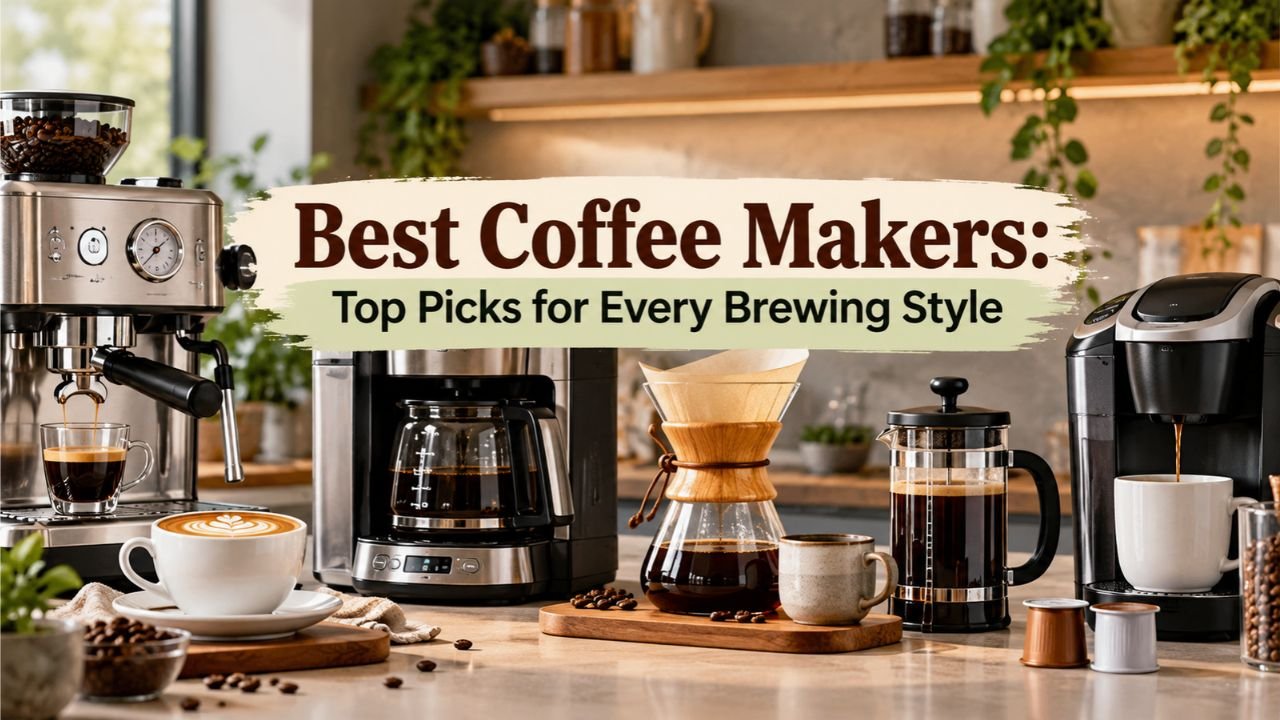
Best Coffee Makers: 15 Top Picks for Every Brewing Style
The best coffee maker for most people is one that produces consistently good coffee, matches their preferred brewing method, and fits their daily routine. The Technivorm Moccamaster KBGV Select is my top pick for premium drip coffee, while the Ninja DualBrew Pro CFP307 offers greater brewing versatility. For espresso lovers, the Breville Barista Express and De’Longhi Magnifica Evo are strong alternatives.
Choosing the wrong coffee machine can lead to bitter coffee, inconsistent brewing temperatures, wasted coffee grounds, and frustrating morning routines. A machine packed with features may still disappoint if it cannot prepare the type of coffee you actually enjoy.
A suitable coffee maker should simplify brewing while giving you enough control over coffee strength, serving size, extraction, and maintenance. Some households need a programmable 14-cup drip machine, while others would be happier with a single-serve brewer or an automatic espresso system.
According to the National Coffee Association’s September 2026 National Coffee Data Trends report, 66% of American adults drank coffee during the previous day, and 83% of those coffee drinkers had coffee at home. The same report found that 48% of American adults consumed specialty coffee in the previous day, demonstrating the growing interest in different brewing styles.
What stood out to me while researching the best coffee makers was the difference between machines designed for coffee quality and those designed primarily for convenience. A premium drip brewer may prepare excellent black coffee but offer no milk frothing, while an automatic espresso machine can make several specialty drinks but cannot brew a large family-size carafe.
I also found that advertised cup capacity can be misleading. Many American drip coffee makers count a cup as approximately 5 fluid ounces, which is considerably smaller than a typical 10- or 12-ounce coffee mug.
The following reviews compare 15 popular coffee makers from 15 different brands with Amazon listings. Each machine is evaluated for brewing technology, features, capacity, usability, cleaning, strengths, limitations, and value, followed by a detailed buying guide covering brewing methods, grind sizes, maintenance, troubleshooting, and choosing the right machine.
Best Coffee Makers at a Glance
These 15 models represent different categories, from premium drip coffee machines to affordable manual brewers and fully automatic espresso makers.
| Coffee Maker | Best For | Brewing Type | Main Advantage |
| Technivorm Moccamaster KBGV Select | Best Overall Drip Coffee Maker | Automatic drip | Consistent temperature and quality construction |
| Ninja DualBrew Pro CFP307 | Best Versatile Coffee Maker | Drip, pods, specialty concentrate | Multiple brewing styles and serving sizes |
| Breville Barista Express BES870XL | Best Semi-Automatic Espresso Machine | Espresso | Built-in grinder and manual milk steaming |
| Keurig K-Supreme Plus SMART | Best Smart Single-Serve Coffee Maker | K-Cup pods | Customizable connected brewing |
| OXO Brew 9-Cup Coffee Maker | Best Thermal Carafe Coffee Maker | Automatic drip | SCA-certified brewing and programmable timer |
| Cuisinart PerfecTemp DCC-3200 | Best Large-Capacity Coffee Maker | Automatic drip | 14-cup capacity and programmable features |
| Hamilton Beach FlexBrew Trio 49916 | Best Budget Dual Coffee Maker | Drip and compatible pods | Single cups and full carafes |
| BUNN Speed Brew Platinum CSB3T | Best Fast-Brewing Coffee Maker | Automatic drip | Full carafe in approximately 4 minutes |
| Bonavita Enthusiast 8-Cup | Best Simple Specialty Drip Brewer | Automatic drip | SCA certification and pre-infusion |
| De’Longhi Magnifica Evo | Best Automatic Espresso Machine | Bean-to-cup espresso | Automatic grinding and milk drinks |
| BLACK+DECKER CM1160B | Best Budget Programmable Coffee Maker | Automatic drip | Simple operation and affordable pricing |
| AeroPress Original | Best Portable Coffee Maker | Manual immersion and pressure-assisted | Lightweight and versatile |
| Nespresso VertuoPlus | Best Capsule Coffee and Espresso Maker | Capsule brewing | Convenient coffee and espresso-size drinks |
| Braun MultiServe Plus KF9370SI | Best Pod-Free Multi-Serve Brewer | Drip and rapid cold brew | Seven serving sizes and cold brewing |
| Philips 3300 LatteGo | Best Easy-Clean Automatic Espresso Maker | Bean-to-cup espresso | Automatic milk system with simple cleaning |
My Top Recommendations
Best Overall Drip Coffee Maker: Technivorm Moccamaster KBGV Select
Best All-in-One Coffee Maker: Ninja DualBrew Pro CFP307
Best Espresso Machine for Home Baristas: Breville Barista Express
Best Automatic Espresso Machine: De’Longhi Magnifica Evo
Best Budget Drip Coffee Maker: BLACK+DECKER CM1160B
Best Large-Capacity Coffee Maker: Cuisinart PerfecTemp DCC-3200
Best Single-Serve Pod Coffee Maker: Keurig K-Supreme Plus SMART
Best Portable Coffee Maker: AeroPress Original
Best for Iced Coffee and Cold Brew: Braun MultiServe Plus
Best for Easy Milk-Based Coffee Drinks: Philips 3300 LatteGo
The models were selected from products listed through Amazon and checked against available manufacturer information. Amazon prices, stock, colors, and package configurations can change, so confirm the exact model number and included accessories before ordering.
How I Selected the Best Coffee Makers for Home Use
A coffee maker should be judged by what it actually does during brewing, not simply by the number of features printed on its packaging.
I compared these machines according to the following considerations.
Brewing performance: A good machine should heat water appropriately, distribute it across the coffee grounds, and produce repeatable results when used with the same recipe.
Brewing versatility: Some machines prepare only drip coffee. Others support pods, espresso, iced coffee, or specialty drinks.
Serving capacity: A single-cup brewer is convenient for one person, while a larger carafe suits households preparing several mugs.
Ease of use: Clear controls, accessible reservoirs, comfortable carafes, and uncomplicated brewing routines improve daily convenience.
Cleaning requirements: Removable components, descaling instructions, milk-system cleaning, and replacement accessories affect ownership.
Construction and support: Materials, warranties, repair options, and availability of replacement components influence long-term value.
Price: An expensive machine needs to justify its additional cost through brewing capability, construction, or convenience that matters to the buyer.
Practical limitations: Every machine has compromises, including pod expenses, limited capacity, noise, maintenance, or lack of grind control.
The recommendations below are based on manufacturer specifications, published product evaluations, and practical comparisons. They do not represent claims that I personally purchased or tested all 15 machines.
I have also avoided assigning made-up performance scores or promising that every machine will produce the same results in every kitchen.
15 Best Coffee Makers Reviewed
1. Technivorm Moccamaster KBGV Select — Best Overall Drip Coffee Maker
The Technivorm Moccamaster KBGV Select is my first recommendation for someone who values the quality of brewed coffee more than having a large number of electronic features.
This Dutch-made drip coffee maker is designed to brew a 40-ounce carafe, which the manufacturer describes as 10 coffee-maker cups.
Its strongest feature is its brewing system.
The Moccamaster uses a copper boiling element designed to heat water to the appropriate range for coffee extraction. A nine-hole outlet arm distributes hot water over the coffee grounds.
The machine can brew a full carafe in approximately 4–6 minutes.
It also includes a selector for brewing a smaller 4–6-cup batch or a larger 8–10-cup batch. This helps the machine accommodate different coffee quantities without relying on the same water-flow arrangement for every batch.
The KBGV Select has Specialty Coffee Association certification, which supports its position as a coffee-focused machine rather than merely a convenient kitchen appliance.
One detail I appreciate from the specifications is the emphasis on straightforward construction.
Instead of a large digital display and extensive menu system, the Moccamaster uses simple controls and a visible brewing process.
Technivorm also offers a five-year limited warranty for its household brewers in the United States.
The machine’s main drawback is its premium price.
It also lacks the programmable delayed brewing and specialty drink functions found on some less expensive competitors.
The glass carafe sits on a hot plate, so people who prefer an insulated thermal carafe may want to consider a different Moccamaster model or the OXO Brew 9-Cup.
Key Specifications
- Brewing method: Automatic drip
- Capacity: 40 ounces, or 10 coffee-maker cups
- Brew time: Approximately 4–6 minutes
- Heating system: Copper boiling element
- Brew-volume selector: Half or full carafe
- Carafe: Glass
- Warranty: Five-year limited
- Brewing certification: SCA-certified
Pros
- Consistent temperature-focused brewing design
- Fast full-carafe preparation
- Straightforward mechanical controls
- SCA certification
- Five-year limited warranty
- Replaceable components available
- Attractive choice for specialty whole-bean coffee
Cons
- High purchase price
- No programmable delayed start
- No built-in coffee grinder
- No espresso or milk-frothing capability
- Glass carafe requires careful handling
My Opinion
The Moccamaster is my preferred choice for someone who regularly drinks black coffee and wants a dedicated drip brewer.
Compared with the Cuisinart DCC-3200, it offers fewer convenience features but places greater emphasis on brewing design and construction.
Compared with the Bonavita Enthusiast, it provides a different carafe arrangement and longer manufacturer warranty.
I would choose the Moccamaster for someone who plans to keep the same drip brewing setup for years and does not need pod compatibility.
Best For: Specialty coffee drinkers, black-coffee enthusiasts, and households prioritizing consistent drip brewing.
Who Should Skip It: Buyers seeking inexpensive programmable coffee or an all-in-one espresso system.
2. Ninja DualBrew Pro CFP307 — Best Versatile Coffee Maker
The Ninja DualBrew Pro Specialty Coffee System CFP307 is one of the most flexible coffee machines in this comparison.
Its main advantage is the ability to prepare coffee from both ground coffee and compatible K-Cup-style pods.
Many households have different coffee habits.
One person may want a quick pod before leaving for work, while another prefers freshly ground coffee brewed into a full carafe.
The DualBrew Pro can handle both situations without requiring two separate machines.
For ground coffee, the machine provides nine serving sizes. These range from individual cups to a full 12-cup carafe.
For compatible pods, it offers four sizes: 6, 8, 10, and 12 ounces.
The machine also includes four brewing styles: Classic, Rich, Over Ice, and Specialty.
Classic produces ordinary brewed coffee.
Rich creates a stronger beverage, while Over Ice is designed to prepare coffee that will be served over ice.
Specialty produces concentrated coffee suitable for making latte-style drinks.
It is important to understand that Specialty Brew is not traditional pressure-brewed espresso.
The machine does not replace a dedicated espresso system such as the Breville Barista Express.
Another useful feature is the fold-away milk frother.
It can froth cold or previously heated milk, but it does not heat milk by itself.
The CFP307 also includes a separate hot-water dispensing system with two temperature settings, making it useful for tea and other hot drinks.
The main drawback is complexity.
The pod adapter, frother, multiple brewing modes, and other accessories create more components to clean and store.
Key Specifications
- Brewing method: Ground coffee and compatible pods
- Carafe: 12-cup glass
- Ground-coffee sizes: 9
- Pod sizes: 4
- Brewing styles: Classic, Rich, Over Ice, Specialty
- Milk frother: Fold-away
- Hot-water system: Separate dispensing
- Built-in grinder: No
Pros
- Ground coffee and pod compatibility
- Single-cup and full-carafe brewing
- Four brewing styles
- Milk frother included
- Separate hot-water system
- Suitable for hot and iced drinks
- Broad serving-size selection
Cons
- Does not produce true espresso
- Frother does not heat milk
- More parts require cleaning
- Larger than a basic drip coffee maker
- No integrated coffee grinder
My Opinion
I consider the DualBrew Pro the strongest overall option for a household with several coffee preferences.
Compared with the Hamilton Beach FlexBrew Trio, it provides more specialty drink options and an independent hot-water system.
Compared with the Braun MultiServe Plus, it adds pod compatibility and milk frothing.
I would choose Ninja if convenience and brewing variety mattered more than dedicated espresso performance.
Best For: Families, mixed pod-and-ground-coffee households, and people preparing several kinds of hot and iced drinks.
Who Should Skip It: Buyers who need genuine espresso or only brew one ordinary pot of coffee each morning.
3. Breville Barista Express BES870XL — Best Semi-Automatic Espresso Machine
The Breville Barista Express BES870XL is my recommendation for people who want to prepare genuine espresso while retaining hands-on control.
Unlike an automatic drip machine, it uses a portafilter, finely ground coffee, and pressure-based extraction.
The machine includes an integrated conical burr grinder with 16 grind settings.
This allows users to grind coffee directly into the portafilter without purchasing a separate grinder immediately.
The Barista Express uses a 54 mm stainless steel portafilter and includes single-wall and dual-wall filter baskets.
Single-wall baskets are intended for users working with freshly ground coffee and adjusting extraction.
Dual-wall baskets are more forgiving and can be useful while developing basic espresso skills.
The machine uses a 15-bar Italian pump, with extraction delivered at approximately 9 bars following low-pressure pre-infusion.
Its thermocoil heating system includes PID temperature control.
Breville specifies a target brewing temperature of approximately 200°F.
The machine also has a pressure gauge, adjustable grind amount, and controls for single or double shots.
These features give users direct involvement in preparing espresso.
A manual steam wand allows milk texturing for cappuccinos and lattes.
This is an advantage for someone who wants to practice milk texture and latte art.
The main drawback is the amount of work required.
You need to grind, dose, distribute, tamp, extract, and clean the portafilter.
Making consistently good espresso requires adjustments as beans change.
The built-in grinder is convenient, but enthusiasts seeking extremely fine adjustment may eventually prefer a separate premium espresso grinder.
Key Specifications
- Brewing method: Semi-automatic espresso
- Integrated grinder: Conical burr
- Grind settings: 16
- Portafilter: 54 mm
- Pump: 15-bar system
- Espresso extraction: Approximately 9 bars
- Heating: PID-controlled thermocoil
- Milk preparation: Manual steam wand
Pros
- Produces genuine espresso
- Integrated grinder
- Manual milk-steaming control
- Pressure gauge
- Adjustable grind amount
- Single- and dual-wall baskets
- Suitable for developing barista skills
Cons
- Requires practice and regular adjustments
- More cleanup than drip coffee
- Limited grinder adjustments compared with dedicated premium grinders
- Manual milk steaming requires attention
- Not suitable for brewing a large coffee carafe
My Opinion
I would choose the Barista Express over the De’Longhi Magnifica Evo if I wanted direct control over espresso preparation.
The De’Longhi automates most of the process, while Breville lets the user control dosing, tamping, and extraction.
Compared with the Philips 3300 LatteGo, the Barista Express demands more involvement but offers greater opportunities to adjust technique.
For someone interested in developing home barista skills, I consider that control part of the appeal.
Best For: Espresso enthusiasts, home barista beginners, and people who enjoy manually preparing cappuccinos and lattes.
Who Should Skip It: Buyers wanting one-touch drinks or a large-batch drip coffee machine.
4. Keurig K-Supreme Plus SMART — Best Smart Single-Serve Coffee Maker
The Keurig K-Supreme Plus SMART is designed for people who want convenient single-cup coffee with more control than a basic pod brewer provides.
Its most recognizable feature is BrewID technology.
When connected and used with supported pods, the machine can recognize the coffee and select brewing parameters associated with that product.
It also includes Keurig’s MultiStream Technology, which distributes water through multiple streams to saturate the coffee grounds inside the pod.
The machine provides five serving sizes: 4, 6, 8, 10, and 12 ounces.
Users can choose between five strength settings and six temperature settings.
This is useful because one pod may taste stronger at a smaller serving size than at a larger one.
The K-Supreme Plus SMART includes a 78-ounce removable water reservoir.
That capacity reduces the frequency of refilling when several people prepare individual cups.
Another selling point is Wi-Fi connectivity.
The Keurig app provides access to stored preferences, scheduling, and supported remote-brewing functions.
Some smart functions depend on an active connection, compatible software, and ongoing service support.
The brewer is designed for 2.4 GHz Wi-Fi networks rather than standard 5 GHz-only connections.
The main limitation is the pod system.
K-Cup convenience comes with ongoing capsule purchases, packaging waste, and less control over freshly grinding whole beans.
The machine also does not produce traditional espresso.
Its strongest role is preparing ordinary single-serve coffee quickly with minimal handling.
Key Specifications
- Brewing method: K-Cup pod
- Serving sizes: 4, 6, 8, 10, 12 ounces
- Strength settings: 5
- Temperature settings: 6
- Water reservoir: 78 ounces
- Brewing technology: MultiStream
- Connected features: Wi-Fi and app controls
- Pod recognition: BrewID
Pros
- Very convenient single-cup brewing
- Five serving sizes
- Adjustable strength and temperature
- Large removable reservoir
- Smart connected controls
- Brew Over Ice option
- Minimal loose-coffee cleanup
Cons
- Ongoing pod expenses
- Not designed for full-carafe brewing
- Does not make traditional espresso
- Smart features depend on connectivity and service support
- Less freedom to experiment with coffee grinding
- K-Cup packaging creates additional waste
My Opinion
The Keurig K-Supreme Plus SMART makes sense for a person who values speed and repeatable convenience above manual brewing.
Compared with the Nespresso VertuoPlus, Keurig offers a broader K-Cup-style coffee selection and more direct strength controls.
Nespresso is more focused on its own capsule-based coffee and espresso-size drinks.
Compared with Ninja DualBrew Pro, Keurig is simpler but cannot brew a full carafe from ground coffee.
I would choose it for an individual household preparing several separate cups throughout the day.
Best For: Single-serve coffee drinkers, busy households, and people who prefer pod convenience.
Who Should Skip It: Whole-bean enthusiasts, espresso purists, and households primarily brewing large pots.
5. OXO Brew 9-Cup Coffee Maker — Best Thermal Carafe Coffee Maker
The OXO Brew 9-Cup Coffee Maker is an attractive choice for people who want a quality drip brewing system with a thermal carafe and programmable controls.
It uses OXO’s BetterBrew Precision Brewing system.
According to the manufacturer, the machine controls brewing water between approximately 197.6°F and 204.8°F.
This range is suitable for many drip coffee recipes.
A Rainmaker showerhead distributes water across the coffee grounds, while the brewing system adjusts its cycle according to the selected quantity.
The machine can brew smaller batches or a full nine-cup carafe.
Its double-wall stainless steel thermal carafe holds brewed coffee without relying on a continuously heated plate.
This is an important advantage for people who drink coffee over an extended morning.
Coffee held on a hot plate can develop a more cooked or bitter flavor over time.
A thermal carafe avoids direct reheating, although its temperature will gradually decline.
The OXO includes a single-dial control system.
Users can choose the brew quantity and program an automatic start time.
A freshness timer shows how long the brewed coffee has been sitting in the carafe.
The machine has Specialty Coffee Association certification.
It is well suited to people who buy good whole-bean coffee and want a convenient automatic brewing process.
The main disadvantages are price and size.
The brewer is relatively tall, so check clearance beneath kitchen cabinets.
Its thermal carafe also requires regular cleaning to prevent coffee oil buildup.
Key Specifications
- Brewing method: Automatic drip
- Capacity: 9 cups
- Brewing temperature: Approximately 197.6–204.8°F
- Carafe: Double-wall stainless steel
- Brewing system: BetterBrew
- Showerhead: Rainmaker design
- Programmable timer: Yes
- SCA certification: Yes
Pros
- Temperature-controlled brewing
- Thermal carafe
- Programmable automatic start
- SCA-certified performance
- Rainmaker water distribution
- Suitable for small and larger batches
- Simple single-dial control
Cons
- Higher price than basic drip machines
- Tall countertop design
- No espresso capability
- No milk frother
- Thermal carafe requires regular cleaning
- No built-in grinder
My Opinion
I would choose the OXO 9-Cup over the Cuisinart DCC-3200 if my priority were specialty-style drip coffee with a thermal carafe.
Cuisinart provides more capacity and a lower typical purchase price.
Compared with the Moccamaster KBGV Select, OXO adds programmable delayed brewing and an insulated carafe.
That makes it particularly appealing to someone who wants coffee ready at a scheduled time without keeping it on a hot plate.
Best For: Drip coffee enthusiasts, households preferring thermal carafes, and people who want programmable brewing.
Who Should Skip It: Buyers needing espresso, coffee pods, or the lowest-priced coffee machine.
6. Cuisinart PerfecTemp DCC-3200 — Best Large-Capacity Coffee Maker
The Cuisinart PerfecTemp 14-Cup Programmable Coffee Maker DCC-3200 is one of my strongest recommendations for households that brew large quantities of ordinary drip coffee.
Its main advantage is capacity.
The machine uses a 14-cup glass carafe, giving it more brewing capacity than many standard 10- and 12-cup machines.
That makes it useful for families, guests, and shared workspaces.
The Cuisinart includes Regular and Bold brewing options.
These allow users to choose between ordinary brewed coffee and a stronger flavor profile.
It also provides a 1–4-cup setting for smaller batches.
That matters because a large coffee maker is not always used at full capacity.
The machine supports 24-hour programmable brewing, so users can prepare coffee grounds and water in advance.
Its automatic shutoff can be adjusted within a range of up to four hours.
The warming plate is designed to keep the glass carafe hot after brewing.
Cuisinart also includes a gold-tone reusable coffee filter and charcoal water filter.
A Brew Pause feature temporarily interrupts dispensing when the carafe is removed.
The machine provides a ready alert tone and a cleaning indicator.
Another useful ownership detail is Cuisinart’s three-year limited warranty.
The main drawback is the glass-carafe warming system.
Coffee held on a heated plate for extended periods can change flavor.
The machine also lacks the more specialized temperature-focused brewing features associated with premium SCA-certified drip machines.
Still, it provides strong convenience at a more accessible price than many premium brewers.
Key Specifications
- Brewing method: Automatic drip
- Capacity: 14 cups
- Carafe: Glass
- Brewing strength: Regular and Bold
- Small-batch setting: 1–4 cups
- Programmable start: 24 hours
- Auto shutoff: Adjustable up to 4 hours
- Warranty: Three-year limited
Pros
- Large brewing capacity
- Useful programmable controls
- Regular and Bold options
- Small-batch setting
- Reusable gold-tone filter
- Charcoal water filter
- Adjustable auto shutoff
- Three-year limited warranty
Cons
- Coffee may change flavor during extended hot-plate warming
- No thermal carafe
- No espresso or pod brewing
- Glass carafe can break
- No built-in grinder
- Less specialized brewing control than premium drip machines
My Opinion
I would choose the Cuisinart DCC-3200 for a family that prepares a full pot of coffee every morning.
Compared with the BLACK+DECKER CM1160B, Cuisinart offers more capacity and additional brewing controls.
Compared with the Moccamaster, it provides more convenience features at a lower typical price, but the brewing approach is less specialized.
For households that drink several large mugs, the Cuisinart is one of the easiest purchases to justify.
Best For: Large families, shared kitchens, and people who prefer programmable drip coffee.
Who Should Skip It: Single-serve households, espresso drinkers, and buyers wanting an insulated thermal carafe.
7. Hamilton Beach FlexBrew Trio 49916 — Best Budget Dual Coffee Maker
The Hamilton Beach FlexBrew Trio 49916 is designed for households that want both pod convenience and traditional drip brewing.
It offers three brewing approaches.
Users can make a full pot from ground coffee, prepare a single serving using a compatible K-Cup pod, or brew a single serving from loose coffee grounds.
This is a useful combination for families.
One person can brew an individual cup before work, while the rest of the household can use the 12-cup carafe.
The single-serve system includes a 56-ounce water reservoir.
Hamilton Beach advertises brewing an individual cup in approximately 90 seconds under specified conditions.
The machine offers five single-serve sizes.
It also includes programmable controls for the carafe side, making it possible to prepare coffee ahead of time.
The carafe side uses a glass pot and warming plate.
Single-serve brewing is handled through a separate brewing area.
This design provides flexibility, but it also increases the number of parts that need cleaning.
The pod holder and ground-coffee basket should be maintained according to the manufacturer’s instructions.
Compared with the Ninja DualBrew Pro, the FlexBrew Trio focuses more on ordinary brewing convenience.
It does not have Ninja’s Specialty concentrate mode, integrated frother, or independent hot-water functions.
That simpler approach can provide good value for buyers who do not need specialty drinks.
The main drawbacks involve countertop space and cleaning.
A dual-system brewer is larger and mechanically more involved than an ordinary single-purpose machine.
Key Specifications
- Model: 49916
- Brewing methods: Carafe, compatible pods, loose-ground single serve
- Carafe capacity: 12 cups
- Single-serve reservoir: 56 ounces
- Single-serve sizes: 5
- Advertised single-cup time: Approximately 90 seconds
- Programmable carafe brewing: Yes
- Built-in grinder: No
Pros
- Three brewing methods
- Compatible pod support
- Full 12-cup carafe
- Separate single-serve reservoir
- Fast individual brewing
- Programmable carafe function
- Suitable for households with different habits
Cons
- No genuine espresso capability
- No milk frother
- More components to wash
- Larger footprint than a simple drip brewer
- Pod brewing has ongoing capsule costs
- No built-in grinder
My Opinion
The FlexBrew Trio is a strong alternative to the Ninja DualBrew Pro when basic coffee flexibility matters more than specialty functions.
Compared with Keurig K-Supreme Plus SMART, Hamilton Beach adds full-carafe brewing and a loose-ground single-serve option.
Keurig offers more advanced controls for pod preparation.
I would choose Hamilton Beach for a household that wants a practical dual coffee maker without paying extra for milk frothing or concentrated specialty drinks.
Best For: Families combining pod and drip coffee, budget-conscious buyers, and households needing single servings plus a full pot.
Who Should Skip It: Buyers prioritizing espresso, specialty coffee drinks, or a very compact appliance.
8. BUNN Speed Brew Platinum CSB3T — Best Fast-Brewing Coffee Maker
The BUNN Speed Brew Platinum CSB3T stands out because of its unusually fast brewing system.
Most conventional drip coffee makers heat water during each brewing cycle.
The BUNN uses an internal stainless steel tank that keeps approximately 70 ounces of water hot and ready for brewing.
This design allows the machine to prepare a full 10-cup carafe in approximately four minutes once the system is operating normally.
It can also prepare approximately 20 ounces of coffee for a travel mug in around two minutes.
For people who want coffee quickly, that is a meaningful advantage.
The machine uses a multi-stream sprayhead designed to distribute hot water over the coffee bed.
The CSB3T includes a double-wall, vacuum-insulated thermal carafe.
According to BUNN, the carafe can keep coffee at a desirable serving temperature for more than two hours under its stated conditions.
It does not rely on a hot plate for maintaining the brewed coffee.
The machine is designed and assembled in the United States.
BUNN also provides a three-year warranty for its Speed Brew models.
Its main disadvantage comes from the same feature that makes it fast.
The internal water tank remains heated while the brewer is switched on.
This means the machine consumes standby electricity to maintain hot water.
For a household that brews coffee only occasionally, that operating approach may be less attractive.
The BUNN also uses a taller filter funnel, and the manufacturer recommends suitable BUNN filters to accommodate the fast water flow.
Key Specifications
- Brewing method: Automatic drip
- Capacity: 10 cups, approximately 50 ounces
- Full-carafe brew time: Approximately 4 minutes
- Travel-mug brew: Approximately 20 ounces
- Heating system: Constantly heated internal tank
- Internal tank capacity: Approximately 70 ounces
- Carafe: Thermal
- Warranty: Three years
Pros
- Very fast brewing
- Large thermal carafe
- Suitable for repeated batches
- Multi-stream sprayhead
- No hot plate required
- Designed and assembled in the United States
- Three-year warranty
Cons
- Heated tank consumes standby electricity
- Less attractive for occasional brewing
- No espresso or milk-frothing functions
- May require suitable taller filters
- Larger than many compact coffee makers
- No integrated grinder
My Opinion
I would choose the BUNN Speed Brew Platinum for a household that prepares several pots daily and values fast turnaround.
Compared with the OXO 9-Cup, BUNN places more emphasis on speed, while OXO provides programmable controls and a temperature-focused brewing system.
Compared with Cuisinart DCC-3200, BUNN has less capacity but a much faster brewing approach.
For someone making one cup every few days, I would not choose a machine that maintains a hot internal tank.
Best For: Busy households, frequent coffee drinkers, and people preparing several batches each day.
Who Should Skip It: Occasional coffee drinkers and buyers seeking low standby electricity use.
9. Bonavita Enthusiast 8-Cup — Best Simple Specialty Drip Brewer
The Bonavita Enthusiast 8-Cup Coffee Brewer is designed for people who want specialty-style drip coffee without managing a complicated control panel.
Its central advantage is a brewing system focused on water temperature, saturation, and a straightforward preparation process.
The Enthusiast uses a 1,500-watt heating system and can brew an eight-cup carafe in approximately six minutes.
It includes a showerhead designed to distribute water across the coffee grounds.
Another feature is its optional pre-infusion mode.
Pre-infusion wets the coffee grounds before the main brewing cycle.
This gives trapped gas an opportunity to escape and allows the coffee bed to become more evenly saturated.
The process can be useful when brewing freshly roasted beans.
The Enthusiast has Specialty Coffee Association certification.
The model reviewed here includes a stainless steel-lined thermal carafe.
This is useful for someone who drinks coffee gradually and prefers avoiding prolonged contact with a warming plate.
The removable water tank also makes filling more convenient than pouring water into a fixed reservoir.
Maintenance features include an accessible filter basket, removable components, and a dedicated descaling control.
Bonavita identifies several components, including the carafe lid and filter basket, as dishwasher-safe.
The main limitation is versatility.
The Enthusiast does not offer coffee pods, espresso, milk frothing, or a long list of specialty drink settings.
That simplicity is intentional.
For someone who primarily drinks black filter coffee, fewer features may mean a more straightforward routine.
Key Specifications
- Brewing method: Automatic drip
- Capacity: 8 cups
- Brew time: Approximately 6 minutes
- Heater: 1,500 watts
- Carafe: Thermal
- Pre-infusion: Optional
- Reservoir: Removable
- SCA certification: Yes
Pros
- SCA-certified brewing
- Optional pre-infusion
- Thermal carafe
- Fast brewing cycle
- Removable water reservoir
- Straightforward controls
- Accessible cleaning components
- Good choice for specialty filter coffee
Cons
- No pod compatibility
- No espresso brewing
- No milk frother
- Smaller capacity than 12- and 14-cup machines
- Premium price compared with basic drip brewers
- No built-in coffee grinder
My Opinion
I consider the Bonavita Enthusiast an attractive alternative to the Technivorm Moccamaster.
Both focus on drip brewing rather than providing numerous specialty drink settings.
The Bonavita offers an insulated carafe, optional pre-infusion, and a convenient removable reservoir.
Compared with the OXO 9-Cup, it has fewer programmable controls.
I would recommend Bonavita for someone who wants to prepare good filter coffee with minimal adjustment each morning.
Best For: Specialty coffee enthusiasts, pour-over drinkers moving to automatic brewing, and people who prefer simple controls.
Who Should Skip It: Families requiring a very large carafe or buyers seeking multiple specialty drink categories.
10. De’Longhi Magnifica Evo — Best Fully Automatic Espresso Machine
The De’Longhi Magnifica Evo ECAM29084SB is designed for people who enjoy espresso drinks but do not want to manage every step manually.
It combines grinding, dosing, extraction, and automatic milk preparation in one machine.
The Magnifica Evo includes a conical burr grinder with 13 grind settings.
Users place whole coffee beans in the hopper and select the desired beverage.
The machine then grinds the beans and prepares the coffee using its internal brewing system.
The LatteCrema milk system automatically prepares milk foam for supported drinks.
This eliminates the need to manually operate a steam wand for ordinary cappuccinos and latte macchiatos.
The ECAM29084SB includes seven one-touch or customizable drink functions.
These cover espresso, coffee, cappuccino, latte macchiato, iced coffee, hot water, and the MyLatte function.
MyLatte is designed around using the amount of milk placed in the carafe.
The machine also supports certain pre-ground coffee preparation through a separate bypass system.
That can be useful when someone wants a decaffeinated drink without replacing the beans in the main hopper.
The main advantage is convenience.
A household can prepare several espresso-based drinks without purchasing a separate grinder and developing the same manual barista routine required by the Breville Barista Express.
The disadvantages are cost, complexity, and maintenance.
The milk system, brew group, drip tray, grounds container, and water system all require regular attention.
Automatic espresso machines also have more internal mechanisms than ordinary drip coffee makers.
Key Specifications
- Brewing method: Fully automatic espresso
- Built-in grinder: Conical burr
- Grind settings: 13
- Drink functions: 7
- Milk system: LatteCrema
- Water reservoir: Approximately 61 ounces
- Bean hopper: Approximately 8.8 ounces
- Coffee compatibility: Whole beans and supported pre-ground use
Pros
- One-touch espresso preparation
- Integrated grinder
- Automatic milk frothing
- Seven drink functions
- Suitable for cappuccinos and latte macchiatos
- Adjustable grind and drink settings
- Convenient for households making several espresso drinks
Cons
- High purchase price
- More cleaning than a drip brewer
- Internal components require maintenance
- Less manual control than a semi-automatic espresso machine
- No large drip coffee carafe
- Takes substantial countertop space
My Opinion
I would choose the Magnifica Evo over the Breville Barista Express if convenience were the primary goal.
Breville gives users greater control over espresso preparation.
De’Longhi reduces the number of manual steps.
Compared with Philips 3300 LatteGo, the Magnifica Evo offers a different drink selection and milk-system design.
I would favor De’Longhi for someone who wants to make espresso and cappuccinos regularly without spending time manually grinding and tamping each dose.
Best For: Busy espresso households, cappuccino drinkers, and buyers wanting automatic bean-to-cup coffee.
Who Should Skip It: Budget buyers, manual espresso enthusiasts, and households mainly preparing large pots of drip coffee.
11. BLACK+DECKER CM1160B — Best Budget Programmable Coffee Maker
The BLACK+DECKER CM1160B 12-Cup Programmable Coffee Maker is a sensible choice for someone who wants basic hot coffee without spending heavily on a premium appliance.
Its strongest advantage is simplicity.
The machine uses a standard drip brewing system with a 12-cup glass carafe.
Large rubberized buttons and an easy-to-read digital display control the brewing process.
It includes 24-hour programmable brewing.
This allows users to prepare the coffee grounds and water the evening before, then schedule brewing for the next morning.
The machine also includes Sneak-A-Cup technology.
This temporarily stops the flow of coffee when the carafe is removed, allowing the user to pour a cup before brewing has finished.
The manufacturer includes a two-hour automatic shutoff function.
A front-facing water-level window makes it easier to see the amount of water inside the reservoir.
The removable brew basket simplifies routine cleaning.
For someone making ordinary drip coffee, these features cover the most common needs.
The machine does not have a built-in grinder, specialty drink settings, or temperature-control options comparable with premium drip brewers.
It also does not have an insulated thermal carafe.
The glass carafe rests on a warming plate.
Coffee held on the warming plate for a long period may taste less fresh than coffee served soon after brewing.
Still, the machine is practical for an apartment, dorm-style living arrangement where permitted, or a small household.
Key Specifications
- Brewing method: Automatic drip
- Capacity: 12 cups
- Carafe: Glass
- Programmable brewing: 24 hours
- Auto shutoff: 2 hours
- Brew pause: Sneak-A-Cup
- Controls: Digital with rubberized buttons
- Built-in grinder: No
Pros
- Affordable
- Simple controls
- Programmable start
- 12-cup capacity
- Automatic shutoff
- Brew-pause function
- Removable filter basket
- Easy-to-read display
Cons
- Basic brewing system
- No espresso or pod compatibility
- No thermal carafe
- No advanced temperature control
- Coffee may change flavor during extended warming
- No built-in grinder
My Opinion
The BLACK+DECKER CM1160B is my preferred recommendation for someone who simply wants a budget-friendly programmable drip machine.
Compared with Cuisinart DCC-3200, it provides fewer brewing features and a smaller carafe.
The Cuisinart is better suited to larger households wanting adjustable strength.
Compared with the Moccamaster, BLACK+DECKER is much more affordable but lacks the same focus on specialty brewing performance.
I would choose this machine for a casual coffee drinker before recommending a premium brewer with features they would never use.
Best For: Budget-conscious households, first-time coffee maker buyers, and people who prefer uncomplicated drip coffee.
Who Should Skip It: Specialty coffee enthusiasts and anyone requiring espresso or pod brewing.
12. AeroPress Original — Best Portable Coffee Maker
The AeroPress Original is the most different product in this comparison because it does not use electricity.
Instead, it combines immersion brewing with pressure-assisted filtration.
Coffee grounds and water are mixed inside the brewing chamber.
After a short steeping period, the user presses the plunger to force brewed coffee through a filter.
The result is a concentrated, relatively clean cup with less suspended sediment than many traditional French press recipes.
The AeroPress is lightweight, compact, and easy to pack.
The manufacturer lists a capacity of approximately 10 ounces for the Original model.
That is enough for a single generous serving or smaller servings prepared from a concentrate.
The product includes a brewing chamber, plunger, filter cap, paper filters, and basic accessories.
It is suitable for travel, camping, office use, and small kitchens.
Because it contains no electrical heating system, a separate source of hot water is necessary.
A kettle or another safe water-heating method is required.
The AeroPress also provides considerable brewing flexibility.
Users can adjust coffee dose, grind size, water temperature, steeping time, and pressing technique.
Different recipes can produce lighter filter-style cups or more concentrated coffee suitable for milk drinks.
Still, it does not produce traditional pump-driven espresso.
The pressure created by hand is different from the regulated extraction used in an espresso machine.
The primary limitations are capacity and manual preparation.
It is not suitable for someone who wants a full 12-cup carafe with the push of a button.
Key Specifications
- Brewing method: Manual immersion and pressure-assisted filtration
- Capacity: Approximately 10 ounces
- Electricity required: No
- Coffee type: Ground coffee
- Filter: Paper, with compatible alternatives available
- Cleaning: Manual rinse and approved dishwasher cleaning
- Portability: High
- Traditional espresso capability: No
Pros
- Compact and lightweight
- No electricity required
- Convenient for travel
- Flexible brewing recipes
- Easy to rinse and clean
- Suitable for different coffee beans
- Relatively affordable
- Minimal countertop storage
Cons
- Requires a separate hot-water source
- Small brewing capacity
- Manual preparation
- Paper filters require replacement
- Does not produce traditional espresso
- Less convenient for large families
My Opinion
I would choose AeroPress over an electric coffee maker for travel or occasional single-cup brewing.
Compared with Keurig, AeroPress offers much more control over the coffee beans and brewing recipe.
Keurig is faster in daily convenience when electricity and compatible pods are available.
Compared with the Bonavita Enthusiast, AeroPress requires manual work but occupies far less space.
For someone who enjoys experimenting with grind size and brewing ratios, the AeroPress offers strong value.
Best For: Travelers, campers, students, office workers, and people who enjoy manual coffee brewing.
Who Should Skip It: Large households and buyers seeking fully automatic coffee preparation.
13. Nespresso VertuoPlus — Best Capsule Coffee and Espresso Maker
The Nespresso VertuoPlus is designed for people who want convenient capsule-based coffee in several serving sizes.
Its main advantage is the ability to prepare both larger coffee servings and espresso-size beverages using one capsule system.
Unlike traditional pump espresso machines, the VertuoPlus uses Nespresso’s Centrifusion technology.
The capsule spins rapidly during brewing while the machine controls the water and extraction process.
Nespresso states that the system can spin capsules at speeds up to 7,000 rotations per minute.
The machine reads a barcode on each compatible Vertuo capsule.
That barcode identifies brewing parameters associated with the selected coffee.
The user inserts the capsule, closes the brewing head, and starts the process with one button.
The VertuoPlus supports espresso, double espresso, Gran Lungo, and regular coffee formats.
The commonly supported serving sizes include approximately 1.35, 2.7, 5, and 8 ounces.
Some older capsule offerings and promotional materials describe additional larger sizes, but capsule availability and machine compatibility should be checked before buying.
The VertuoPlus has a movable water reservoir that can be positioned to fit different countertop arrangements.
A standard version uses a 40-ounce tank, while certain Deluxe configurations have a larger reservoir.
The machine’s main convenience advantage is minimal preparation.
There is no need to grind coffee, measure a dose, tamp a portafilter, or clean loose coffee grounds after each drink.
The main disadvantage is the proprietary capsule system.
Vertuo capsules are different from standard K-Cups and Nespresso Original capsules.
Key Specifications
- Brewing method: Nespresso Vertuo capsules
- Brewing technology: Centrifusion
- Capsule recognition: Barcode-based
- Drink formats: Espresso, double espresso, Gran Lungo, coffee
- Standard reservoir: Approximately 40 ounces
- Water tank: Adjustable position
- Used-capsule collection: Automatic ejection
- Built-in grinder: No
Pros
- Convenient one-touch brewing
- Espresso-size and larger coffee drinks
- Automatic capsule recognition
- Minimal loose-ground cleanup
- Compact compared with many espresso machines
- Adjustable reservoir position
- Broad range of Vertuo coffee flavors
Cons
- Requires compatible Vertuo capsules
- Ongoing capsule costs
- Less control over grind and dose
- Different extraction method from traditional pump espresso
- No large drip coffee carafe
- Milk frother may require a separate purchase or bundle
My Opinion
I would choose the VertuoPlus over Keurig if espresso-size capsule drinks were a regular priority.
Keurig offers more strength and temperature controls with a different capsule ecosystem.
Compared with the Breville Barista Express, Nespresso is much simpler but offers far less direct brewing control.
For someone wanting occasional espresso-style drinks without dealing with a grinder or portafilter, the VertuoPlus is attractive.
Best For: Capsule coffee drinkers, small households, and people wanting coffee and espresso-size drinks from one machine.
Who Should Skip It: Traditional espresso enthusiasts, bulk coffee brewers, and buyers seeking low ongoing capsule costs.
14. Braun MultiServe Plus KF9370SI — Best Pod-Free Multi-Serve Coffee Maker
The Braun MultiServe Plus KF9370SI offers an unusual combination of brewing flexibility and quality-focused drip coffee features.
Unlike a traditional single-serve machine, it does not rely on disposable coffee pods.
Instead, the machine uses ordinary ground coffee for several serving sizes.
Its MultiServe Dial provides seven brewing sizes, ranging from a single cup to a full 10-cup carafe.
This is attractive for a household that wants one machine for personal servings and family-size coffee.
Braun uses an ExactBrew system designed to control water flow, temperature, and brewing speed according to the selected beverage.
The machine includes BrewChoice Plus settings, giving users different brewing preferences.
It also provides a rapid cold brew setting.
This prepares cold-brew-style coffee in minutes rather than using the long steeping time associated with traditional immersion cold brew.
The machine has Specialty Coffee Association Golden Cup certification.
That certification supports its ordinary drip brewing capabilities.
Another useful feature is a separate hot-water dispenser.
This allows the machine to dispense hot water for tea and similar drinks without using the coffee brewing path.
The Braun includes a 10-cup carafe, gold-tone filter, and charcoal water filter.
The main drawback is that its many functions come at a higher price than basic drip coffee makers.
It also occupies more countertop space and requires familiarity with multiple serving and brewing selections.
The Rapid Cold Brew mode should not be assumed to produce the same flavor as coffee steeped overnight.
Key Specifications
- Brewing method: Ground-coffee drip
- Serving sizes: 7
- Carafe capacity: 10 cups
- Brewing system: ExactBrew
- Brewing settings: BrewChoice Plus
- Cold brewing: Rapid Cold Brew
- Separate hot-water dispenser: Yes
- SCA certification: Yes
Pros
- Single-cup and carafe brewing
- No disposable pods required
- Seven serving sizes
- Rapid cold brew option
- SCA-certified drip brewing
- Separate hot-water system
- Suitable for several household routines
Cons
- More expensive than basic drip machines
- No true espresso capability
- No automatic milk frother
- More controls require familiarization
- Rapid cold brew differs from long-steeped cold brew
- No built-in coffee grinder
My Opinion
I would choose Braun MultiServe Plus over a basic pod brewer if I wanted several serving sizes while continuing to use freshly ground coffee.
Compared with Ninja DualBrew Pro, Braun sacrifices pod compatibility and the frother but provides SCA-certified drip brewing and dedicated rapid cold brew.
Compared with the OXO 9-Cup, Braun is more versatile.
For a household focused entirely on classic hot drip coffee, the OXO may be simpler.
Best For: Pod-free households, iced coffee drinkers, and people wanting single servings plus a full carafe.
Who Should Skip It: Espresso drinkers and buyers who prefer the simplest possible control system.
15. Philips 3300 LatteGo — Best Easy-Clean Automatic Espresso Maker
The Philips 3300 Series LatteGo EP3347/90 is designed for people who want freshly ground espresso drinks with very little manual preparation.
It combines an integrated grinder, automatic extraction, drink selection, and milk frothing.
The machine offers six beverage functions, including espresso, black coffee, cappuccino, latte macchiato, iced coffee, and hot water.
The built-in grinder includes 12 adjustment settings.
Users can also adjust selected drink strength and serving size through the machine’s controls.
The main feature that distinguishes the Philips from many other automatic espresso machines is the LatteGo milk system.
LatteGo uses a two-piece milk container without the long internal milk tubes found in some competing systems.
This makes it relatively easy to separate and clean after preparing milk drinks.
Philips states that the LatteGo system can be cleaned in approximately 10 seconds under its demonstrated conditions.
The machine also includes SilentBrew technology.
According to Philips, the technology reduces operating noise by approximately 40% compared with earlier models used for its comparison.
That does not mean the grinder or brewing system is silent.
The AquaClean filtration system is another notable feature.
Philips advertises the possibility of preparing up to 5,000 cups without descaling when filters are replaced according to machine prompts and the specified conditions are met.
Actual maintenance requirements depend on water conditions and use.
The primary drawbacks are price and reduced manual control.
The machine is convenient, but its internal grinder and automated brewing system limit certain adjustments compared with separate specialty espresso equipment.
Key Specifications
- Brewing method: Fully automatic espresso
- Grinder: Built-in
- Grind settings: 12
- Drink functions: 6
- Milk system: LatteGo
- Brewing technology: SilentBrew
- Water filtration: AquaClean compatible
- Interface: Touch controls
Pros
- One-touch espresso and milk drinks
- Integrated grinder
- Simple two-piece milk system
- Iced coffee option
- Adjustable coffee settings
- Noise-reduction design
- Convenient automatic preparation
- AquaClean filtration compatibility
Cons
- High purchase price
- No full-size drip coffee carafe
- Limited manual espresso control
- Internal components require cleaning
- Milk system must be maintained after use
- Grinder adjustments are less extensive than dedicated specialty grinders
My Opinion
The Philips 3300 LatteGo is one of my preferred machines for people who want automatic cappuccinos without a complicated milk-cleaning routine.
Compared with De’Longhi Magnifica Evo, Philips places particular emphasis on simple milk-system cleaning and quieter operation.
Both machines are suitable for buyers who prefer automatic espresso preparation over manual tamping and steaming.
I would choose the Philips for a household that prepares several milk drinks daily and wants a straightforward way to clean the milk container afterward.
Best For: Latte and cappuccino drinkers, automatic espresso beginners, and households prioritizing easy milk-system cleaning.
Who Should Skip It: Manual espresso enthusiasts, budget buyers, and people who mainly need a large drip coffee carafe.
Key Takeaway: Choose Moccamaster for premium drip coffee, Ninja for broad brewing flexibility, Breville for hands-on espresso, and De’Longhi or Philips for automatic milk drinks. The remaining models serve specific needs such as fast brewing, pod convenience, budget pricing, and portable coffee preparation.
Which Coffee Maker Is Best for Your Brewing Style?
A machine can have excellent specifications and still be a poor match for the coffee you drink.
The strongest buying decision starts with the brewing method.
Best Coffee Maker for Drip Coffee
Automatic drip machines heat water and distribute it over ground coffee held in a filter.
The brewed coffee collects in a glass or thermal carafe.
This method is convenient for preparing several servings.
For quality-focused drip brewing, I recommend the Technivorm Moccamaster KBGV Select, OXO Brew 9-Cup, and Bonavita Enthusiast.
These machines place substantial attention on brewing temperature and water distribution.
For larger households, the Cuisinart PerfecTemp DCC-3200 offers more capacity.
The BLACK+DECKER CM1160B provides a lower-cost alternative for ordinary daily use.
A dedicated drip machine is generally the most practical option when several people drink black coffee each morning.
Best Coffee Maker for Espresso
Traditional espresso uses finely ground coffee and pressurized water.
A suitable espresso machine must manage extraction through a compact coffee bed.
The Breville Barista Express is my recommendation for someone who wants to grind, tamp, extract, and steam milk manually.
De’Longhi Magnifica Evo and Philips 3300 LatteGo serve people who prefer automatic preparation.
The main difference is involvement.
Manual espresso requires more practice but gives the user greater control.
Automatic machines simplify the process, although cleaning and maintenance remain necessary.
Do not assume a machine makes genuine espresso simply because it advertises a concentrated Specialty setting.
Best Single-Serve Coffee Maker
Single-serve machines prepare one cup at a time.
This is convenient for households with different schedules.
The Keurig K-Supreme Plus SMART offers adjustable cup sizes and connected features.
Nespresso VertuoPlus makes capsule coffee and espresso-size drinks using its own brewing system.
AeroPress Original offers a manual alternative without disposable proprietary capsules.
The right selection depends on how much preparation you want to handle.
Pod machines emphasize convenience, while AeroPress provides more direct control over coffee and water.
Best Coffee Maker for Iced Coffee
Iced coffee can be prepared in several ways.
Some machines brew hot coffee at a concentrated setting intended for ice.
Others use rapid cold-brewing programs.
Braun MultiServe Plus is my main recommendation for households preparing both hot drip coffee and quick cold-brew-style drinks.
Ninja DualBrew Pro provides an Over Ice setting and several other brewing options.
Nespresso VertuoPlus can also prepare coffee intended for serving over ice with appropriate capsules.
The best option depends on the drink.
An iced latte made with espresso is different from iced drip coffee or traditional long-steeped cold brew.
Best Coffee Maker for Cappuccinos and Lattes
Cappuccinos and lattes generally require espresso or espresso-style coffee combined with textured milk.
For genuine espresso-based milk drinks, choose Breville Barista Express, De’Longhi Magnifica Evo, or Philips 3300 LatteGo.
Breville uses manual milk steaming.
De’Longhi and Philips provide automatic milk systems.
Ninja DualBrew Pro can make latte-style drinks using concentrated coffee and a whisk-style frother.
This is convenient but produces a different beverage from traditional espresso.
Best Coffee Maker for Travel
A portable coffee maker should be lightweight, compact, and easy to clean.
AeroPress Original is my preferred option because it requires no electricity and occupies little space.
It is suitable for camping, hotels, offices, and travel situations where hot water is available.
Its limited capacity makes it less attractive for preparing several cups at once.
A travel coffee maker should be selected according to portability rather than competing directly with full-size countertop espresso machines.
Key Takeaway: Drip machines suit batch brewing, espresso machines suit concentrated coffee and milk drinks, pod brewers emphasize convenience, and manual brewers offer portability and control. Choose according to the drinks you prepare most frequently.
Types of Coffee Makers Explained
Coffee makers use different extraction methods.
Understanding those differences helps prevent buying a machine that cannot prepare the desired beverage.
Automatic Drip Coffee Makers
A drip coffee maker heats water and passes it through ground coffee in a filter basket.
The beverage collects in a carafe.
Most models use gravity to move water through the coffee bed.
Drip brewing works well for households preparing several cups.
Some machines include programmable timers, strength settings, and insulated carafes.
Others focus on brewing temperature and water distribution.
Examples include Moccamaster, OXO, Bonavita, Cuisinart, BUNN, and BLACK+DECKER.
Single-Serve Pod Coffee Makers
Pod coffee makers use pre-portioned coffee capsules.
The machine punctures or opens the capsule and directs water through the contained coffee.
The main advantages are speed and convenience.
Cleanup is usually limited because the grounds remain inside the used capsule.
The drawbacks include recurring capsule purchases and limited control over grind size.
Keurig and Nespresso are two major systems, but their capsules are not interchangeable.
Semi-Automatic Espresso Machines
Semi-automatic espresso machines require the user to manage several parts of preparation.
The user commonly grinds coffee, fills the portafilter, tamps the grounds, and starts extraction.
Some machines provide programmed shot volumes, but preparation remains hands-on.
This type appeals to people interested in adjusting espresso recipes.
The Breville Barista Express is an example.
Fully Automatic Espresso Machines
Fully automatic espresso machines grind beans and prepare coffee through internal mechanisms.
Many also froth milk automatically.
These machines reduce manual preparation but require cleaning of milk systems, brewing groups, and internal trays.
De’Longhi Magnifica Evo and Philips 3300 LatteGo represent this category.
They are suitable for people who want espresso drinks without manually handling every brewing step.
Manual Coffee Makers
Manual coffee makers rely on the user’s preparation rather than an electric brewing program.
Examples include AeroPress, French press, and pour-over drippers.
They are generally smaller and less expensive than automatic machines.
The tradeoff is that the user must manage water temperature, coffee dose, brewing time, and filtration.
Manual methods can produce excellent coffee when used with appropriate recipes.
Key Takeaway: Coffee makers differ primarily in how they heat water, contact the grounds, and control extraction. Understanding the brewing category is more useful than comparing unrelated machines by price alone.
What to Look for When Buying the Best Coffee Makers
A coffee maker should be evaluated according to its daily use rather than its promotional features.
Several specifications deserve attention before purchase.
Brewing Temperature
Water temperature influences how coffee compounds dissolve during extraction.
The Specialty Coffee Association uses defined brewing-temperature criteria when certifying qualifying home coffee brewers.
A commonly referenced target range is approximately 195–205°F for automatic drip brewing.
Water that is too cool may extract coffee differently from the intended recipe.
Excessive heat can also influence extraction and flavor.
The Moccamaster, OXO, Bonavita, and Braun models in this comparison have brewing systems associated with SCA certification.
Certification provides useful evidence that a machine has met particular test requirements.
It does not guarantee that every bean and recipe will taste excellent.
Coffee Maker Capacity
Manufacturer cup ratings deserve careful attention.
Many drip coffee machines use cups of approximately 5 ounces.
A 12-cup machine may therefore hold around 60 ounces rather than twelve 12-ounce mugs.
For a household that drinks large mugs, actual fluid-ounce capacity is a better comparison.
For example, a 40-ounce machine provides about four 10-ounce servings before accounting for any differences in final brewed output.
Large carafes are useful for families, while smaller brewers may be better for one or two people.
Glass Carafe vs Thermal Carafe
Glass carafes are common in budget and family-size coffee makers.
They are easy to see through and often sit on warming plates.
The main drawback is that extended heating can alter coffee flavor.
Thermal carafes use insulated walls to slow heat loss.
They keep coffee warm without direct heating from a hot plate.
The drawback is that the coffee still cools gradually.
Thermal carafes may also require additional attention when cleaning the interior.
For people drinking coffee over several hours, I generally prefer a thermal carafe.
Programmable Brewing
Programmable coffee makers can start brewing at a selected time.
This is convenient when the same morning routine repeats daily.
Cuisinart, BLACK+DECKER, OXO, and several other models offer scheduling features.
A programmable machine does not eliminate the need to prepare water and coffee grounds.
It also does not guarantee that ground coffee will retain the same aroma overnight as beans ground immediately before brewing.
Choose programmability when convenience matters more than maximizing freshly ground aroma.
Built-In Grinder
Some coffee makers include burr grinders.
Breville Barista Express, De’Longhi Magnifica Evo, and Philips 3300 LatteGo all have integrated grinding systems.
This reduces the need for a separate appliance.
The drawbacks include increased cost, additional cleaning, and limited flexibility when upgrading grinder components.
A separate grinder may provide more adjustment options.
For drip coffee, a quality standalone burr grinder can serve several different coffee makers.
Brewing Strength Control
Strength settings may adjust brewing time, water flow, beverage volume, or another part of the brewing program.
They do not necessarily add more coffee automatically.
A Rich setting can produce stronger-tasting coffee, but the result still depends on the amount of grounds.
If a machine has strength control, read how the specific model uses it.
For precise brewing, measuring coffee by weight is still useful.
Cleaning and Descaling
Every coffee maker needs maintenance.
Drip machines require cleaning of reservoirs, brew baskets, and carafes.
Pod machines need capsule-area cleaning and periodic descaling.
Espresso machines add maintenance of portafilters, brewing groups, grinders, and milk systems.
A machine that takes several minutes to clean after every milk drink may be frustrating for someone who wants the fastest possible routine.
I recommend evaluating maintenance before purchasing a premium automatic espresso system.
Countertop Dimensions
Coffee makers vary in height, width, and depth.
A machine may fit on a countertop but lack enough clearance to open its water reservoir or bean hopper.
Measure the space beneath upper cabinets.
Also check the room needed to remove a carafe, insert a portafilter, or access a water tank.
For small kitchens, compact brewers such as AeroPress can offer a practical advantage.
Warranty and Replacement Parts
Warranty coverage matters for appliances containing heating elements, pumps, motors, and electronic controls.
Some manufacturers also offer replacement carafes, filters, brew baskets, and other components.
Technivorm provides a five-year limited warranty on its household brewers.
Cuisinart offers a three-year limited warranty for its DCC-3200 series.
Warranty terms differ by model, seller, and country.
Check coverage and parts availability before making an expensive purchase.
Key Takeaway: Brewing temperature, actual capacity, carafe design, cleaning requirements, grinder quality, and warranty support are more useful buying criteria than the number of advertised features.
How Coffee Brewing Temperature Affects Flavor
Temperature is one of the main variables involved in coffee extraction.
Hot water dissolves substances from ground coffee.
Different compounds dissolve at different rates, and the result depends on temperature, grind size, water contact time, and coffee-to-water ratio.
Why Drip Coffee Makers Need Stable Heating
A machine that delivers water at inconsistent temperatures may produce different results from one batch to another.
A well-designed heating system aims to maintain suitable brewing conditions throughout the cycle.
The Moccamaster uses a copper heating element.
OXO uses temperature-controlled BetterBrew technology.
Bonavita uses a high-wattage heating system designed for fast brewing.
These approaches differ mechanically but share the goal of controlled extraction.
Why Espresso Uses Different Conditions
Espresso uses pressure and a finely ground coffee bed.
Temperature still matters, but extraction also depends strongly on grind resistance and beverage yield.
A machine with a 15-bar pump does not necessarily extract coffee at 15 bars.
For example, Breville Barista Express uses a 15-bar pump while targeting approximately 9-bar extraction.
Pump specifications and actual brewing pressure should not be treated as the same measurement.
Does Hotter Coffee Always Taste Better?
No.
Higher temperatures do not automatically produce better flavor.
The ideal brewing approach depends on the coffee, roast level, grind, and desired result.
Very dark coffee may taste excessively bitter under certain extraction conditions.
Lighter coffee may require adjustments to bring out sweetness and complexity.
Choose a machine capable of repeatable brewing, then adjust the recipe rather than assuming maximum heat is always preferable.
Key Takeaway: Stable brewing conditions support repeatability, but coffee flavor also depends on grind size, dose, roast level, and extraction time. Temperature alone cannot determine cup quality.
Coffee Maker Size Guide for Different Households
The number of people drinking coffee influences which machine will be convenient.
A small household may prioritize single servings, while a family may prefer a large carafe.
| Household Situation | Suggested Brewing Capacity | Suitable Models |
| One occasional coffee drinker | Single serving | AeroPress Original, Keurig K-Supreme Plus SMART |
| One person drinking several cups | Single serve or small batch | Nespresso VertuoPlus, OXO Brew 9-Cup |
| Two regular coffee drinkers | Small to medium carafe | Bonavita Enthusiast, Moccamaster |
| Family of 3–4 coffee drinkers | 10–14-cup brewer | Cuisinart DCC-3200, Ninja DualBrew Pro |
| Household with different drink preferences | Multi-format machine | Ninja DualBrew Pro, Hamilton Beach FlexBrew Trio |
| Several espresso drinkers | Automatic espresso machine | De’Longhi Magnifica Evo, Philips 3300 LatteGo |
| Frequent batch brewing | Fast 10-cup machine | BUNN Speed Brew Platinum |
Small Households
A person who drinks one cup daily may not need a 14-cup machine.
AeroPress is inexpensive and compact.
Keurig and Nespresso reduce manual preparation.
If the person prefers freshly ground drip coffee, a machine with a small-batch setting can be more suitable.
Medium-Sized Households
For two or three coffee drinkers, an 8- or 9-cup machine often provides enough capacity.
Moccamaster, OXO, and Bonavita are attractive options for quality-focused drip brewing.
The specific choice depends on programmability, carafe preference, and price.
Larger Families
A large carafe reduces repeated brewing.
Cuisinart DCC-3200 provides 14 coffee-maker cups.
Ninja DualBrew Pro combines a 12-cup carafe with individual servings.
Hamilton Beach FlexBrew Trio also supports both options.
For families preparing several espresso-based drinks instead of drip coffee, an automatic espresso machine may be more convenient.
Key Takeaway: Choose capacity according to actual mug size and daily consumption. The cup count on a coffee maker is not the same as the number of large mugs it can fill.
How to Make Better Coffee With an Automatic Coffee Maker
A quality machine provides suitable brewing conditions, but the coffee beans and recipe still matter.
A few preparation habits can improve results across several machines.
Step 1: Start With Suitable Coffee Beans
Choose beans that match the flavor you enjoy.
Medium roasts are often suitable for ordinary drip coffee.
Dark roasts provide a stronger roasted flavor direction.
Light roasts may emphasize acidity and origin-related characteristics.
Freshness matters more than choosing the most expensive bag.
Store beans sealed and away from excessive heat, light, and moisture.
Step 2: Grind the Coffee Correctly
A burr grinder provides more consistent particle sizes than a blade grinder.
Most drip machines work with a medium grind as a starting point.
A very fine grind may slow the filter and increase bitterness.
An excessively coarse grind may produce weak coffee.
Espresso requires a much finer grind and precise adjustment.
Adjust the grinder according to the brewing method rather than using one setting for every machine.
Step 3: Measure Coffee and Water
A practical starting ratio for many drip recipes is approximately 1 gram of coffee for every 16 grams of water.
For example, 30 grams of coffee can be paired with 480 grams of water.
This is a starting recipe rather than a mandatory ratio for every machine.
Manufacturer recommendations may differ according to the brewing basket and serving size.
A digital scale provides more repeatable measurements than relying entirely on scoops.
Step 4: Prepare the Filter
Use the correct filter for the machine.
Some coffee makers include permanent filters.
Others use paper filters in specified shapes and sizes.
Do not use an oversized filter that folds awkwardly into the basket.
A filter that collapses or blocks the outlet can interrupt brewing.
When appropriate, rinse paper filters before adding coffee grounds to reduce loose paper particles and warm the brewing equipment.
Step 5: Use Fresh Drinking Water
Coffee is mostly water.
Strong odors, excessive minerals, or other water-quality problems can influence flavor.
Use fresh drinking water suitable for the machine.
Hard water can increase scale buildup.
Some espresso machines also require specific water-treatment practices.
Follow the manufacturer’s guidance before using distilled or highly purified water.
Step 6: Select the Correct Brewing Mode
Choose Classic or ordinary drip mode for a familiar cup.
Use stronger settings when the manufacturer recommends them for the desired result.
For iced coffee, follow the machine’s instructions for ice quantity and brew size.
For espresso, select an appropriate recipe and adjust the grind based on extraction.
Step 7: Serve Coffee Soon After Brewing
Freshly brewed coffee changes as it sits.
A thermal carafe slows cooling without applying direct heat.
A warming plate maintains temperature but may gradually alter the flavor.
For the best taste, serve coffee shortly after the brewing cycle.
If a large batch will not be consumed, consider brewing less next time.
Coffee Grind Size Chart for Different Coffee Makers
Grind size controls how easily water moves through coffee and how quickly flavor compounds are extracted.
The following table provides starting guidance.
| Brewing Method | Starting Grind Size | Example Machine |
| Traditional espresso | Very fine | Breville Barista Express |
| Automatic espresso | Machine-adjusted fine grind | De’Longhi Magnifica Evo |
| Manual concentrated coffee | Fine to medium | AeroPress Original |
| Automatic drip | Medium | Moccamaster, OXO, Cuisinart |
| Pod coffee | Pre-ground inside capsule | Keurig, Nespresso |
| Pour-over | Medium-fine to medium | Manual pour-over brewer |
| French press | Medium-coarse to coarse | French press |
| Cold brew | Medium-coarse to coarse | Dedicated cold brew system |
The texture descriptions are approximate.
Different grinders produce different particle distributions.
A grinder setting labeled 10 on one machine may produce a completely different grind from setting 10 on another.
For drip coffee, begin with the manufacturer’s recommended range.
For espresso, adjust in small increments.
If the beverage tastes unpleasant, change one brewing variable at a time.
Key Takeaway: Drip coffee generally starts with a medium grind, while traditional espresso requires finer grinding and greater precision. Pod systems supply the grounds inside capsules, and manual brewers offer more recipe flexibility.
Glass Carafe vs Thermal Carafe Coffee Makers
Carafe construction influences how coffee is stored after brewing.
Both glass and thermal designs have advantages.
Benefits of Glass Carafes
Glass carafes allow users to see how much coffee remains.
They are common in affordable programmable machines.
Replacement carafes are also available for many popular models.
Glass pots are usually easy to rinse.
Their main limitation is breakability.
They also often depend on warming plates to maintain beverage temperature.
Benefits of Thermal Carafes
Thermal carafes use insulated walls to reduce heat loss.
They can keep brewed coffee warm without placing it directly on a heating plate.
This may preserve flavor better during extended serving periods.
Thermal carafes are common in premium drip coffee makers.
They also tend to cost more and may require careful cleaning inside the insulated container.
Which Carafe Is Better?
I prefer thermal carafes when coffee will be consumed gradually.
For someone who drinks the whole batch immediately, a glass carafe can be perfectly suitable.
Glass carafes are also practical for buyers seeking lower purchase prices.
The strongest choice depends on serving habits rather than one material being universally superior.
Key Takeaway: Choose thermal carafes for longer heat retention without direct heating. Glass carafes are convenient for immediate serving and are common in budget-friendly coffee makers.
Are Expensive Coffee Makers Worth the Money?
Premium coffee makers often cost several times more than ordinary drip machines.
The additional expense can be justified, but only when the machine offers meaningful advantages for the buyer.
What You Get From Budget Coffee Makers
Budget machines generally focus on basic brewing.
They may include programmable starts, glass carafes, warming plates, and simple strength controls.
BLACK+DECKER CM1160B is a good example.
These features can be sufficient for everyday coffee.
The main compromises may involve construction, temperature control, insulation, and available brewing options.
What You Get From Midrange Coffee Makers
Midrange machines may provide better brewing controls, larger capacities, or multiple serving styles.
Cuisinart, Hamilton Beach, Ninja, and Braun offer different combinations of these features.
Their value comes from convenience rather than necessarily producing better coffee in every situation.
A machine with several brew settings may be worth buying if those settings are used regularly.
What You Get From Premium Coffee Makers
Premium drip machines may focus on temperature stability, water distribution, carafe quality, and replaceable components.
Premium espresso machines may include grinders, dosing assistance, automatic milk systems, and adjustable drink programs.
The price difference can be substantial.
Moccamaster is easier to justify for a dedicated black-coffee enthusiast than for someone who occasionally makes instant-style coffee.
De’Longhi or Philips makes more sense for households regularly buying espresso drinks.
When Spending More Makes Sense
A higher price may be justified when:
- The machine is used several times daily.
- Brewing consistency matters to the household.
- Espresso drinks are prepared frequently.
- The machine replaces several separate appliances.
- Repair support and replacement components are important.
- The additional features reduce meaningful daily work.
The price premium is less attractive when the machine’s extra features will rarely be used.
Key Takeaway: Expensive machines are worth considering when their brewing capability, construction, and convenience match regular habits. A well-chosen budget coffee maker can be the better purchase for simple daily brewing.
Coffee Maker Operating Costs: Pods vs Ground Coffee
Purchase price is only one part of the cost of making coffee at home.
Coffee grounds, capsules, filters, cleaning products, and electricity contribute to ongoing expenses.
Ground Coffee Cost
Whole-bean and ground coffee prices vary.
A large package often costs less per ounce than a small specialty bag.
For example, suppose a bag of coffee costs $18 and contains 12 ounces, or approximately 340 grams.
If one serving uses 20 grams:
340 ÷ 20 = 17 servings.
That produces a coffee ingredient cost of approximately $1.06 per serving.
This is an illustrative calculation, not a current price for a particular coffee brand.
Pod Coffee Cost
Pod coffee makers require compatible capsules unless a suitable reusable accessory is available.
The cost per serving depends on the capsule brand and quantity purchased.
If a capsule costs $0.65 and one is used daily, the annual capsule expense would be approximately $237 before taxes and other costs.
The convenience may justify that expense for some households.
Others may prefer ground coffee because it offers greater buying flexibility.
Espresso Coffee Cost
Espresso machines can have high initial prices but use ordinary whole coffee beans.
A double espresso commonly begins with a dose around 18 grams, depending on the basket and recipe.
Milk drinks also require milk and cleaning supplies.
Automatic espresso systems may need specific water filters, descaling products, and maintenance components.
A realistic cost comparison should include those expenses.
Electricity and Standby Use
Most drip coffee makers use electricity primarily during brewing and warming.
BUNN Speed Brew uses an internally heated water tank that maintains hot water for rapid preparation.
This creates a different standby electricity pattern from machines that heat water only during brewing.
The actual cost depends on local electricity rates and operating habits.
Key Takeaway: Pods emphasize convenience but create recurring capsule costs. Ground-coffee systems offer more flexibility, while automatic espresso machines may have higher maintenance expenses.
How to Clean and Maintain a Coffee Maker
Routine cleaning protects coffee flavor and reduces buildup.
Different brewing technologies require different maintenance procedures.
Daily Cleaning After Brewing
After preparing coffee, remove used grounds or capsules.
Wash the carafe and filter basket according to the manufacturer’s instructions.
Rinse components that contact coffee.
Avoid allowing damp grounds to remain in a closed machine for long periods.
For espresso machines, clean the portafilter and milk-contact components after use.
A clean machine is less likely to transfer old coffee residue into the next drink.
Cleaning the Water Reservoir
Remove and wash the reservoir when the manufacturer permits it.
Use mild dish soap and warm water for approved components.
Rinse thoroughly.
Do not immerse the electrical body of the coffee maker.
Check that the reservoir is properly seated before operating the machine again.
Descaling the Coffee Maker
Minerals dissolved in water can accumulate inside heating systems.
This buildup is called scale.
Scale can affect water flow, heating, and machine operation.
Follow the manufacturer’s descaling instructions.
Some machines recommend specific descaling solutions.
Do not substitute vinegar automatically because certain manufacturers discourage it.
Bonavita, for example, advises against using vinegar in its Enthusiast brewer.
Cleaning a Milk Frother
Milk residue can collect in steam wands, frothing containers, and internal milk lines.
Clean the milk system after preparing drinks.
For manual steam wands, follow the manufacturer’s wiping and purging procedure.
For automatic systems such as LatteGo or LatteCrema, disassemble and wash the approved components.
Do not store milk-contact parts dirty between uses.
Maintaining an Integrated Grinder
Machines with built-in grinders can accumulate coffee oils and fine particles.
Use manufacturer-approved cleaning methods.
Do not pour water into a dry grinding chamber unless the manual specifically permits it.
Avoid inserting hard tools into the burr area.
For certain automatic machines, the removable brew group also requires cleaning and lubrication according to the manufacturer’s schedule.
Replacing Worn Components
Carafes, seals, filters, capsule holders, and other accessories can wear or break.
Use parts compatible with the exact model number.
A cracked glass carafe should be replaced rather than repaired for hot beverage use.
If the machine leaks near electrical components, unplug it and stop using it until the issue has been addressed.
Key Takeaway: Clean coffee-contact parts after use, descale according to water conditions and manufacturer instructions, and maintain milk and grinder components separately.
Common Coffee Maker Problems and How to Fix Them
Some brewing problems can be corrected through simple adjustments.
Others indicate a mechanical problem that needs professional service.
Coffee Tastes Weak
Weak coffee may result from too little ground coffee, an overly coarse grind, or excessive water.
Check the coffee-to-water ratio.
Use a scale when practical.
Try a stronger brewing setting if the machine supports it.
For pod brewers, smaller serving sizes may produce stronger-tasting coffee from the same capsule.
Coffee Tastes Bitter
Bitterness can come from dark roasting, extraction conditions, or coffee held too long on a hot plate.
Check the grind size and dose.
A slightly coarser grind may improve certain recipes.
For drip coffee, avoid leaving a small amount in a heated glass carafe for hours.
If the beans are very dark, a medium roast may better match your preference.
Coffee Maker Brews Too Slowly
Slow brewing may indicate mineral scale, a blocked filter, or a clogged outlet.
Inspect the removable brewing components.
Run the approved descaling process when needed.
Use the recommended filter size.
If the machine continues operating abnormally, contact the manufacturer rather than repeatedly forcing brewing cycles.
Coffee Maker Is Leaking
Check that the reservoir, filter basket, and carafe are correctly positioned.
Inspect user-removable seals for visible damage.
A loose water tank can sometimes cause dripping.
If water leaks from the electrical housing, unplug the machine immediately.
Do not continue operating an appliance with an unexplained internal leak.
Coffee Is Not Hot Enough
Check that the machine has completed its normal heating and brewing cycle.
For pod machines, review temperature settings.
For thermal carafes, prewarming with hot water may reduce heat loss where the manufacturer allows it.
Persistent low brewing temperature may indicate a heating problem or scale buildup.
Espresso Has Little Crema
Espresso crema depends on beans, freshness, grind size, extraction, and brewing technology.
For traditional espresso machines, use beans appropriate for espresso and adjust the grind.
Stale beans may produce less crema.
For Nespresso Vertuo machines, the foam is produced through a different centrifugal brewing process.
It should not be directly compared with traditional espresso crema as though both were created in the same way.
Milk Frother Produces Poor Foam
Milk composition and temperature affect foam formation.
Check that the frothing equipment is clean.
Use the manufacturer-recommended milk type and quantity.
Some plant-based milks are designed specifically for frothing.
For automatic systems, verify that the milk container is correctly assembled.
The Machine Will Not Start
Check the power connection and outlet.
Make sure the reservoir and required components are seated correctly.
Look for displayed error messages.
Consult the manual before attempting resets or maintenance procedures.
Do not open electrical housings or bypass safety switches.
Key Takeaway: Coffee quality problems often relate to the recipe, while flow and heating problems may indicate scale or maintenance needs. Stop using a machine when water leaks near electrical parts or a serious fault appears.
Common Mistakes When Buying Coffee Makers
A few mistakes can lead to expensive purchases that do not fit the household’s actual habits.
Buying an espresso machine for ordinary drip coffee: Espresso and drip coffee use different brewing methods. An expensive espresso machine is unnecessary if the household only wants full coffee pots.
Assuming every Specialty setting produces espresso: Concentrated drip coffee is not identical to pressure-brewed espresso.
Ignoring the actual carafe capacity: A 12-cup rating may represent approximately 60 ounces rather than twelve large mugs.
Buying a large machine for one daily cup: Smaller machines may be easier to clean and store.
Overpaying for smart features: Wi-Fi control and app scheduling are useful only if they fit the daily routine.
Ignoring capsule expenses: Pod-based convenience creates ongoing costs.
Forgetting the grinder: Many coffee makers do not grind whole beans.
Choosing a glass carafe for long serving periods: A thermal carafe may better suit people who drink coffee gradually.
Overlooking milk-system cleaning: Automatic espresso machines require more care than simple drip brewers.
Assuming more brewing settings always mean better coffee: The quality of the brewing system matters more than the number of modes.
Buying a discontinued variation without checking support: Similar-looking model numbers may have different features and replacement parts.
Ignoring machine dimensions: Reservoirs and bean hoppers need clearance for filling and cleaning.
The simplest approach is to choose the brewing category first, then compare the features that matter within that category.
Which Coffee Maker Brand Should You Choose?
Brand reputation can be useful, but the exact model matters more than the name on the machine.
Each of these 15 brands has a different strength.
Technivorm Moccamaster is attractive for dedicated drip coffee enthusiasts seeking a temperature-focused brewing system and long warranty.
Ninja is a strong choice for households wanting several serving sizes and brewing styles.
Breville appeals to home baristas who want espresso control and integrated grinding.
Keurig emphasizes convenient single-cup pod brewing.
OXO offers straightforward design with specialty drip brewing features.
Cuisinart provides programmable family-size coffee makers.
Hamilton Beach offers practical combinations of pod and carafe brewing.
BUNN is known for fast brewing systems using an internally heated tank.
Bonavita focuses on relatively simple specialty drip coffee preparation.
De’Longhi offers automatic espresso systems and integrated milk preparation.
BLACK+DECKER provides affordable everyday drip coffee machines.
AeroPress emphasizes compact manual brewing and recipe flexibility.
Nespresso offers a capsule ecosystem covering coffee and espresso-size drinks.
Braun provides ground-coffee brewing with multiple serving sizes and specialty functions.
Philips offers automatic bean-to-cup systems with an emphasis on convenient milk preparation and cleaning.
I would not rank these brands by a single universal score because their products solve different problems.
A budget drip machine and a premium automatic espresso system should be compared according to their intended purpose rather than treated as interchangeable appliances.
Final Coffee Maker Recommendations by Buyer Type
For someone still deciding, the following recommendations narrow the selection to practical situations.
| Buyer Type | Recommended Coffee Maker | Why I Recommend It |
| Serious black-coffee drinker | Moccamaster KBGV Select | Focused drip brewing and long warranty |
| Household with different preferences | Ninja DualBrew Pro | Pods, grounds, iced coffee, specialty concentrate |
| Home barista beginner | Breville Barista Express | Hands-on espresso with integrated grinder |
| Convenient pod drinker | Keurig K-Supreme Plus SMART | Customizable single servings |
| Thermal carafe preference | OXO Brew 9-Cup | Temperature control and programmable brewing |
| Large family | Cuisinart DCC-3200 | 14-cup capacity |
| Budget dual brewing | Hamilton Beach FlexBrew Trio | Pods, loose grounds, and full carafe |
| Frequent batch brewing | BUNN Speed Brew Platinum | Very fast carafe preparation |
| Simple specialty drip coffee | Bonavita Enthusiast | SCA certification and pre-infusion |
| One-touch espresso drinks | De’Longhi Magnifica Evo | Automatic grinding and milk preparation |
| Limited budget | BLACK+DECKER CM1160B | Basic programmable drip brewing |
| Travel and camping | AeroPress Original | Compact manual operation |
| Capsule coffee and espresso sizes | Nespresso VertuoPlus | One-touch capsule brewing |
| Pod-free hot and cold coffee | Braun MultiServe Plus | Seven sizes and rapid cold brew |
| Easy-clean automatic cappuccinos | Philips 3300 LatteGo | Integrated grinder and simple milk system |
The most expensive model in the table is not automatically the strongest purchase.
A household that only drinks drip coffee may find the BLACK+DECKER or Cuisinart more convenient than an automatic espresso machine.
Similarly, someone who prepares cappuccinos daily may appreciate the integrated grinder and milk system of De’Longhi or Philips.
My Best Three Choices for Most Households
1. Ninja DualBrew Pro CFP307
The strongest recommendation when several people want different kinds of coffee.
It combines ground coffee, pods, single servings, carafes, iced drinks, and milk frothing.
2. Technivorm Moccamaster KBGV Select
My preferred selection for someone who prioritizes the actual drip brewing process.
It has fewer electronic features but a well-established temperature-focused design.
3. Cuisinart PerfecTemp DCC-3200
A practical purchase for families that need a large programmable coffee maker without the expense of premium specialty equipment.
My Best Two Choices for Espresso Drinkers
Breville Barista Express is better for someone who wants to develop espresso preparation skills.
De’Longhi Magnifica Evo is better for someone who prefers automatic brewing with minimal manual preparation.
Philips 3300 LatteGo is a close alternative to De’Longhi, mainly because of its convenient milk-system cleaning.
Conclusion
The best coffee makers are the machines that prepare the drinks you enjoy, fit your kitchen, and provide a brewing routine you can maintain comfortably. A premium drip brewer, a convenient pod machine, and a fully automatic espresso system serve different purposes, so comparing them only by price or feature count is misleading.
Among the 15 models reviewed, I recommend the Technivorm Moccamaster KBGV Select for dedicated drip coffee drinkers and the Ninja DualBrew Pro CFP307 for households seeking brewing flexibility. The Breville Barista Express is my preferred hands-on espresso choice, while the De’Longhi Magnifica Evo and Philips 3300 LatteGo suit people who want automatic milk-based coffee drinks.
For budget buyers, the BLACK+DECKER CM1160B offers straightforward programmable brewing. The Cuisinart DCC-3200 provides more capacity, and the Hamilton Beach FlexBrew Trio offers both pods and a full carafe at a relatively accessible price. For travel, AeroPress Original remains a practical manual option.
My recommendation is to begin with the coffee you drink most often, then decide on capacity, grinder requirements, carafe type, cleaning, and cost. A machine that matches your daily routine is a better investment than a more expensive model with features that will rarely be used.
FAQs About the Best Coffee Makers
What Is the Best Coffee Maker for Home Use?
The Ninja DualBrew Pro CFP307 is my overall recommendation for households seeking several brewing options in one machine.
It handles ground coffee, compatible pods, single servings, full carafes, iced coffee, and concentrated specialty drinks.
For people who exclusively drink black drip coffee, I prefer the Technivorm Moccamaster KBGV Select.
The better option depends on brewing habits rather than one machine being superior for every household.
Which Coffee Maker Makes the Best Tasting Coffee?
A quality coffee maker with suitable brewing temperature, water distribution, and extraction control can produce excellent results.
The Technivorm Moccamaster KBGV Select, OXO Brew 9-Cup, and Bonavita Enthusiast are strong choices for specialty drip coffee.
Still, flavor depends on the coffee beans, grind size, water, brewing ratio, and freshness.
No machine can guarantee the best taste with every recipe.
What Is the Best Coffee Maker for Beginners?
For ordinary drip coffee, I recommend the BLACK+DECKER CM1160B or Cuisinart DCC-3200.
Both provide familiar controls and programmable brewing.
For beginners interested in espresso, the De’Longhi Magnifica Evo offers automatic preparation.
The Breville Barista Express is more suitable for someone who wants to practice grinding, tamping, and milk steaming.
Are Ninja Coffee Makers Better Than Keurig?
Ninja and Keurig serve different brewing preferences.
The Ninja DualBrew Pro can brew ground coffee into individual servings or a full carafe, and it also supports compatible pods and specialty concentrate.
The Keurig K-Supreme Plus SMART focuses on single-serve K-Cup brewing with customizable controls.
Choose Ninja for broader brewing versatility and Keurig for a streamlined pod routine.
Is a Coffee Maker With a Grinder Worth Buying?
A coffee maker with an integrated grinder can be worthwhile when freshly ground beans and convenient preparation are priorities.
The Breville Barista Express, De’Longhi Magnifica Evo, and Philips 3300 LatteGo all include grinders.
The main advantage is having grinding and brewing in one machine.
The disadvantages include higher initial cost, additional cleaning, and less flexibility when replacing or upgrading the grinder separately.
How Long Should a Coffee Maker Last?
A coffee maker’s service life depends on its construction, frequency of use, water hardness, cleaning habits, and replacement-part availability.
There is no reliable single lifespan for every coffee maker.
Mineral scale, damaged seals, worn pumps, and neglected cleaning may shorten service life.
Follow the manufacturer’s maintenance instructions and warranty terms.
Repairable components can make long-term ownership more practical.
Is a Thermal Carafe Better Than a Glass Carafe?
A thermal carafe is generally preferable when brewed coffee will be consumed over a longer period.
It slows heat loss without requiring direct heating from a warming plate.
A glass carafe is often less expensive and lets the user see the remaining coffee.
For households that drink the batch immediately, glass can be perfectly suitable.
For extended serving, I prefer a thermal carafe.
Can You Make Espresso in a Regular Coffee Maker?
An ordinary drip coffee maker does not produce traditional pressure-brewed espresso.
Some machines, such as the Ninja DualBrew Pro, offer concentrated Specialty Brew settings that can be used for latte-style drinks.
Traditional espresso requires a suitable extraction system using finely ground coffee and pressure.
The Breville Barista Express, De’Longhi Magnifica Evo, and Philips 3300 LatteGo are examples of machines designed for real espresso preparation.