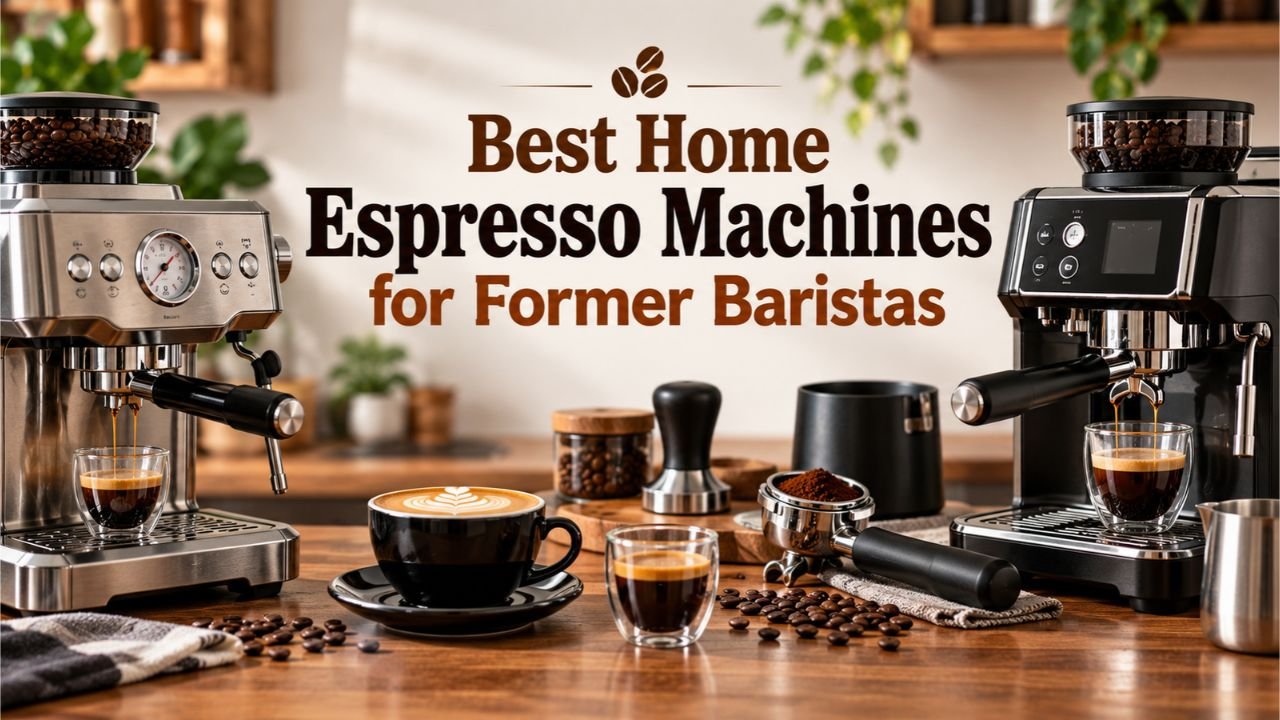
Best Home Espresso Machines for Former Baristas: 8 Picks
Former baristas should look for home espresso machines with stable brewing temperatures, precise extraction control, dependable steam power, and professional-style portafilters. The Lelit Bianca V3 is my top choice for hands-on espresso control, while the La Marzocco Linea Micra offers a familiar café-style experience. The Breville Dual Boiler provides many professional features at a lower price.
Moving from a commercial espresso machine to home equipment can feel restrictive. Weak steaming, temperature fluctuations, slow recovery between drinks, and limited extraction settings may interrupt techniques that previously felt automatic behind a café counter.
A suitable home machine should let you dial in fresh beans, prepare consistent espresso, and texture milk without fighting the equipment. The goal is to recreate the parts of commercial brewing that matter most while accepting the smaller capacity of a residential machine.
According to the National Coffee Association’s September 2026 report, 47% of American adults consumed an espresso-based beverage during the previous week, a record high. With espresso drinks becoming more common, experienced coffee makers have several residential machines offering features once associated mainly with commercial equipment.
The best home espresso machines for former baristas are not necessarily the most expensive models. What stood out to me when comparing manufacturer specifications was how differently machines handle temperature control, steaming, extraction adjustments, and maintenance.
A former café professional making two cortados every morning may prefer a compact dual-boiler machine. Someone interested in experimenting with light-roast espresso may get more satisfaction from manual flow control or programmable pressure profiles.
The recommendations below compare eight machines across different budgets, including their strengths, drawbacks, and ideal users. The buying advice also covers grinders, boiler systems, milk steaming, serviceability, and the differences between commercial and home espresso workflows.
What Former Baristas Should Look for in a Home Espresso Machine
Professional barista experience changes what matters in an espresso machine.
Someone familiar with dosing, distribution, tamping, extraction ratios, and milk texturing generally needs less automation and more control over the brewing process.
Temperature Stability and Brewing Control
Temperature stability is the ability to maintain consistent brewing temperatures during espresso extraction.
Small temperature changes can affect how coffee tastes, especially when working with lighter roasts or switching between different beans.
Machines with PID temperature controllers regulate heating more precisely than basic thermostat-only systems.
For an experienced barista, adjustable brew temperature is useful when fine-tuning extraction.
Pre-infusion is another feature worth considering. It introduces water to the coffee puck before full brewing pressure develops.
Some machines offer adjustable pre-infusion, while others provide manual flow control for changing the water delivery throughout extraction.
These features create more room for experimenting with different espresso recipes.
Steam Power and Simultaneous Brewing
Milk steaming is often where inexpensive home machines feel different from café equipment.
Commercial espresso machines generally provide strong steam delivery and support rapid preparation of several drinks.
A home machine may produce excellent microfoam but require more time to heat milk.
A dual-boiler espresso machine has separate boilers for brewing and steaming.
This permits simultaneous espresso extraction and milk steaming without switching one boiler between brewing and steaming temperatures.
Some dual-thermoblock machines offer the same simultaneous workflow using different heating technology.
For someone who regularly prepares cappuccinos, flat whites, and lattes, simultaneous brewing and steaming is worth prioritizing.
Portafilter Size, Build Quality, and Serviceability
Many commercial espresso machines use 58 mm portafilters.
Several prosumer home machines also use 58 mm systems, making familiar dosing and tamping techniques straightforward.
Still, a 58 mm portafilter designation does not guarantee that every commercial basket or accessory fits every machine.
Build quality also matters.
Check the group head, pump, steam valve, boiler construction, availability of replacement parts, and service support.
A durable machine with accessible replacement gaskets, filters, and valves may be preferable to a machine with more features but limited repair options.
Key Takeaway: Former baristas should prioritize stable brew temperatures, suitable steaming capacity, practical extraction controls, and dependable service support over automatic drink presets.
Best Home Espresso Machines for Former Baristas: 8 Picks
These eight machines cover different ways of recreating a professional espresso routine at home.
The recommendations are based on manufacturer specifications, brewing capabilities, construction, and practical ownership considerations rather than claimed firsthand testing.
Quick Comparison of the Best Machines
| Espresso Machine | Best For | Heating System | Approx. U.S. Price |
| Lelit Bianca V3 | Best overall for hands-on control | Dual boiler | $3,000 |
| La Marzocco Linea Micra | Familiar café-style workflow | Dual boiler | $4,500 |
| Breville Dual Boiler | Best value for experienced baristas | Dual boiler | $1,600 |
| Rancilio Silvia Pro X | Compact professional-style setup | Dual boiler | $2,195 |
| Ascaso Steel DUO Plus PID | Fast warm-up and modern controls | Dual thermoblock | $2,415 |
| ECM Synchronika II | Premium traditional machine | Dual boiler | $3,599 |
| Decent DE1PRO | Digital pressure and flow profiling | Electronic heating system | $3,600 |
| Gaggia Classic Pro E24 | Budget manual espresso setup | Single boiler | $549 |
Prices are approximate U.S. advertised prices checked in October 2026. Retailer pricing, configurations, promotions, and availability may change. Grinders are sold separately unless a package specifically includes one.
1. Lelit Bianca V3 — Best Overall for Former Baristas
The Lelit Bianca V3 is my top recommendation for a former barista who wants substantial control over espresso extraction.
Its defining feature is the manual flow-control paddle mounted above the brew group.
The paddle adjusts water flow through the coffee puck, allowing you to influence extraction as the shot progresses.
This is useful for experimenting with pre-infusion, declining-pressure extractions, and different roast profiles.
The Bianca also includes independent brew and steam boilers, PID temperature control, a rotary pump, and a 58 mm group.
Its electronic controls support programmable low-flow settings, while the water reservoir can be repositioned or the machine connected to a suitable water supply.
The dual-boiler design makes it practical for preparing milk drinks without switching between brewing and steaming modes.
Pros
- Manual flow-control paddle for hands-on extraction adjustments
- Independent brew and steam boilers
- PID temperature control and programmable settings
- Quiet rotary pump
- Reservoir or direct-plumb operation
- Professional 58 mm accessory compatibility
Cons
- Larger footprint than compact machines
- Higher purchase price
- Traditional group design requires warm-up time
- Flow profiling adds complexity to everyday brewing
Who should buy it?
Former specialty café baristas who enjoy dialing in different beans, experimenting with extraction recipes, and maintaining direct control over each shot.
My recommendation: Choose the Bianca V3 if the process of making espresso matters almost as much as drinking it. Its combination of tactile operation and extraction adjustment makes it a strong long-term home machine.
2. La Marzocco Linea Micra — Best for a Familiar Café Experience
The La Marzocco Linea Micra is an appealing choice for anyone accustomed to working on La Marzocco equipment.
It carries design elements from the company’s commercial Linea family into a smaller home-focused machine.
The Micra features dual boilers, PID temperature control, an integrated brew group, and a professional 58 mm portafilter system.
Its compact body measures approximately 11.5 inches wide, making it easier to accommodate than many large prosumer machines.
The separate 1.6-liter steam boiler supports milk preparation, while the integrated group helps maintain consistent extraction conditions.
La Marzocco also offers app-based controls for selected machine settings.
The Micra is built primarily around repeatable traditional espresso preparation rather than extensive manual pressure profiling.
Pros
- Familiar La Marzocco design and operation
- Dual boilers with PID temperature control
- Compact footprint
- Strong steam capability for home use
- Professional-style portafilter
- Quick warm-up compared with many traditional machines
Cons
- Expensive for a residential espresso machine
- Limited manual flow-profiling capability
- Compact working area and steam wand may feel restrictive
- Some settings rely on app controls
Who should buy it?
Former baristas who miss the familiar feel of commercial espresso equipment and want a straightforward, high-quality home brewing routine.
My recommendation: The Linea Micra is a strong choice for daily espresso and milk drinks when consistency and familiar operation matter more than complex extraction experiments.
3. Breville Dual Boiler — Best Value for Experienced Baristas
The Breville Dual Boiler BES920 provides many features associated with more expensive espresso machines.
It has independent stainless steel boilers for brewing and steaming, an actively heated group head, and electronic PID temperature control.
The machine also uses a 58 mm stainless steel portafilter.
Programmable pre-infusion allows you to adjust how the coffee puck is initially saturated.
Its shot timer helps track extraction, while the adjustable brew temperature provides additional control when changing beans.
The separate steam boiler permits simultaneous brewing and milk texturing.
These features make the Breville an attractive choice for someone who wants professional-style control without moving immediately into the 3,000–5,000 price category.
Pros
- Dual boilers for simultaneous extraction and steaming
- Adjustable PID brewing temperature
- Programmable low-pressure pre-infusion
- Professional 58 mm portafilter
- Built-in shot timer
- Lower price than many prosumer dual-boiler machines
Cons
- No standard manual flow-control paddle
- Different internal construction from traditional E61 machines
- Repair arrangements and parts access vary by region
- Large enough to require dedicated counter space
Who should buy it?
Former baristas seeking temperature control, dependable milk preparation, and familiar manual espresso techniques without paying for a premium traditional machine.
My recommendation: This is one of the strongest value choices for experienced home espresso makers. I would put the money saved toward a capable espresso grinder and good-quality coffee.
4. Rancilio Silvia Pro X — Best Compact Professional-Style Machine
The Rancilio Silvia Pro X combines a compact body with several features associated with commercial espresso equipment.
It measures approximately 9.8 inches wide, making it suitable for kitchens where counter space is limited.
Despite its narrow design, it includes separate brew and steam boilers, two PID controllers, and a 58 mm portafilter.
Rancilio also provides a soft-infusion function adjustable from 0 to 6 seconds.
This introduces water at reduced pressure before normal extraction.
The steam wand offers manual milk-texturing control, which former baristas may appreciate after working with commercial steam systems.
Its interface is relatively straightforward, with physical controls and a digital display.
Pros
- Compact footprint
- Separate brew and steam boilers
- Dual PID temperature control
- Adjustable soft infusion
- Professional 58 mm portafilter
- Manual steam wand with good mobility
Cons
- No manual flow-profiling paddle
- Vibration pump rather than a rotary pump
- Reservoir-only operation
- Limited advanced extraction programming
Who should buy it?
Former café workers who make espresso and milk drinks regularly but want a smaller machine without giving up dual-boiler operation.
My recommendation: The Silvia Pro X makes sense when a familiar manual workflow and compact size matter more than advanced pressure profiling.
5. Ascaso Steel DUO Plus PID — Best for Fast Warm-Up
The Ascaso Steel DUO Plus PID takes a different approach to home espresso heating.
Rather than using two traditional boilers, it uses independent thermoblock heating systems for espresso and steam.
This allows simultaneous brewing and milk preparation with a relatively short warm-up period.
Ascaso lists a brewing warm-up time of approximately 3 minutes and 30 seconds for the U.S. model.
The machine includes PID temperature control, programmable pre-infusion, a 58 mm portafilter, and programmable shot settings.
Its modern construction and compact footprint make it a practical option for daily coffee preparation.
Pros
- Fast brewing warm-up
- Independent heating systems for coffee and steam
- PID temperature adjustment
- Programmable extraction controls
- Professional 58 mm portafilter
- Compact countertop footprint
Cons
- Different steaming behavior from traditional boiler machines
- No traditional E61-style group workflow
- Requires a suitable 20-amp electrical circuit in its U.S. configuration
- More expensive than several capable dual-boiler alternatives
Who should buy it?
Former baristas who want to prepare morning coffee quickly without waiting for a large traditional machine to reach operating temperature.
Important electrical consideration: The U.S. Steel DUO Plus is specified with a NEMA 5-20 plug and a 20-amp circuit requirement. Confirm that your kitchen electrical supply is suitable before purchasing. An included plug adapter does not remove the need to meet the machine’s electrical requirements.
My recommendation: Choose the Steel DUO Plus if rapid readiness and a modern workflow are priorities. I would compare its steam delivery and electrical requirements carefully before choosing it over a conventional dual boiler.
6. ECM Synchronika II — Best Premium Traditional Espresso Machine
The ECM Synchronika II is designed for experienced espresso makers who appreciate traditional mechanical controls and refined construction.
It uses independent boilers, PID temperature management, a rotary pump, and an ECM brew group with supplemental heating cartridges.
The updated heating system is one of its most interesting features.
ECM specifies approximately 6.5 minutes to espresso brewing readiness, while full steam readiness takes around 15 minutes.
That distinction matters for former baristas who prepare milk drinks immediately after switching on the machine.
The Synchronika II also offers a water reservoir or direct plumbing connection.
Selected retail configurations include optional flow-control hardware.
Pros
- Independent boilers with PID controls
- Rotary pump
- Traditional group operation
- Fast espresso warm-up for its machine category
- Reservoir and direct-plumb options
- Strong service-oriented construction
Cons
- Expensive
- Heavy and relatively large
- Full steam readiness takes longer than espresso readiness
- Flow-control hardware may cost extra
Who should buy it?
Experienced baristas who prefer mechanical espresso equipment, traditional controls, and the option of maintaining or upgrading a machine over time.
My recommendation: The Synchronika II is attractive for someone who wants premium traditional equipment without moving to a commercial one-group machine. Confirm that the configuration you purchase includes the flow-control features you want.
7. Decent DE1PRO — Best for Advanced Espresso Experimentation
The Decent DE1PRO is designed for espresso makers who want detailed control over extraction.
Its main feature is software-driven management of brewing variables.
The machine can adjust pressure, flow, and temperature during a shot and display extraction information through a tablet interface.
It supports programmable profiles that can be repeated or modified.
This gives experienced baristas an opportunity to compare different extraction methods with greater consistency.
For example, you can experiment with slower pre-infusion, declining pressure, and other shot profiles rather than relying entirely on fixed-pressure brewing.
The DE1PRO also has a compact footprint and a relatively short warm-up period.
Pros
- Programmable pressure and flow profiles
- Real-time extraction data
- Repeatable brewing recipes
- Adjustable temperature behavior
- Compact construction
- Software updates and profile-sharing capabilities
Cons
- Tablet-centered workflow differs from traditional café equipment
- More settings than many home users need
- Steaming is slower than some large dual-boiler machines
- Service may involve factory support outside the United States
- Higher purchase price
Who should buy it?
Former specialty coffee baristas who enjoy analyzing extraction curves, experimenting with new brewing methods, and comparing espresso recipes.
My recommendation: Choose the DE1PRO when repeatable experimentation is your main interest. If you primarily make traditional espresso and milk drinks, a conventional dual-boiler machine may feel more natural.
8. Gaggia Classic Pro E24 — Best Budget Machine for Former Baristas
The Gaggia Classic Pro E24 provides a straightforward manual espresso experience at a much lower price than the other machines on this list.
Its updated design includes a lead-free brass boiler, commercial-style steam wand, and 58 mm portafilter.
Gaggia specifies a 9-bar brewing pressure configuration.
The machine uses physical rocker switches, which give it a direct and uncomplicated interface.
Its main limitation is the single-boiler design.
The same boiler must support brewing and steaming at different temperatures, so you cannot perform both operations simultaneously.
Unlike the higher-priced machines, the Classic E24 does not include factory PID temperature control.
Managing brewing temperature and switching between espresso and steam require more attention.
Pros
- Affordable entry into manual espresso
- 58 mm portafilter
- Brass boiler
- Commercial-style steam wand
- Compact size
- Straightforward mechanical controls
Cons
- Single boiler for espresso and steam
- No factory PID temperature control
- Requires waiting between brewing and steaming
- Limited extraction programming
- Less convenient for several milk drinks
Who should buy it?
Former baristas on a smaller budget who want to retain direct control over grinding, dosing, tamping, extraction, and milk texturing.
My recommendation: The Classic E24 is a reasonable budget starting point for espresso-focused households. For someone making several lattes every morning, saving for a dual-boiler machine may be more satisfying.
Key Takeaway: The Lelit Bianca V3 offers the strongest balance of hands-on control and advanced brewing features. The Linea Micra suits familiar café-style operation, while the Breville Dual Boiler provides a lower-cost route to simultaneous brewing and steaming.
Which Espresso Machine Fits Your Former Barista Workflow?
Working behind a café counter does not mean every former barista wants the same experience at home.
The best choice changes according to drink preferences, how frequently the machine will be used, and how much control you want.
For Straight Espresso and Specialty Coffee
If you primarily drink espresso without milk, brew temperature and extraction control deserve greater attention.
The Lelit Bianca V3 and Decent DE1PRO are strong candidates.
Both offer ways to influence the extraction beyond a conventional fixed-pressure shot.
The Bianca provides direct paddle operation, while the Decent uses programmable profiles.
These controls are useful when experimenting with light-roast single-origin coffee or adjusting extraction behavior.
Still, a fixed-pressure machine with good temperature control and a capable grinder can produce excellent espresso.
Flow control is an option for experimentation rather than a requirement for quality.
For Lattes, Flat Whites, and Cappuccinos
Former café baristas who enjoy milk drinks should prioritize steam delivery and workflow.
A dual-boiler machine reduces waiting between espresso extraction and milk steaming.
The Linea Micra, Silvia Pro X, Bianca V3, and Breville Dual Boiler are suitable options.
Look beyond the existence of a steam wand.
Consider the wand’s range of movement, available space for a milk pitcher, steam control, and the machine’s ability to prepare consecutive drinks.
A machine with strong steam may feel different from your previous café setup, but controlled technique can still produce fine microfoam.
For Several Drinks in One Session
Home machines are generally built for smaller workloads than commercial equipment.
If you regularly prepare drinks for several people, consider a machine with separate brew and steam heating systems and sufficient recovery capacity.
The Linea Micra and larger traditional dual-boiler machines are practical choices for repeat preparation.
For buyers with a substantially larger budget and frequent milk-drink service, the La Marzocco Linea Mini is another option worth considering.
Its larger 3-liter steam boiler and roomier construction may be more attractive for repeated milk preparation than the compact Micra.
Yet for one or two daily drinks, the extra cost and size of a larger machine may not provide a meaningful advantage.
Key Takeaway: Choose extraction control for espresso experimentation, steam capacity for milk drinks, and comfortable repeat operation when preparing several beverages in one session.
How to Build a Home Espresso Setup Around Your Machine
An expensive espresso machine does not guarantee satisfying coffee on its own.
The grinder, water supply, accessories, and available countertop space all influence the result.
Invest in a Suitable Espresso Grinder
A precise burr grinder is one of the most important parts of a home espresso setup.
Espresso extraction is sensitive to particle size.
Small grind adjustments can change shot time, flow, and flavor.
A suitable grinder should provide fine adjustment across the espresso range and produce repeatable results.
For a former barista accustomed to commercial grinders, a basic household grinder with large adjustment steps may feel restrictive.
Flat-burr and conical-burr grinders can both produce excellent espresso.
Their results depend on burr design, alignment, grind adjustment, and the coffee being used.
I recommend reserving a meaningful portion of the total equipment budget for the grinder rather than spending every available dollar on the machine.
A well-matched grinder and mid-priced dual boiler may be more satisfying than a premium machine paired with an inconsistent grinder.
Check Water Quality and Maintenance Requirements
Water affects espresso flavor and machine reliability.
Hard water can cause mineral deposits inside boilers, valves, and heating passages.
Water with very little mineral content may also fall outside a manufacturer’s recommended operating range.
Different espresso machine manufacturers specify different water requirements.
Use a water hardness test and follow the guidance for the specific machine.
Do not assume that distilled water, household softened water, or every bottled water is suitable for espresso equipment.
For expensive machines, preventing scale is generally less troublesome than repairing scale-related damage.
Also confirm access to replacement gaskets, filters, cleaning products, and authorized service.
Plan for Counter Space and Electrical Supply
A machine may fit on the countertop but still lack enough space for comfortable operation.
Measure the available width, depth, and height.
Allow room for the portafilter, steam pitcher, grinder, knock box, and water reservoir access.
Some traditional machines are relatively deep.
Others require clearance above the machine for filling the reservoir.
Check electrical requirements before purchasing, especially for high-power equipment such as the U.S. Ascaso Steel DUO Plus.
A proper installation is part of choosing a suitable home machine.
Key Takeaway: Pair the espresso machine with a capable grinder, water that meets manufacturer requirements, and enough space for a comfortable workflow. These supporting decisions matter as much as many premium machine features.
Common Buying Mistakes Former Baristas Should Avoid
Experience with commercial espresso machines can make the transition to home equipment easier, but it can also create unrealistic expectations.
Paying for extraction features you will rarely use: Flow profiling and detailed shot graphs are interesting, but a standard dual-boiler machine may be more convenient for everyday cappuccinos.
Ignoring steam capacity: A machine that pulls excellent espresso may feel slow when preparing several milk drinks.
Choosing a single boiler without considering workflow: Single-boiler machines can make good coffee, but switching between brewing and steaming temperatures becomes inconvenient during repeated drink preparation.
Underestimating the grinder: Poor grind consistency can make dialing in frustrating, even with precise brewing temperature control.
Assuming all 58 mm accessories are interchangeable: Check actual basket, tamper, and portafilter compatibility before purchasing replacement equipment.
Overlooking machine warm-up requirements: Brew-ready time and full steam-ready time may differ.
Ignoring repair support: A machine with readily available service and replacement parts can be a better long-term purchase than one with limited local support.
Trying to recreate a commercial café setup exactly: A residential machine has different electrical, water, space, and workload constraints. Prioritize the professional features you actually use.
For many former baristas, the most satisfying home setup is not a miniature version of the busiest café station. It is a comfortable workstation that makes a few excellent drinks consistently.
Conclusion
The best home espresso machines for former baristas offer professional-style control without requiring a full commercial setup. The Lelit Bianca V3 is my leading choice for experienced espresso makers who enjoy shaping extraction, while the La Marzocco Linea Micra provides a familiar café-inspired brewing routine.
The Breville Dual Boiler is a strong value option, and the Rancilio Silvia Pro X suits smaller kitchens. The ECM Synchronika II provides premium traditional construction, while the Decent DE1PRO serves baristas interested in detailed extraction experiments.
I recommend choosing the machine around the drinks you actually prepare. A former barista making two flat whites every morning may benefit more from stable steam delivery than advanced pressure graphs.
Before buying, allow room in your budget for a suitable grinder, water treatment, accessories, and maintenance. A balanced home espresso setup will be more satisfying than an expensive machine that does not fit your everyday routine.
FAQs About Home Espresso Machines for Former Baristas
What Is the Best Home Espresso Machine for an Ex-Barista?
The Lelit Bianca V3 is my preferred overall choice for an experienced former barista who wants manual flow control, dual boilers, PID temperature adjustment, and a professional-style workflow.
The La Marzocco Linea Micra is another strong option for someone who prefers familiar café-inspired operation without extensive profiling controls.
For a smaller budget, the Breville Dual Boiler provides many useful professional features at a lower price.
Do Former Baristas Need a Dual-Boiler Espresso Machine?
Not necessarily. A single-boiler machine can prepare excellent espresso.
Dual boilers become more attractive when you regularly make milk drinks or prepare several beverages in one session.
Separate boilers permit brewing and steaming at the same time without switching one boiler between two temperature ranges.
For someone who drinks mostly straight espresso, a capable single-boiler machine may be sufficient.
Is a La Marzocco Linea Micra Worth Buying for Home Use?
The Linea Micra can be worth its price for someone who values its construction, brewing consistency, steam capability, compact design, and connection to La Marzocco’s commercial equipment.
It is less attractive when the main goal is advanced extraction profiling or minimizing cost.
The Lelit Bianca V3 offers more direct flow control for less money, while the Breville Dual Boiler provides a substantial set of brewing features at a much lower price.
Is the Breville Dual Boiler Good Enough for a Former Barista?
Yes. The Breville Dual Boiler includes separate brewing and steam boilers, a 58 mm portafilter, electronic temperature control, programmable pre-infusion, and a manual steam wand.
These features support familiar espresso preparation techniques.
Its construction and service arrangements differ from traditional prosumer machines, but it provides substantial brewing control for its price.
Pairing it with a good espresso grinder is a sensible approach.
What Espresso Machine Is Best for Latte Art at Home?
The La Marzocco Linea Micra, Lelit Bianca V3, Rancilio Silvia Pro X, and other capable dual-boiler machines are strong choices for manual milk texturing.
Steam wand movement, controllable steam delivery, pitcher clearance, and consistent steam pressure are important.
Latte art quality also depends on milk choice, pitcher technique, and pouring skill.
A machine with stronger steam does not automatically produce better latte art without suitable texturing technique.
Is Flow Control Necessary for Professional-Quality Espresso?
No. Many commercial espresso machines produce excellent coffee using relatively stable brewing pressure without manual flow profiling.
Flow control provides extra opportunities to adjust pre-infusion, extraction speed, and pressure development.
It can be useful when experimenting with lighter roasts and different coffee recipes.
For everyday espresso made from familiar beans, stable temperature, appropriate grind size, and sound puck preparation may matter more.
Can a Home Espresso Machine Replace a Commercial Espresso Machine?
A good home machine can produce espresso and milk drinks comparable in quality to those made with commercial equipment.
The main differences involve workload, heating capacity, service requirements, physical size, and speed during repeated preparation.
Most home machines are not designed to serve dozens of customers every hour.
For a household making a few drinks per day, a suitable dual-boiler or dual-thermoblock machine can provide the brewing control an experienced barista expects.
How Much Should a Former Barista Spend on a Home Espresso Setup?
A basic manual setup can begin around 500–1,000 for the espresso machine, with additional money needed for a suitable grinder.
Dual-boiler machines commonly occupy a higher price category, with capable options around 1,600–2,500.
Premium traditional machines and digitally controlled models often cost $3,000 or more.
My recommendation is to set the total budget first, including the grinder, water treatment, accessories, and future servicing. A well-balanced setup is usually a better purchase than spending nearly the entire budget on the espresso machine alone.