
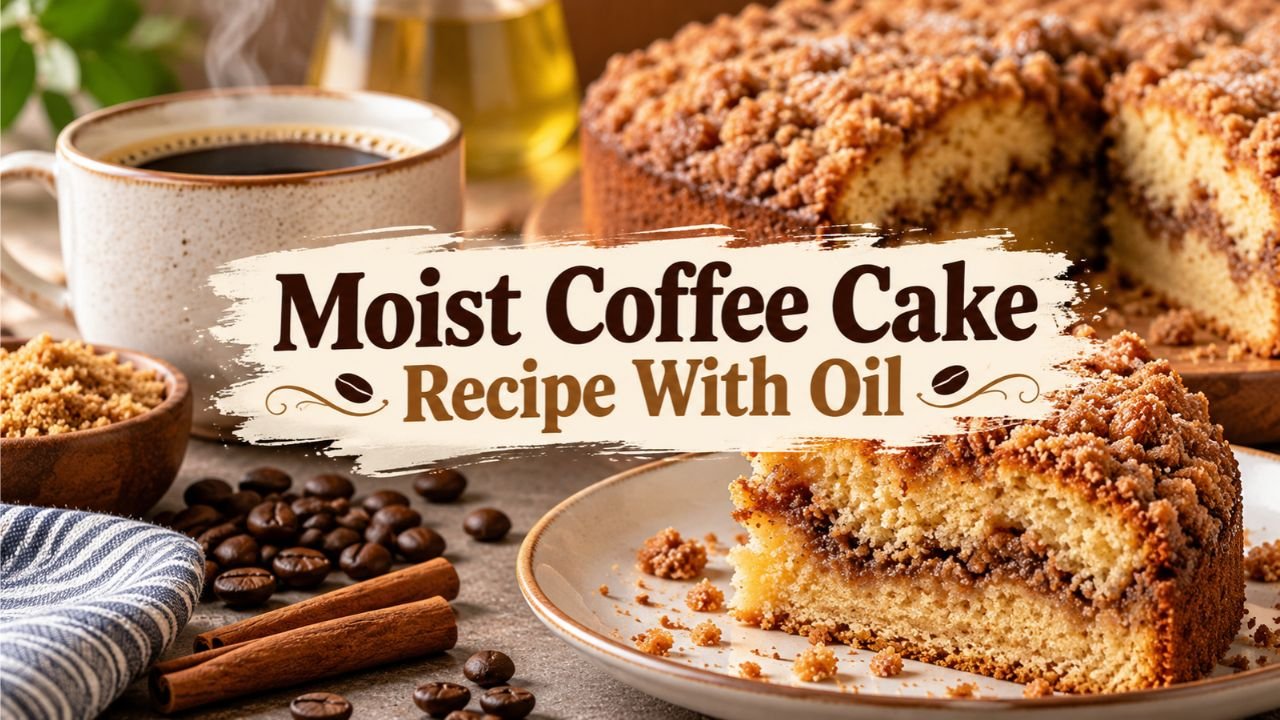
Moist Coffee Cake Recipe With Oil and Cinnamon Streusel
A soft, moist coffee cake can be made with vegetable oil instead of butter. Combine oil, eggs, sour cream, milk, sugar, and vanilla for a tender cake, then add a cinnamon-brown sugar filling and crumb topping. Bake at 350°F until the center is fully set. The result is a rich breakfast cake with no butter required.
Dry coffee cake is often caused by too much flour, excessive mixing, or leaving the cake in the oven too long. Even a recipe with enough oil can turn out dense or crumbly if the batter is handled incorrectly.
Using oil simplifies preparation because there is no butter to soften or cream with sugar. It also keeps the cake tender after cooling, making it a practical option for breakfast, brunch, or a dessert prepared ahead of time.
Food safety matters when preparing homemade cake batter. In a 2023 investigation, the Centers for Disease Control and Prevention identified 14 Salmonella illnesses across 13 U.S. states linked to contaminated flour. Raw flour and uncooked eggs can carry harmful bacteria, so the batter should never be tasted before baking.
What I like about this approach is the combination of neutral oil and sour cream. The oil contributes softness, while sour cream provides richness and a slight tang that balances the sweetness of the cinnamon topping.

This moist coffee cake recipe with oil uses an easy-to-mix vanilla batter, a brown sugar cinnamon ribbon, and a crumbly streusel made without butter. It produces a classic American-style coffee cake without requiring a stand mixer or complicated techniques.
The exact ingredient measurements, baking instructions, substitutions, pan sizes, troubleshooting tips, and storage recommendations below cover the details needed to make a tender cake without a dry center or soggy topping.
Moist Coffee Cake Recipe With Oil: Ingredients and Measurements
This recipe is designed for a 9-inch square baking pan and makes approximately 9 large or 12 smaller servings.
<text weight=”medium”>Recipe details</text>
| Detail | Amount |
| Recipe type | Cinnamon streusel coffee cake |
| Preparation time | 20 minutes |
| Estimated baking time | 35–45 minutes |
| Initial cooling time | 20 minutes |
| Oven temperature | 350°F (175°C) |
| Pan size | 9 × 9 inches |
| Servings | 9–12 |
| Main fat | Neutral vegetable oil |
| Butter required | No |
| Mixer required | No |
The cinnamon filling and streusel are prepared separately so the cake has a distinct center ribbon and a crumbly top.
Ingredients for the Coffee Cake Batter
| Ingredient | Quantity |
| All-purpose flour | 1¾ cups (210 g) |
| Granulated sugar | ¾ cup (150 g) |
| Baking powder | 2 teaspoons |
| Baking soda | ¼ teaspoon |
| Salt | ½ teaspoon |
| Large eggs | 2 |
| Vegetable or canola oil | ½ cup (120 ml) |
| Full-fat sour cream | ½ cup (120 g) |
| Whole milk | ⅓ cup (80 ml) |
| Vanilla extract | 2 teaspoons |
All-purpose flour provides the cake’s structure without making it excessively heavy.
Use neutral-flavored oil, such as vegetable, canola, or sunflower oil. These oils contribute moisture without competing with the vanilla and cinnamon flavors.
Full-fat sour cream adds richness and acidity. The acidity also reacts with baking soda, helping the batter rise.
Whole milk loosens the batter enough to spread into the pan while maintaining a soft texture.
Ingredients for the Cinnamon Sugar Filling
The filling creates a distinct brown sugar and cinnamon ribbon through the center of the cake.
| Ingredient | Quantity |
| Light brown sugar, packed | ⅓ cup (about 70 g) |
| Ground cinnamon | 1½ teaspoons |
Light brown sugar has a mild molasses flavor that pairs well with cinnamon.
Dark brown sugar can also be used, but it produces a stronger molasses taste.
The filling does not need additional oil because moisture from the cake batter softens the sugar during baking.
Ingredients for the Oil-Based Streusel Topping
A streusel topping is a crumbly mixture of flour, sugar, fat, and often cinnamon.
Traditional versions use butter, but this one uses vegetable oil.
| Ingredient | Quantity |
| All-purpose flour | ⅔ cup (80 g) |
| Light brown sugar, packed | ⅓ cup (about 70 g) |
| Ground cinnamon | 1 teaspoon |
| Salt | ⅛ teaspoon |
| Vegetable or canola oil | 3 tablespoons (45 ml) |
An oil-based streusel tends to form smaller, slightly sandier crumbs than a traditional butter streusel.
For larger crumbs, squeeze small portions of the mixture together with your fingers before placing them on the batter.
If the mixture remains powdery, add oil in small amounts until it holds together when pressed.
Equipment Needed
No stand mixer is required.
Prepare a 9-inch square metal baking pan, two medium mixing bowls, one small bowl for the cinnamon filling, a whisk, a flexible spatula, measuring cups or a kitchen scale, parchment paper, and a toothpick or cake tester.
A kitchen scale is useful for measuring flour because tightly packed cups can contain more flour than the recipe requires.
Key Takeaway: The cake uses oil and sour cream for tenderness, a cinnamon-brown sugar filling for flavor, and an oil-based streusel for a crumbly finish without butter.
How to Make Moist Coffee Cake With Oil Step by Step
The preparation method is straightforward. The main priorities are mixing the batter gently, distributing the cinnamon filling evenly, and checking the center before removing the cake from the oven.
Step 1: Preheat the Oven and Prepare the Pan
Preheat the oven to 350°F (175°C).
Position a rack near the center of the oven to provide even heat around the baking pan.
Lightly grease a 9 × 9-inch metal baking pan with vegetable oil or a suitable baking spray.
Line the bottom and two opposite sides with parchment paper, leaving enough overhang to lift the cake after it cools.
Parchment paper prevents sticking and helps protect the streusel when removing the cake.
Step 2: Prepare the Cinnamon Streusel
In a medium bowl, combine:
- ⅔ cup all-purpose flour
- ⅓ cup light brown sugar
- 1 teaspoon cinnamon
- ⅛ teaspoon salt
Mix the dry ingredients until the cinnamon and sugar are distributed evenly.
Add 3 tablespoons of vegetable oil.
Stir with a fork until the mixture begins forming small crumbs.
Pinch portions together to create larger clumps. The finished mixture should be crumbly rather than liquid or completely powdery.
Set it aside while preparing the cake.
Tip: Prepare the topping first. This prevents the cake batter from sitting too long after the baking powder and baking soda have been mixed with the wet ingredients.
Step 3: Mix the Cinnamon Filling
In a separate small bowl, stir together ⅓ cup packed light brown sugar and 1½ teaspoons ground cinnamon.
Break apart any large brown sugar lumps.
Set the filling aside.
Keeping the filling separate from the streusel gives the cake a defined cinnamon ribbon instead of distributing all the sugar through the topping.
Step 4: Combine the Dry Cake Ingredients
In a medium bowl, whisk together:
- 1¾ cups all-purpose flour
- 2 teaspoons baking powder
- ¼ teaspoon baking soda
- ½ teaspoon salt
Whisking distributes the leavening ingredients throughout the flour.
This reduces the chance of uneven rising or pockets of baking powder in the finished cake.
Set the bowl aside.
Step 5: Combine the Wet Ingredients
In a large mixing bowl, add the granulated sugar and eggs.
Whisk for approximately 30–60 seconds, until the ingredients are evenly combined.
Add ½ cup vegetable oil and continue whisking until the mixture looks smooth.
Mix in the sour cream, milk, and vanilla extract.
The mixture should appear fairly smooth, although small streaks of sour cream are not a concern.
The eggs and dairy ingredients are easier to mix when they are near room temperature.
Avoid heating them directly.
Step 6: Make the Coffee Cake Batter
Add the dry ingredients to the wet mixture.
Use a spatula to fold everything together until no obvious dry flour remains.
The batter should be thick but spreadable.
Do not continue beating after the flour disappears.
Extended mixing encourages gluten development, which can create a tougher, denser cake.
A few small lumps are acceptable.
If the batter seems unusually stiff, first check that the flour was measured correctly. Do not automatically add large amounts of extra milk.
Step 7: Layer the Batter and Cinnamon Filling
Spread approximately half the cake batter into the prepared pan.
Use a spatula to create an even layer across the bottom.
Sprinkle the entire cinnamon-brown sugar filling over the batter, leaving a narrow margin around the edges.
Add the remaining batter in small portions over the filling.
Gently spread it to cover the cinnamon layer without stirring the sugar into the batter.
The top does not have to be perfectly smooth.
Avoid aggressive spreading, which can pull the filling into uneven patches.
Step 8: Add the Streusel Topping
Distribute the prepared oil-based streusel over the surface.
Scatter the larger crumbs first, then fill the gaps with the smaller pieces.
Keep the topping relatively even so one area does not carry all the extra weight.
Do not force the crumbs into the batter.
A light surface coating is enough to create the desired cinnamon crumb layer as the cake bakes.
Step 9: Bake Until the Center Is Set
Place the pan on the middle oven rack.
Bake at 350°F for approximately 35–45 minutes.
Begin checking near the lower end of that range because ovens and pan materials vary.
Insert a toothpick into the center, aiming for an area of cake rather than a thick pocket of cinnamon filling.
The cake is ready when the toothpick comes out clean or with a few moist crumbs and no liquid batter.
The center should also spring back gently when touched.
If the center remains wet, continue baking in short intervals and check again.
Do not rely solely on a golden streusel topping. The top can brown before the middle finishes baking.
Step 10: Cool Before Slicing
Place the baking pan on a wire rack.
Allow the cake to cool for at least 20 minutes before cutting.
The crumb structure continues to settle as the cake cools, making slices less likely to fall apart.
For neatly cut squares, let the cake cool further before lifting it from the pan using the parchment paper.
Serve slightly warm or at room temperature.
The cinnamon filling will be softer when warm, while the streusel becomes more defined as it cools.
Key Takeaway: Mix the batter only until combined, keep the cinnamon filling separate, distribute the streusel evenly, and bake until the center contains no wet batter.
Why Oil Makes Coffee Cake Moist and Tender
Oil contributes to the soft texture of this coffee cake, but it works alongside the flour, eggs, sugar, and sour cream.
Using enough oil does not automatically prevent dryness if the cake is overbaked or the batter contains too much flour.
Oil Stays Liquid at Room Temperature
Most neutral vegetable oils remain liquid at ordinary room temperatures.
Butter contains milk fat that becomes firmer as it cools.
This difference can affect how soft a finished cake feels, especially after storage.
King Arthur Baking explains that oil-based cakes can retain a tender crumb because liquid oil distributes fat throughout the batter.
Oil coats flour particles and limits some of the gluten development that can make cake tough.
Butter contributes its own flavor and performs well in recipes that rely on creaming for aeration.
For a coffee cake mixed by hand, oil removes the need for that extra step.
Sour Cream Supports a Soft Crumb
Sour cream contributes fat, moisture, and acidity.
Its thickness gives the batter body without requiring an excessive quantity of flour.
The acidity also reacts with baking soda to produce carbon dioxide, which contributes to the cake’s rise.
Using full-fat sour cream creates a richer result than using only milk.
Plain whole-milk yogurt can provide a similar function when sour cream is unavailable.
I prefer sour cream in a cinnamon coffee cake because its mild tang balances the sweet brown sugar layers.
Proper Mixing Preserves Tenderness
The texture depends on how the batter is mixed.
When wheat flour combines with liquid, gluten begins developing.
A moderate amount of gluten provides structure, but too much mixing can produce a tight, chewy texture.
Use a spatula rather than beating the finished batter at high speed.
Stop as soon as the dry ingredients are incorporated.
Key Takeaway: Oil provides lasting softness, sour cream adds richness and acidity, and gentle mixing prevents the cake from becoming unnecessarily dense.
How to Know When Oil-Based Coffee Cake Is Fully Baked
Baking time is a useful starting point, but the actual condition of the cake is more reliable than the clock.
A cinnamon filling and thick streusel can make doneness harder to judge by appearance alone.
Check the Center With a Toothpick
Insert a wooden toothpick or thin cake tester into the center.
Look for one of three results:
| Toothpick result | What it means | Next action |
| Wet, shiny batter | Cake is underbaked | Continue baking |
| A few moist cake crumbs | Cake is generally ready | Remove if the center is set |
| Completely clean and dry | Cake is baked | Remove to avoid unnecessary additional drying |
Brown sugar filling can leave a sticky mark on the toothpick even after the cake is fully baked.
Test another spot if the first result seems to come from the cinnamon layer.
The center should feel set rather than liquid or sunken.
Watch the Surface and Edges
The top should look baked rather than wet.
The streusel may become golden brown, and the cake edges may begin pulling slightly away from the pan.
A gentle press near the center should produce a slight spring-back.
If the center remains sunken or visibly moves like uncooked batter, it needs additional oven time.
A dark metal pan may brown the edges faster than a light-colored pan.
If the topping darkens before the center is finished, loosely cover the pan with aluminum foil without pressing it onto the crumbs.
Why Cooling Matters
Removing a cake from the oven does not mean its texture is immediately firm enough for slicing.
The crumb continues setting as heat moves through the cake.
Cutting too early can cause the warm cinnamon layer to pull apart the surrounding crumb.
Cooling for at least 20 minutes produces cleaner slices while still allowing the cake to be served warm.
Key Takeaway: Check the center with a toothpick and a gentle touch. A few moist crumbs are acceptable, but liquid batter means the cake needs more time.
How to Make Coffee Cake Streusel Without Butter
Butter is traditional in crumb toppings, but oil can also bind flour and sugar into small clusters.
The finished texture is slightly different.
Getting the Right Crumb Texture
A classic butter streusel often produces firm, irregular chunks.
An oil-based streusel tends to be softer and more sandy before baking.
The goal is a mixture that forms small clumps when pressed.
If it looks like loose flour and sugar, add a little more oil.
If it becomes a wet paste, stir in a small amount of flour until it returns to a crumbly consistency.
Avoid pouring extra oil directly over the assembled cake. This may create greasy spots on the surface.
Keeping the Streusel on Top
The cake batter should be thick enough to support the topping.
Scatter crumbs evenly rather than placing a heavy mound in the center.
Avoid pressing the topping deep into the batter.
If the streusel sinks, the batter may be too thin, the crumbs may be too large or heavy, or the flour measurement may be incorrect.
A uniform topping gives the finished cake a more consistent texture.
Key Takeaway: Oil-based streusel should form small crumbs that hold together when pressed. Keep the topping light and evenly distributed to prevent sinking.
Ingredient Substitutions for Coffee Cake Made With Oil
Several ingredients can be changed without completely altering the recipe.
Some substitutions affect moisture, flavor, or baking time, so small changes are safer than replacing multiple ingredients at once.
Best Oils for Coffee Cake
The oil should have a mild flavor that allows the vanilla and cinnamon to remain noticeable.
| Oil | Suitability | Flavor effect |
| Canola oil | Excellent | Mild and neutral |
| Vegetable oil | Excellent | Neutral |
| Sunflower oil | Good | Mild |
| Avocado oil | Good | Mild when refined |
| Light-tasting olive oil | Suitable | May add a subtle olive note |
| Extra-virgin olive oil | Use with flavor awareness | More noticeable flavor |
| Coconut oil | Requires recipe adjustment | Can firm up as the cake cools |
Canola or ordinary vegetable oil is my first choice.
Extra-virgin olive oil may work for a cake with a more pronounced flavor, but it changes the classic cinnamon-vanilla profile.
Coconut oil becomes firmer at cooler temperatures, so it is not a direct substitute when the goal is a consistently soft cake.
Can Sour Cream Be Replaced With Yogurt?
Yes. Plain, unsweetened whole-milk yogurt is a practical substitute for sour cream.
Use ½ cup yogurt in place of ½ cup sour cream.
Regular yogurt may produce a slightly looser batter.
Thick Greek yogurt is closer in texture to sour cream, although some varieties are firmer.
If using very thick Greek yogurt, mix it thoroughly with the milk before adding the dry ingredients.
Avoid strongly flavored yogurt because it may compete with the cinnamon.
Can You Make Coffee Cake Without Milk?
Milk contributes liquid, mild sweetness, and dairy flavor.
Unsweetened oat milk or soy milk can be used in the same measured quantity as a substitute, though the finished texture may differ slightly.
The recipe still contains sour cream and eggs, so changing only the milk does not make it dairy-free or vegan.
If avoiding all dairy, use suitable dairy-free sour cream and milk alternatives, recognizing that plant-based products vary in acidity, thickness, and fat content.
Adding Fruit or Nuts
A small amount of fruit or chopped nuts can change the flavor without turning the cake into a completely different recipe.
Possible additions include:
- ½ cup blueberries
- ½ cup finely diced apple
- ⅓ cup chopped pecans or walnuts
- 1 teaspoon finely grated orange zest
These quantities are modest starting points rather than separately tested variations.
Fruit adds moisture, so the cake may need a little extra time in the oven.
Keep the center doneness test as the final check.
If using frozen blueberries, fold them into the batter while still frozen to reduce excessive streaking.
Key Takeaway: Neutral oil and full-fat sour cream provide the classic texture. Plain yogurt, mild oils, and small fruit additions are reasonable variations, with possible changes to baking time.
Common Coffee Cake Problems and How to Fix Them
Oil-based coffee cake is straightforward to prepare, but a few mistakes can affect the texture.
The most useful approach is to identify the cause rather than adding more ingredients without a reason.
Coffee Cake Is Dry or Crumbly
A dry cake may result from excessive flour, overbaking, or insufficient liquid.
Flour is a common cause because measuring cups can hold different amounts depending on how they are filled.
For this recipe, aim for 210 g of all-purpose flour.
If measuring by volume, fluff the flour, spoon it into the cup, and level the top without pressing it down.
Begin checking for doneness before the end of the baking window.
Oil cannot fully compensate for a cake left in the oven too long.
Coffee Cake Is Dense or Gummy
A dense texture may come from excessive mixing, inaccurate leavening measurements, or batter that is too wet.
Check that baking powder and baking soda are fresh and measured correctly.
Do not pack flour into the measuring cup, but do not leave out part of the measured flour either.
A gummy center may indicate incomplete baking rather than a mixing problem.
If the center is underbaked, return the cake to the oven promptly and continue until it sets.
If the cake has already cooled with a wet, raw center, it should not be served.
Cinnamon Filling Sinks or Becomes Uneven
The filling may settle into pockets if the batter is thin or the second batter layer is spread too aggressively.
Spread the first layer evenly before adding the cinnamon sugar.
Spoon the remaining batter over the filling in several small portions.
Then smooth it gently.
A ribbon that looks slightly irregular is normal. The goal is to distribute cinnamon throughout the center without stirring it completely into the batter.
Streusel Becomes Greasy or Soft
Too much oil can make the topping heavy and greasy.
Measure the oil before adding it to the flour and sugar.
For this recipe, start with 3 tablespoons.
Add more only if the mixture cannot form crumbs when pressed.
A streusel that feels softer after storage may have absorbed moisture from the cake.
This is normal to some degree, especially in an airtight container.
Coffee Cake Rises and Then Sinks
A sunken center can come from underbaking, excess leavening, or opening the oven before the structure has set.
Measure baking powder and baking soda carefully.
Avoid repeatedly opening the oven during the early baking period.
Check for doneness near the estimated finish rather than moving the pan every few minutes.
A small amount of settling is normal as the cake cools. A deep, wet depression usually points to a baking problem.
Key Takeaway: Dryness often comes from excess flour or baking time, while gummy centers and sinking usually indicate problems with mixing, leavening, or incomplete baking.
How to Store, Freeze, and Reheat Coffee Cake With Oil
Oil-based coffee cake can remain pleasant after the day it is baked, provided it is stored correctly.
The cinnamon topping may soften during storage, but the cake crumb can retain much of its tenderness.
Storing at Room Temperature
Allow the cake to cool completely.
Place it in an airtight container or wrap it securely.
A plain baked coffee cake without perishable frosting or filling can generally be stored at room temperature for up to 2–3 days in a cool, dry kitchen.
Keep it away from direct sunlight and excessive heat.
Because this recipe contains sour cream baked into the batter, it is different from a cake topped with fresh dairy cream.
If you add a perishable cream filling or frosting, refrigerate the cake according to that ingredient’s storage requirements.
Refrigerating Leftover Coffee Cake
Refrigeration can extend storage, although it may make the crumb feel firmer.
Place cooled slices in an airtight container and refrigerate for approximately 4–5 days.
For better flavor and texture, let a slice return toward room temperature before serving.
Reheat gently if you prefer warm cake.
Avoid leaving individual slices uncovered in the refrigerator because exposed cake dries out faster.
Freezing for Later
Coffee cake can also be frozen.
Allow it to cool completely, then cut it into portions.
Wrap individual slices securely and place them in a freezer-safe container or bag.
For best quality, aim to use the frozen cake within 2–3 months.
Thaw in the refrigerator or at room temperature under suitable food-safe conditions.
The streusel may lose some of its original texture after thawing, but the cake itself can remain soft.
Reheating Without Drying the Cake
For an individual slice, a brief microwave warming is usually enough.
Start with approximately 10–15 seconds and add more time only if needed.
Heating too long can make the cake rubbery or overly hot.
For several slices, use a low oven temperature, such as 300°F, and warm them just until heated through.
Cover loosely if the edges begin drying.
Key Takeaway: Store cooled coffee cake airtight, refrigerate for longer storage, or freeze individual portions. Gentle reheating preserves a softer texture than prolonged heating.
Conclusion
This moist coffee cake recipe with oil uses a straightforward batter, sour cream for richness, a cinnamon-brown sugar filling, and an oil-based streusel topping. The entire cake can be prepared without butter, making it convenient when you want a soft homemade breakfast cake using common pantry ingredients.
The most useful details are accurate flour measurement, gentle mixing, even batter layering, and baking only until the center is set. Oil contributes tenderness, but proper preparation and baking time determine the final texture.
I recommend using neutral vegetable or canola oil with full-fat sour cream for a classic vanilla-cinnamon flavor. Prepare the streusel before mixing the batter, and check the cake near the lower end of the baking window.
Serve the finished coffee cake slightly warm with freshly brewed coffee, or store individual portions for breakfast during the following days.
FAQs About Moist Coffee Cake Made With Oil
Can You Make Coffee Cake With Oil Instead of Butter?
Yes. Vegetable oil, canola oil, and other mild-flavored liquid oils can be used to make a soft coffee cake. Oil remains liquid at room temperature and contributes a tender texture. It can replace butter in a recipe developed for oil-based mixing, but direct substitution in a butter-creaming recipe may change the cake’s structure. The recipe above uses oil in both the batter and streusel, so no butter is required.
What Is the Best Oil for a Moist Coffee Cake?
Canola oil and ordinary vegetable oil are good choices because they have mild flavors and remain liquid at room temperature. Sunflower oil and refined avocado oil can also work. Extra-virgin olive oil may introduce a noticeable flavor, while coconut oil can firm up as the cake cools. For a traditional cinnamon-vanilla cake, I recommend a neutral liquid oil.
Can I Make Coffee Cake With Oil and No Sour Cream?
Yes, but the liquid ingredients may need adjustment because sour cream contributes thickness, fat, and acidity. Plain whole-milk yogurt is the closest convenient replacement and can be used in the same quantity. Buttermilk is another option, although it produces a thinner batter and may require reducing the additional milk. Keeping the batter thick enough to support the cinnamon filling is important.
Does Coffee Cake Actually Contain Coffee?
Traditional American coffee cake usually does not contain brewed coffee or coffee powder. The name refers to a sweet cake commonly served alongside coffee, often for breakfast or brunch. Cinnamon, brown sugar, and a streusel topping are familiar ingredients. Some variations contain actual coffee, but it is not required. This oil-based version uses vanilla and cinnamon rather than coffee flavoring.
How Do You Keep Coffee Cake Moist After Baking?
Let the coffee cake cool, then store it in an airtight container to reduce moisture loss. Avoid overbaking, since oil cannot restore moisture lost during excessive oven time. Store the cake at room temperature for a short period or freeze portions for longer storage. Brief reheating can make a slice feel softer. Keep the cake covered rather than leaving it exposed on the countertop.
Can I Use Olive Oil in Coffee Cake?
Yes. A light-tasting olive oil can be substituted for neutral vegetable oil in an oil-based coffee cake, although the flavor may change slightly. Extra-virgin olive oil has a more noticeable taste that may pair well with citrus, nuts, or stronger spices. For a classic vanilla and cinnamon cake, canola or vegetable oil provides a more neutral flavor.
Can I Make This Coffee Cake in a 9 × 13-Inch Pan?
Yes, but the quantities should be increased to maintain a similar cake thickness. For a 9 × 13-inch pan, use approximately 1½ times each ingredient. That includes 3 eggs instead of 2 and ¾ cup of oil instead of ½ cup. Begin checking around 35 minutes, then continue baking until the center is set. The larger batch may require additional time depending on the pan and oven.
Why Is My Coffee Cake Dry Even Though I Used Oil?
The most common causes are too much flour, overbaking, or excessive mixing. For this recipe, measure 1¾ cups of flour, ideally 210 g using a kitchen scale. Stop mixing when the dry ingredients disappear, and begin checking the cake near the lower end of the baking window. Oil contributes tenderness but cannot completely prevent dryness caused by incorrect ingredient ratios or prolonged baking.
Can You Make Cinnamon Streusel With Oil Instead of Butter?
Yes. Mix flour, brown sugar, cinnamon, salt, and a small amount of neutral oil until crumbs form. Press portions together for larger clusters. Oil-based streusel may be more sandy and less rich than a traditional butter topping, but it provides cinnamon flavor and a crumbly surface. Avoid adding too much oil because a wet topping can sink into the cake or become greasy.