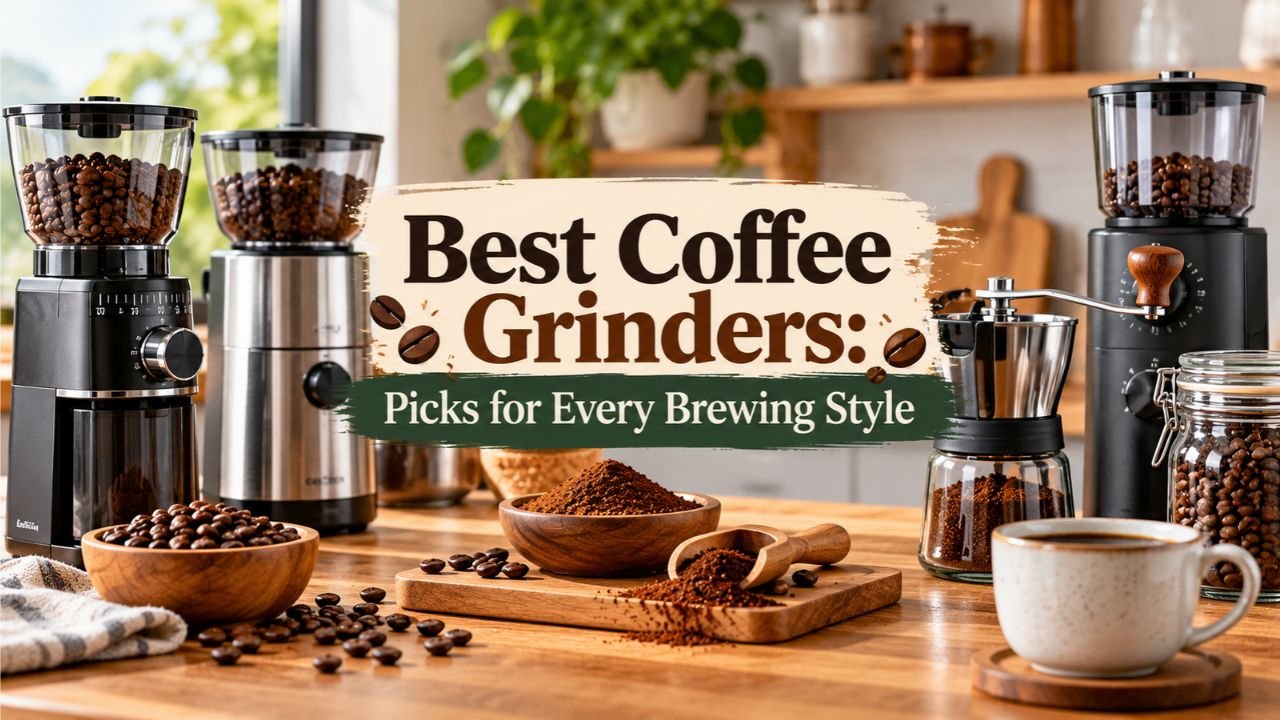
15 Best Coffee Grinders: Picks for Every Brewing Style
The best coffee grinder for most home brewers is a burr grinder that produces consistent grounds, offers useful grind adjustments, and matches their preferred brewing method. The Baratza Encore ESP is my overall pick for its ability to handle espresso and filter coffee, while the OXO Brew Conical Burr Grinder offers excellent everyday value. Dedicated espresso and pour-over drinkers may benefit from more specialized models.
A poor grinder can make freshly roasted coffee taste disappointing. Uneven particles extract at different rates, potentially creating a cup that tastes bitter, sour, or muddy. Even an expensive coffee maker cannot fully correct coffee that has been ground poorly.
Choosing the right grinder gives you greater control over flavor, brewing time, strength, and consistency. It also lets you buy whole coffee beans and grind only the amount needed for each brew.
Coffee remains a major part of American daily life. According to the National Coffee Association’s September 2026 National Coffee Data Trends report, 66% of American adults drank coffee in the previous day, and 83% of past-day coffee drinkers had coffee at home. A dependable grinder is a practical investment for this large group of home coffee drinkers.
The difficulty with choosing among the Best Coffee Grinders is that the most expensive machine is not necessarily the most suitable. Espresso requires precise adjustments at fine grind sizes, while French press, drip coffee, and pour-over brewing place different demands on a grinder.
After comparing manufacturer specifications, grinder designs, independent evaluations, and practical limitations, I found that grind consistency, adjustment precision, maintenance, and brewing compatibility deserve more attention than motor wattage or a large number of advertised settings.
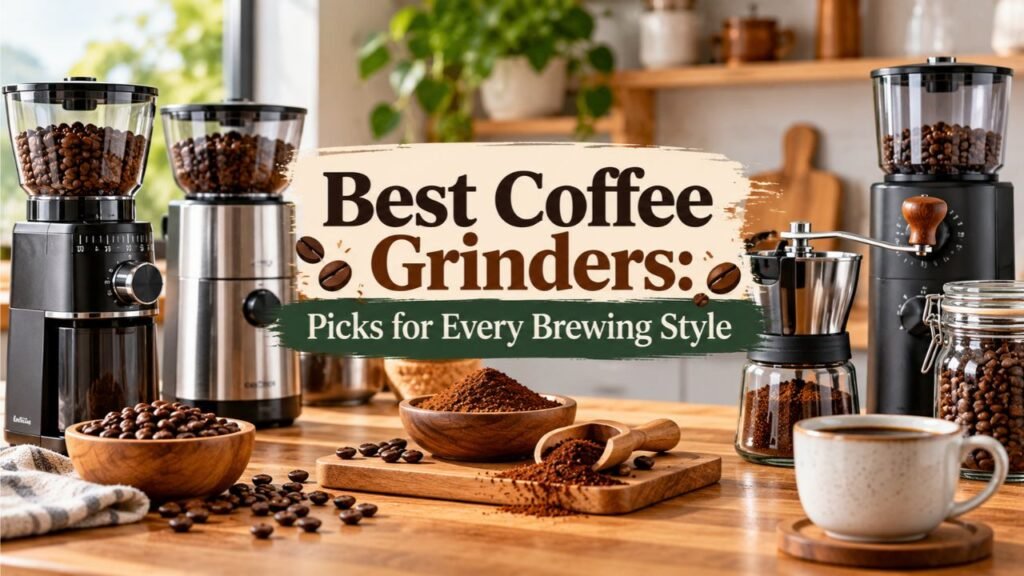
These 15 grinders come from 15 different brands, with selections for beginners, espresso enthusiasts, pour-over drinkers, travelers, and budget-conscious households. Each review covers important features, strengths, drawbacks, competing options, and the type of coffee drinker most likely to appreciate the machine.
Best Coffee Grinders at a Glance
These are my recommended models across different brewing needs.
| Coffee Grinder | Best For | Grinder Type | Main Advantage |
| Baratza Encore ESP | Best Overall | Electric conical burr | Espresso and filter versatility |
| OXO Brew Conical Burr | Best Value Electric | Electric conical burr | Simple controls and good filter grinding |
| Fellow Ode Gen 2 | Best for Pour-Over | Electric flat burr | Filter-focused grind quality |
| Breville Smart Grinder Pro | Best Digital Controls | Electric conical burr | Programmable timed dosing |
| KitchenAid KCG8433 | Best Automatic Dosing | Electric conical burr | Smart dosing and 70 settings |
| Eureka Mignon Specialità | Best Premium Espresso | Electric flat burr | Stepless espresso adjustment |
| SHARDOR Professional 64mm | Best Feature-Packed Flat Burr | Electric flat burr | Large burrs and 100 settings |
| Capresso Infinity | Best Simple Daily Grinder | Electric conical burr | Compact design and straightforward controls |
| Cuisinart DBM-8P1 | Best Budget Batch Grinder | Electric burr mill | Large-capacity grinding |
| Bodum Bistro Burr Grinder | Best Glass Catch Cup | Electric conical burr | Low-static glass grounds container |
| KRUPS Silent Vortex | Best Blade Grinder | Electric blade | Low price and compact size |
| 1Zpresso J-Ultra | Best Manual Espresso | Manual conical burr | Very fine adjustment control |
| KINGrinder K6 | Best Value Manual | Manual conical burr | Versatile grinding at a reasonable cost |
| TIMEMORE Chestnut C3S Pro | Best Travel Grinder | Manual conical burr | Compact metal construction |
| Hario Skerton Pro | Best Large-Capacity Manual | Manual ceramic burr | Large grounds jar and simple operation |
Best overall recommendation: Baratza Encore ESP.
Best budget electric burr grinder: OXO Brew Conical Burr.
Best dedicated filter grinder: Fellow Ode Gen 2.
Best serious espresso grinder: Eureka Mignon Specialità.
Best affordable manual grinder: KINGrinder K6.
Best for travel: TIMEMORE Chestnut C3S Pro.
These recommendations reflect the strengths and limitations of each design rather than an assumption that one grinder performs best for every brewing method.
Amazon prices, availability, colors, and included accessories change. Check the exact model and seller before buying, especially when several variations share similar names.
How I Selected These 15 Coffee Grinders
A coffee grinder should be evaluated according to how well it performs the job it was designed to do.
I compared the selected models using several practical criteria.
Grind consistency: The grinder should produce a reasonably controlled particle distribution at its intended settings. This matters because uneven particles can cause uneven extraction.
Brewing compatibility: Some grinders work well for both espresso and filter coffee. Others are better suited to one category. I did not treat a filter-only grinder as an espresso recommendation.
Adjustment control: The ability to make small, repeatable changes is important, especially when dialing in espresso.
Construction: Burr design, motor operation, adjustment mechanisms, housing materials, and access to replacement components influence ownership.
Ease of use: Timers, grounds containers, portafilter holders, adjustment markings, and cleaning access all affect the morning routine.
Price and value: A grinder should justify its cost through features that matter to its intended buyer.
Limitations: Each recommendation includes compromises that deserve attention before purchase.
These are research-based product evaluations, not claims of personal hands-on testing. Performance observations are informed by published specifications and independent evaluations. My recommendations reflect how those characteristics fit common home-brewing situations.
I also included a small number of inexpensive or specialized models because a person making occasional drip coffee may have different priorities from someone dialing in multiple espresso shots every morning.
15 Best Coffee Grinders Reviewed
1. Baratza Encore ESP — Best Overall Coffee Grinder
The Baratza Encore ESP is my top recommendation for someone who wants one electric grinder capable of preparing both espresso and ordinary brewed coffee.
Its greatest advantage is the adjustment system.
The grinder has 40 grind settings divided into two distinct ranges. Settings 1–20 provide smaller adjustments intended for espresso, while settings 21–40 cover brewing methods such as drip, pour-over, French press, and cold brew.
This solves a common problem with entry-level grinders: they can produce fine grounds, but their adjustment steps are often too large to control espresso extraction accurately.
The Encore ESP uses 40 mm M2 conical steel burrs and a motor designed for steady grinding.
A supplied dosing cup supports espresso preparation, while the regular grounds bin works for filter coffee.
The machine is compact enough for many kitchen counters and maintains the straightforward design associated with Baratza grinders.
Another advantage is serviceability. Baratza provides replacement components and product support, which gives the Encore ESP a stronger long-term ownership argument than some inexpensive grinders with limited parts availability.
The controls are relatively basic. Users select a grind setting and operate the grinder without a sophisticated dosing display.
That simplicity is useful for beginners, although people who want programmable dosing may prefer Breville or KitchenAid.
Key Specifications
- Grinder type: Electric conical burr
- Burr size: 40 mm steel
- Grind settings: 40
- Espresso capability: Yes
- Bean hopper capacity: Approximately 10.6 ounces
- Dosing: Manual operation
- Main strength: Fine espresso control plus broad brewing compatibility
Pros
- Works for both espresso and filter brewing
- Fine adjustment range intended for espresso
- Replaceable components and accessible maintenance
- Compact countertop footprint
- Easy-to-understand controls
- Strong versatility for the price
Cons
- No programmable dosing timer
- Not as quiet as some premium alternatives
- Switching frequently between brewing methods can require purging retained grounds
- Fewer espresso adjustments than dedicated stepless grinders
My Opinion
I consider the Encore ESP the strongest all-around recommendation because it avoids forcing beginners to choose between espresso capability and ordinary brewed coffee.
Compared with the OXO Brew Conical Burr, Baratza offers better adjustment control for traditional espresso.
Compared with the Eureka Mignon Specialità, it costs less and makes switching between espresso and coarser brewing methods simpler.
The Eureka provides more control for dedicated espresso preparation, but the Encore ESP is easier to justify for someone making several coffee styles.
Best For: Home brewers who want one grinder for espresso, drip coffee, pour-over, AeroPress, and French press.
Who Should Skip It: Someone who exclusively drinks pour-over and wants a dedicated flat-burr grinder, or an espresso enthusiast seeking stepless adjustment.
2. OXO Brew Conical Burr Coffee Grinder — Best Value Electric Grinder
The OXO Brew Conical Burr Coffee Grinder is a practical choice for someone moving from pre-ground coffee or an inexpensive blade grinder to freshly ground whole beans.
It uses stainless steel conical burrs and provides 15 main grind settings with additional intermediate adjustments.
The controls are straightforward. Add beans, choose the desired grind setting, adjust the grinding time, and start the machine.
A one-touch start function remembers the previous time setting, reducing repeated adjustments when making the same coffee each morning.
The bean hopper holds approximately 12 ounces, which is convenient for households preparing several cups daily.
OXO also uses a UV-blocking tinted hopper and a removable hopper design that helps contain beans when the hopper is detached.
The stainless steel grounds container is intended to reduce static buildup, although no electric grinder is completely immune to static.
For ordinary drip coffee, French press, cold brew, and many pour-over recipes, this grinder offers a sensible combination of convenience and capability.
Its main weakness is espresso.
OXO advertises fine settings, but the machine does not provide the same fine-grind adjustment control as a grinder built specifically for traditional espresso.
It may work for certain pressurized espresso baskets, but buyers using nonpressurized baskets should consider the Baratza Encore ESP instead.
Key Specifications
- Grinder type: Electric conical burr
- Burr material: Stainless steel
- Grind settings: 15 main settings with intermediate adjustments
- Bean capacity: 12 ounces
- Controls: Timed grinding with one-touch operation
- Main strength: Everyday filter-coffee value
Pros
- Straightforward controls
- Good choice for drip and French press
- Large bean hopper
- Grounds container designed to reduce static
- Convenient remembered timer setting
- More affordable than many espresso-capable grinders
Cons
- Limited fine adjustment for espresso
- Grinding can be noisy
- Some retained grounds may remain inside
- Not intended for advanced espresso dialing
- Less control than premium filter grinders
My Opinion
For a household that primarily uses a drip coffee maker, I would consider the OXO before spending considerably more money.
Compared with the Cuisinart DBM-8P1, the OXO’s conical burr design is a more attractive option for someone who cares about grind quality.
Compared with the Fellow Ode Gen 2, it lacks the same filter-focused refinement but costs substantially less.
The OXO makes sense when the goal is fresher coffee without turning grinding into a complicated daily activity.
Best For: Beginners, drip coffee drinkers, French press users, and households seeking an affordable electric burr grinder.
Who Should Skip It: People buying a grinder mainly for a traditional espresso machine.
3. Fellow Ode Brew Grinder Gen 2 — Best for Pour-Over Coffee
The Fellow Ode Gen 2 is a specialized electric grinder designed for brewed coffee rather than espresso.
Its 64 mm flat stainless steel burrs are intended for pour-over, automatic drip, French press, AeroPress, and cold brew.
The grinder offers 31 adjustment steps across 11 numbered settings.
Unlike a traditional large-hopper grinder, the Ode Gen 2 is built around single-dose grinding.
You weigh the beans needed for one brew, place them in the hopper, and grind that measured quantity.
This approach is attractive for people who buy specialty coffee beans and frequently switch between different roasts or origins.
The Gen 2 model introduced updated burrs, an improved bean-feeding design, and anti-static technology.
According to Fellow, its anti-static system can reduce retained coffee compared with the original Ode under specified conditions.
A magnetic catch cup, knocker, and automatic stop feature make the workflow convenient.
The machine also has a modern appearance and relatively compact height.
Its main limitation is intentional: the Ode Gen 2 is not designed for espresso.
Someone purchasing it for a traditional espresso machine would be choosing the wrong tool.
The grinder is most attractive when filter brewing is the priority and consistent results matter more than broad espresso compatibility.
Key Specifications
- Grinder type: Electric flat burr
- Burr size: 64 mm stainless steel
- Grind adjustments: 31 steps
- Bean capacity: 100 grams
- Workflow: Single-dose
- Espresso capability: No
- Main strength: Dedicated brewed-coffee grinding
Pros
- Large flat burrs
- Designed specifically for filter coffee
- Single-dose workflow supports bean switching
- Anti-static technology reduces mess
- Automatic shutoff after grinding
- Compact, attractive construction
Cons
- Cannot serve as a traditional espresso grinder
- Higher purchase cost
- Small single-dose hopper compared with batch grinders
- Grounds cup may require adjustment to personal preference
- More expensive than necessary for casual drip coffee
My Opinion
I would choose the Fellow Ode Gen 2 over the Baratza Encore ESP if I brewed V60, Chemex, or another pour-over method almost every day and had no interest in espresso.
The large flat burrs and filter-focused design make it a more specialized choice.
The OXO provides better budget value, but the Ode is the more attractive option for someone seeking greater control over filter brewing.
Paying extra makes sense when the grinder supports a brewing method you care about deeply.
Best For: Specialty pour-over drinkers, Chemex users, light-roast enthusiasts, and people who enjoy single-dose brewing.
Who Should Skip It: Espresso drinkers and households looking for an inexpensive all-purpose grinder.
4. Breville Smart Grinder Pro — Best for Digital Dosing Controls
The Breville Smart Grinder Pro appeals to coffee drinkers who prefer programmable controls rather than a simple manual switch.
It offers 60 grind settings and a digital dosing system called Dosing IQ.
The LCD screen displays the grind setting, grinding time, and selected number of cups or espresso shots.
Users can adjust grinding time in 0.2-second increments, giving them repeatable control over how long the machine runs.
That is useful for households preparing similar drinks each morning.
The grinder includes portafilter cradles for common espresso basket sizes, along with a grounds container.
You can grind into an espresso portafilter or use the grounds container for other brewing methods.
The stainless steel conical burrs cover a broad range, from fine espresso grinding to coarser filter preparation.
This versatility makes Breville attractive for someone who already owns a Breville espresso machine or wants matching coffee equipment.
One limitation is that timed dosing is not the same as weighing the actual output.
Coffee density, roast level, bean size, and grind setting can change how much ground coffee comes out during a fixed period.
A coffee scale is still useful for precise dosing.
The grinder also lacks the continuously adjustable espresso control found in higher-priced specialty models.
Key Specifications
- Grinder type: Electric conical burr
- Grind settings: 60
- Dosing: Programmable timed grinding
- Time adjustment: 0.2-second increments
- Display: LCD
- Included accessories: Portafilter cradles and grounds container
- Main strength: Convenient digital controls
Pros
- Clear digital display
- Useful timed dosing system
- Direct grinding into portafilters
- Broad adjustment range
- Convenient for mixed brewing methods
- Suitable for many beginner espresso setups
Cons
- Timed output is not exact weight-based dosing
- May need internal burr adjustment for certain espresso beans
- More electronic controls than a basic grinder
- Grounds can remain in the grinding path
- Less espresso precision than a dedicated premium grinder
My Opinion
I prefer the Breville Smart Grinder Pro for someone who wants a comfortable daily routine and frequently uses an espresso machine.
Compared with the Baratza Encore ESP, Breville provides more programmable convenience.
Baratza has a simpler operating system and strong serviceability.
Compared with the Eureka Mignon Specialità, Breville costs less but lacks the same stepless adjustment control.
If timed dosing and a visible display matter to your routine, Breville earns its place.
Best For: Home espresso beginners, Breville espresso-machine owners, and people who want programmable grinding.
Who Should Skip It: Someone seeking a low-retention single-dose grinder or advanced stepless espresso adjustment.
5. KitchenAid KCG8433 Burr Coffee Grinder — Best for Automatic Dosing
The KitchenAid KCG8433 is designed for people who want a modern electric grinder with convenient automatic dosing.
Its most interesting feature is Smart Dosing Technology.
Instead of requiring the user to set every grinding time manually, the machine adjusts its operation according to the selected brewing method and dose.
The grinder provides 70 grind settings covering French press, drip coffee, percolator brewing, and espresso.
KitchenAid identifies specific ranges for different methods, including settings 55–70 for espresso.
The machine uses stainless steel conical burrs and includes a portafilter holder.
It also features anti-static technology intended to reduce grounds spraying around the countertop.
The removable hopper is useful when changing coffee beans.
Its controls are more advanced than a basic dial-operated grinder, yet the overall purpose remains straightforward: select the brewing method and desired quantity.
One important limitation is that automatic dosing does not guarantee the exact gram weight required for a particular recipe.
Grind time and actual coffee weight can vary with the beans.
Someone making espresso with strict dose targets should still check the grounds using a scale.
The 70 settings provide plenty of options, but the number alone does not establish better espresso performance than grinders with fewer, finer adjustments.
Key Specifications
- Grinder type: Electric conical burr
- Burr material: Stainless steel
- Grind settings: 70
- Dosing: Automatic Smart Dosing Technology
- Brewing range: Espresso through French press
- Main strength: Convenience and adjustable dosing
Pros
- Wide selection of grind settings
- Automatic dosing controls
- Anti-static design
- Removable bean hopper
- Portafilter compatibility
- Attractive option for modern kitchens
Cons
- Automatic dosing is not true weight measurement
- More features than casual coffee drinkers may need
- Additional controls require familiarization
- Grind retention remains possible
- Dedicated espresso grinders offer finer control
My Opinion
KitchenAid is worth considering when the main goal is simplifying regular coffee preparation.
Compared with the Breville Smart Grinder Pro, KitchenAid emphasizes automated dose selection, while Breville provides direct timed dosing control through its LCD interface.
Both are suitable for people who prefer convenient electric grinding rather than manual weighing and adjustment.
I would select KitchenAid for someone who appreciates automatic settings and wants one appliance to serve several brewing methods.
Best For: Households preparing different coffee styles and users who value automatic dosing.
Who Should Skip It: Espresso enthusiasts who prefer single-dosing or fine stepless adjustment.
6. Eureka Mignon Specialità — Best Premium Espresso Grinder
The Eureka Mignon Specialità is the most espresso-focused electric grinder among my premium recommendations.
Its main strength is the combination of 55 mm hardened steel flat burrs and a stepless micrometric adjustment system.
Unlike grinders that move between fixed click positions, the Specialità lets users make very small changes to the burr spacing.
This is useful for traditional espresso because minor adjustments can change shot resistance, flow rate, and extraction.
The grinder also features Eureka’s Silent Technology, which uses vibration control to reduce operating noise.
Its ACE system is designed to reduce clumping and electrostatic effects.
A touchscreen supports timed dosing, and the adjustable portafilter fork permits hands-free grinding.
The Specialità is built for a routine where espresso is prepared frequently and precise adjustments are repeated over time.
A stepless dial offers freedom, but it also creates a tradeoff.
Returning to exactly the same coarser setting can be less convenient than selecting a marked click on a general-purpose grinder.
Someone who alternates between espresso and French press several times daily may find that workflow frustrating.
The Specialità is also heavier and more expensive than entry-level alternatives.
Key Specifications
- Grinder type: Electric flat burr
- Burr size: 55 mm hardened steel
- Adjustment: Stepless micrometric
- Dosing: Programmable timed dosing
- Display: Touchscreen
- Bean hopper capacity: Approximately 300 grams on standard configurations
- Main strength: Fine espresso adjustment
Pros
- Fine stepless adjustment
- Strong focus on espresso preparation
- Noise-reduction technology
- Flat steel burrs
- Anti-clumping design
- Programmable timed dosing
Cons
- Premium purchase price
- Less convenient for frequent switching between coarse and fine settings
- Large compared with manual grinders
- Some grounds retention is possible
- More machine than beginners need for casual coffee
My Opinion
For someone who prepares espresso every morning and wants control over shot extraction, I would choose the Eureka Mignon Specialità over the Baratza Encore ESP.
The Eureka’s stepless adjustment better suits a dedicated espresso routine.
The Baratza remains the more practical purchase for someone who alternates between espresso and filter coffee.
Compared with the 1Zpresso J-Ultra, Eureka avoids manual grinding and supports a faster routine for multiple drinks.
The price premium makes sense when espresso is your primary brewing method rather than an occasional experiment.
Best For: Serious home espresso drinkers, nonpressurized portafilter users, and households preparing several espresso drinks daily.
Who Should Skip It: Filter-only drinkers, occasional coffee makers, and buyers needing a low-cost grinder.
7. SHARDOR Professional 64mm Flat Burr Grinder — Best Feature-Packed Flat Burr Option
The SHARDOR Professional 64mm Flat Burr Grinder offers an unusual collection of features for its price category.
It includes 64 mm flat burrs, 100 grind settings, a digital timer, and anti-static technology.
The grinder is advertised for several brewing methods, from espresso to French press and cold brew.
Its LED interface allows users to adjust grinding time in 0.1-second increments.
The machine also includes a portafilter holder and removable components that simplify access to the grinding path.
A bellows-style grounds-clearing accessory helps push retained grounds out after grinding.
This is useful for people who change coffee beans or want to reduce the amount of stale coffee remaining inside the grinder.
The large flat burr format makes this model interesting compared with several similarly priced conical grinders.
Still, burr diameter alone does not determine grind quality.
Burr geometry, manufacturing tolerances, alignment, and adjustment precision all influence particle distribution.
The SHARDOR is also larger than compact models, with a height around 17 inches on the listed version.
Buyers should confirm the exact model because SHARDOR sells several grinders with different housing designs and features.
Another consideration is the long-term availability of replacement burrs and components compared with established specialty grinder brands.
Key Specifications
- Grinder type: Electric flat burr
- Burr size: 64 mm
- Grind settings: 100
- Dosing: Digital timer
- Time adjustment: 0.1-second increments
- Features: Anti-static system, removable chute, grounds-clearing accessory
- Main strength: Large burrs and extensive controls at a moderate price
Pros
- Large 64 mm flat burrs
- Extensive adjustment options
- Digital timed dosing
- Anti-static features
- Useful removable cleaning components
- Portafilter support
Cons
- Larger countertop footprint
- Long-term parts support deserves verification
- A large number of settings does not guarantee espresso precision
- Requires more attention to cleaning and setup than basic grinders
- Several similar SHARDOR variants can create purchasing confusion
My Opinion
The SHARDOR is an interesting alternative to the Breville Smart Grinder Pro for buyers attracted to large flat burrs and digital controls.
Its specifications offer plenty of features, but I would not automatically place it above Baratza or Eureka based on burr diameter alone.
The Baratza Encore ESP has a more established serviceability argument, while Eureka offers a proven espresso-focused adjustment design.
I would consider SHARDOR for a buyer who values its specific features and is comfortable evaluating the exact model and seller.
Best For: Home coffee enthusiasts seeking large flat burrs, multiple grind settings, and digital controls without entering the highest price category.
Who Should Skip It: Buyers who prioritize a long-established specialty grinder service network over feature count.
8. Capresso Infinity Conical Burr Grinder — Best for Simple Daily Grinding
The Capresso Infinity is a traditional electric burr grinder built around simple controls and a compact design.
Its 16 grind settings are divided into four categories: extra fine, fine, medium, and coarse.
The grinder uses steel conical burrs and a geared motor.
Capresso describes its burrs as precision-manufactured matched pairs, with the motor operating at relatively low speed.
The bean container holds approximately 8.8 ounces.
Grinding is controlled by a timer that can run from 5 to 60 seconds.
There is no touchscreen, complicated programming system, or extensive menu to understand.
That simplicity is part of the appeal.
For everyday drip coffee and French press, users can choose a suitable setting, operate the timer, and transfer the grounds to the brewer.
The Infinity is also compact enough for kitchens where counter space matters.
Its limitation is fine adjustment.
Sixteen settings provide a useful basic range, but traditional espresso often requires smaller adjustments than this system offers.
Capresso advertises very fine grinding capability, yet producing fine coffee and precisely dialing in a nonpressurized espresso basket are different requirements.
The machine also uses a grounds container that may collect static and retained coffee.
Key Specifications
- Grinder type: Electric conical burr
- Grind settings: 16
- Bean capacity: 8.8 ounces
- Timer: 5–60 seconds
- Operation: Simple mechanical controls
- Main strength: Straightforward daily grinding
Pros
- Easy operation
- Compact footprint
- Conical burr grinding
- Useful grind range for common brewed coffee
- Timer control
- Minimal programming requirements
Cons
- Limited fine adjustment
- Not my first choice for traditional espresso
- Grounds retention is possible
- Fewer features than newer digital grinders
- Grounds container can require extra cleanup
My Opinion
I see the Capresso Infinity as a straightforward alternative to the OXO Brew Conical Burr.
The Capresso has a traditional control layout and may appeal to buyers who prefer a simple appliance.
The OXO offers a more convenient grounds container and additional intermediate grind adjustments.
If prices are close, I would generally lean toward the OXO for everyday filter brewing.
The Capresso still makes sense when compact construction and familiar controls are the priority.
Best For: Drip coffee users, casual French press drinkers, and people who want an uncomplicated electric burr grinder.
Who Should Skip It: Espresso enthusiasts and people who frequently make very small grind adjustments.
9. Cuisinart DBM-8P1 Supreme Grind — Best Budget Batch Grinder
The Cuisinart DBM-8P1 Supreme Grind Automatic Burr Mill is designed for people who want to grind a relatively large quantity of coffee without spending heavily on a specialty grinder.
It provides 18 grind settings and a slide control for selecting a quantity associated with 4–18 cups.
The removable bean hopper holds approximately 8 ounces, while the grounds chamber can hold enough ground coffee for larger batches.
Automatic shutoff ends the selected grinding cycle.
These features make the Cuisinart convenient for households preparing a full pot of coffee rather than measuring individual espresso doses.
Its strongest argument is affordability combined with batch capacity.
There are important compromises.
The burr-mill mechanism does not provide the same refinement associated with higher-quality conical or flat cutting burr systems.
Coarser settings may produce a noticeable mixture of large particles and fines.
This can affect flavor clarity in French press and pour-over brewing.
The grinder is also not a sensible recommendation for traditional espresso preparation.
Although the manufacturer describes an ultra-fine setting, the adjustment system does not provide the same precision as an espresso-oriented grinder.
Noise and grounds retention may be additional concerns.
Key Specifications
- Grinder type: Electric burr mill
- Grind settings: 18
- Bean hopper capacity: 8 ounces
- Quantity selector: 4–18 cups
- Controls: Automatic timed operation
- Main strength: Low-cost batch grinding
Pros
- Relatively affordable
- Convenient quantity selector
- Good hopper capacity
- Removable grounds chamber
- Automatic shutoff
- Simple controls
Cons
- Less consistent grinding than stronger burr alternatives
- Not suitable for precise espresso dialing
- Can generate substantial fines
- May be noisy
- Grounds can cling inside the chamber
My Opinion
The Cuisinart is best viewed as an entry-level batch grinder, not as a direct competitor to premium burr machines.
Compared with the KRUPS Silent Vortex blade grinder, it provides more defined grind settings and automatic quantity selection.
Compared with the OXO Brew Conical Burr, it is a weaker choice for someone focused on improving cup quality.
I would recommend the Cuisinart primarily to someone making large batches of ordinary drip coffee on a restricted budget.
Best For: Budget-focused households preparing drip coffee in larger quantities.
Who Should Skip It: Pour-over enthusiasts, espresso drinkers, and buyers seeking tighter grind consistency.
10. Bodum Bistro Electric Burr Grinder — Best Glass Grounds Container
The Bodum Bistro Electric Burr Grinder stands out because of its borosilicate glass grounds container.
Many inexpensive grinders collect coffee in plastic containers that attract static, causing fine grounds to cling to the walls.
Bodum’s glass container, paired with its design, is intended to reduce that problem.
The grinder uses conical burrs and offers 12 grind settings.
It also includes a preset timer.
On the glass-container version, the timer operates over a short grinding interval, making the machine suitable for measuring and grinding modest amounts of coffee at a time.
The bean hopper holds approximately 220 grams.
Bodum uses a compact design with a recognizable appearance.
The controls are approachable for beginners, and the grinder can prepare grounds for several brewing methods.
The main limitation is adjustment precision.
Twelve settings are adequate for many drip and immersion recipes but provide limited control when traditional espresso requires small changes.
Another practical concern is the glass container.
It can reduce static-related mess, but it is also breakable if dropped.
The manufacturer also specifies operating limits and rest periods for certain Bistro models, so buyers should review the manual before grinding repeated large batches.
Key Specifications
- Grinder type: Electric conical burr
- Grind settings: 12
- Bean capacity: Approximately 220 grams
- Grounds container: Borosilicate glass on the reviewed version
- Controls: Preset timer
- Main strength: Convenient glass grounds catcher
Pros
- Glass grounds container
- Reduced static compared with many plastic catchers
- Straightforward controls
- Suitable for common brewed-coffee methods
- Attractive countertop design
- Removable components for cleaning
Cons
- Glass container can break
- Limited grind adjustment
- Not ideal for serious espresso
- Short grinding cycles may require pauses
- Different Bistro versions have different grounds containers
My Opinion
I like the Bodum Bistro concept for someone who dislikes grounds clinging to plastic containers.
Compared with the Capresso Infinity, Bodum places more emphasis on the grounds-catching experience.
Compared with the OXO, it offers fewer adjustments and may provide less practical value at a similar price.
The glass catcher is a real convenience feature, but I would not choose the Bistro solely because it looks attractive.
Its strongest role is ordinary drip coffee and French press preparation.
Best For: Casual home brewers who want a simple burr grinder with a glass grounds container.
Who Should Skip It: Espresso-focused buyers and people who prefer unbreakable containers.
11. KRUPS Silent Vortex Electric Grinder — Best Budget Blade Grinder
The KRUPS Silent Vortex is different from the other electric grinders in this list because it uses a spinning blade rather than burrs.
A blade grinder chops beans by repeatedly striking them with a rotating blade.
It does not maintain a fixed gap that determines particle size.
As a consequence, grinding produces a mixture of larger pieces and fine particles.
This can create uneven extraction during brewing.
The Silent Vortex remains worth considering for people with limited budgets or occasional coffee-grinding needs.
Its compact design occupies little counter space.
The removable grinding bowl can hold approximately 3 ounces of ingredients and is dishwasher-safe according to the manufacturer.
KRUPS also markets the machine for grinding dry herbs and spices.
The motor and bowl design are intended to reduce noise compared with the brand’s traditional blade models.
The main appeal is convenience at a low price.
The major compromise is grind consistency.
Blade grinders require users to judge particle size by grinding duration, making repeatable results difficult.
They are not suitable for dialing in traditional espresso.
For ordinary drip coffee, pulsing in short bursts and gently redistributing the beans may produce more balanced results than grinding continuously.
Still, that method does not make a blade grinder equivalent to a burr grinder.
Key Specifications
- Grinder type: Electric blade
- Bowl capacity: Approximately 3 ounces
- Grinding: Duration-controlled rather than calibrated grind settings
- Bowl: Removable and dishwasher-safe
- Additional uses: Certain dry herbs and spices
- Main strength: Low cost and compact size
Pros
- Affordable
- Compact and easy to store
- Removable grinding bowl
- Convenient for occasional use
- Can handle certain dry spices
- Quieter design than some traditional blade grinders
Cons
- Uneven particle sizes
- No true burr adjustment system
- Poor choice for espresso
- Difficult to reproduce the same grind
- Fine powder may mix with larger fragments
My Opinion
I would choose a burr grinder over the Silent Vortex whenever coffee quality is the main concern.
Even the budget Cuisinart provides defined grind settings that the KRUPS blade system lacks.
The Silent Vortex makes sense for someone who occasionally grinds coffee and also wants a compact machine for other permitted dry ingredients.
It is not a substitute for the Baratza, OXO, or Capresso when consistent coffee preparation matters.
Best For: Occasional coffee drinkers and budget-conscious households needing a compact blade grinder.
Who Should Skip It: Espresso drinkers, pour-over enthusiasts, and anyone seeking consistent, repeatable grind sizes.
12. 1Zpresso J-Ultra — Best Manual Grinder for Espresso
The 1Zpresso J-Ultra is a premium manual grinder designed mainly for espresso.
It uses a 48 mm burr system and an external adjustment mechanism.
Its most important feature is the precision of that adjustment system.
Each click moves the burr adjustment by approximately 8 microns, allowing small changes when dialing in espresso.
This is useful because a slight change in grind fineness can influence resistance inside the portafilter basket.
The external dial makes adjustment more convenient than systems requiring access beneath the grounds container.
The grinder also includes a magnetic catch cup and an ergonomic body intended for comfortable handling.
Its stated capacity is approximately 35–40 grams, depending on the beans.
That is enough for many single and double espresso doses.
The J-Ultra does not require electricity, making it practical for small kitchens, travel, or use during power outages.
Its drawback is the physical work.
Grinding espresso-fine coffee manually can demand noticeable effort, especially with dense light-roast beans.
Preparing multiple drinks for a group also takes time.
The burr design favors espresso, so it is not necessarily the best manual option for someone whose main interest is light-roast pour-over.
Key Specifications
- Grinder type: Manual conical burr
- Burr size: 48 mm
- Adjustment: External
- Adjustment movement: Approximately 8 microns per click
- Capacity: Approximately 35–40 grams
- Main strength: Manual espresso precision
Pros
- Very fine adjustment control
- Espresso-oriented burr system
- No electricity required
- External adjustment is convenient
- Magnetic grounds cup
- Compact compared with electric espresso grinders
Cons
- Requires physical effort
- Slower for multiple espresso drinks
- Expensive for a manual grinder
- More specialized toward espresso than filter coffee
- Not ideal for large batch grinding
My Opinion
The J-Ultra is the manual grinder I would choose for someone who values espresso precision but does not want a large electric machine.
Compared with the KINGrinder K6, it provides finer adjustment increments and a more espresso-focused design.
The K6 offers stronger budget value and broader appeal for mixed brewing methods.
Compared with the Eureka Mignon Specialità, the J-Ultra requires more work but occupies less space and costs less.
For one or two espresso drinks daily, it is a convincing option.
Best For: Manual espresso enthusiasts, small-apartment owners, and people seeking precise espresso grinding without electricity.
Who Should Skip It: Households making several espresso drinks in quick succession and users who dislike hand grinding.
13. KINGrinder K6 — Best Value Manual Coffee Grinder
The KINGrinder K6 is my value-focused manual recommendation because it combines a substantial burr system with useful adjustment control.
It uses stainless steel burrs and an external adjustment mechanism.
The manufacturer specifies 60 clicks per rotation, with approximately 16 microns of burr movement per click.
Its aluminum body provides a durable structure without requiring a large electric motor.
The grinder holds approximately 30–35 grams of beans.
That capacity suits single-cup pour-over, AeroPress, moka pot, and many espresso recipes.
The external dial makes it straightforward to record preferred grind settings.
This is useful when changing brewing methods.
For example, someone can use one setting for a V60 and another for French press without repeatedly guessing how far the burrs have moved.
The K6 also offers an unusual degree of versatility for a manual grinder in its general price category.
It can produce fine grounds for espresso, although the adjustment steps are larger than those of the 1Zpresso J-Ultra.
Like every hand grinder, it requires manual effort.
Grinding large doses or preparing several cups can become tiring.
The metal construction also means it is not the lightest possible travel grinder.
Key Specifications
- Grinder type: Manual conical burr
- Burr material: Stainless steel
- Adjustment: External stepped dial
- Adjustment movement: Approximately 16 microns per click
- Capacity: Approximately 30–35 grams
- Main strength: Manual versatility and value
Pros
- Good adjustment control for the price
- Suitable for several brewing methods
- Sturdy metal construction
- External adjustment
- No electricity required
- Practical for one or two cups
Cons
- Requires manual effort
- Heavier than some compact travel grinders
- Less fine espresso adjustment than J-Ultra
- Batch grinding takes time
- Smaller capacity than electric hopper grinders
My Opinion
I would select the KINGrinder K6 over many inexpensive electric grinders if I only brewed one or two cups daily.
Money that would otherwise pay for a motor, housing, and electronics can instead support a substantial manual burr mechanism.
Compared with the TIMEMORE C3S Pro, the K6 offers finer adjustment increments on its external dial.
Compared with the 1Zpresso J-Ultra, it provides strong value for someone making both espresso and filter coffee.
Best For: Budget-focused coffee enthusiasts, AeroPress users, pour-over drinkers, and occasional espresso makers.
Who Should Skip It: People who regularly prepare large quantities of coffee or want automatic grinding.
14. TIMEMORE Chestnut C3S Pro — Best Manual Grinder for Travel
The TIMEMORE Chestnut C3S Pro is a compact manual grinder designed for convenient storage and portable coffee preparation.
Its metal body and folding handle make it attractive for travelers.
The grinder uses a 38 mm stainless steel burr system with TIMEMORE’s S2C grinding design.
The capacity of the regular C3S Pro is approximately 20 grams, making it suitable for a single serving or a modest two-person recipe.
The folding handle reduces the amount of space required in a travel bag.
Its metal construction also gives it a more substantial feel than entry-level plastic manual grinders.
For AeroPress, pour-over, and other common brewing methods, the C3S Pro offers useful grind control.
The main point to understand is the adjustment system.
The regular C3S Pro uses a classic stepped adjustment mechanism, while models carrying the ESP designation are designed with finer espresso adjustment control.
The standard model can grind coffee fine enough for some espresso preparations, but making very small changes for a nonpressurized espresso basket is less convenient.
Its modest capacity also means larger recipes require multiple grinding cycles.
Key Specifications
- Grinder type: Manual conical burr
- Burr size: 38 mm
- Burr material: Stainless steel
- Body: Metal
- Handle: Folding
- Capacity: Approximately 20 grams
- Main strength: Portable construction
Pros
- Compact travel design
- Folding handle
- Durable metal body
- Stainless steel burrs
- Good option for single-cup brewing
- No electricity needed
Cons
- Limited bean capacity
- Manual grinding takes time
- Regular C3S Pro adjustment is less suited to fine espresso dialing
- Larger batches require refilling
- More expensive than basic ceramic hand grinders
My Opinion
For travel, I would choose the TIMEMORE C3S Pro over the Hario Skerton Pro because it is more compact and has a more travel-oriented design.
The Hario offers greater capacity, but the glass collection jar is less convenient for packing.
Compared with the KINGrinder K6, the TIMEMORE prioritizes compact storage rather than broad adjustment versatility.
I recommend the C3S Pro for AeroPress and pour-over drinkers who want good grinding capability away from home.
Best For: Travelers, campers, office coffee drinkers, and people making one fresh cup at a time.
Who Should Skip It: Households preparing large batches or buyers primarily concerned with precise espresso adjustment.
15. Hario Skerton Pro — Best Large-Capacity Manual Coffee Grinder
The Hario Skerton Pro is a recognizable manual grinder that uses ceramic burrs and a glass grounds jar.
It is designed around straightforward hand grinding rather than advanced electronic features.
The model features an improved handle attachment and a bottom adjustment mechanism compared with earlier Skerton versions.
Its stated bean capacity is approximately 100 grams, which is unusually generous for a manual grinder.
The large glass container makes it possible to collect enough grounds for larger brewing recipes.
The silicone base helps stabilize the jar while handling the grinder.
Ceramic burrs offer corrosion resistance and do not require electricity.
The Skerton Pro is useful for people who appreciate a traditional manual grinding experience.
Its drawbacks become apparent when compared with newer precision hand grinders.
Adjustment is less convenient than an external dial, and coarse grind consistency may be less controlled than on models with more rigid burr alignment.
The large jar also makes it less portable.
Glass provides a pleasant grounds container, but it can break if dropped.
For espresso, I would strongly prefer the KINGrinder K6 or 1Zpresso J-Ultra.
Key Specifications
- Grinder type: Manual ceramic burr
- Burr material: Ceramic
- Adjustment: Bottom adjustment mechanism
- Bean capacity: Approximately 100 grams
- Grounds container: Glass
- Main strength: Large manual grinding capacity
Pros
- Large bean capacity
- No electricity required
- Ceramic burrs resist corrosion
- Simple construction
- Stable glass collection jar
- Suitable for casual manual brewing
Cons
- Bulky for travel
- Glass container can break
- Adjustment is less convenient than external systems
- Limited precision for traditional espresso
- Coarse grind consistency may lag behind newer hand grinders
My Opinion
The Skerton Pro makes sense for someone who wants a large manual grinder without paying for a premium espresso-oriented model.
Compared with the TIMEMORE C3S Pro, it has greater capacity but is less convenient for travel.
Compared with the KINGrinder K6, it offers a more traditional design but less adjustment control.
I would choose the Hario mainly for home use with drip coffee or French press, where manual grinding is part of the routine.
Best For: Casual manual coffee drinkers who want a larger grounds container.
Who Should Skip It: Espresso enthusiasts, frequent travelers, and people who prioritize fast manual grinding.
Key Takeaway: The Baratza Encore ESP is the strongest all-around choice, the Fellow Ode Gen 2 stands out for dedicated filter brewing, and the Eureka Mignon Specialità suits serious espresso preparation. For lower budgets, OXO and KINGrinder provide attractive electric and manual alternatives.
Coffee Grinder Comparison: Which One Should You Choose?
Choosing among 15 grinders becomes simpler when the models are grouped by brewing purpose.
The most expensive machine is not always the strongest choice.
| Brewing Situation | My First Choice | Alternative |
| One grinder for espresso and filter | Baratza Encore ESP | Breville Smart Grinder Pro |
| Affordable daily drip coffee | OXO Brew Conical Burr | Capresso Infinity |
| Premium pour-over | Fellow Ode Gen 2 | Baratza Encore ESP |
| Dedicated espresso station | Eureka Mignon Specialità | Baratza Encore ESP |
| Digital timed dosing | Breville Smart Grinder Pro | KitchenAid KCG8433 |
| Automatic dose selection | KitchenAid KCG8433 | Breville Smart Grinder Pro |
| Large flat burrs at a moderate price | SHARDOR 64mm | Fellow Ode Gen 2 for filter only |
| Manual espresso | 1Zpresso J-Ultra | KINGrinder K6 |
| Affordable manual versatility | KINGrinder K6 | TIMEMORE C3S Pro |
| Portable hand grinding | TIMEMORE C3S Pro | KINGrinder K6 |
| Large-capacity hand grinding | Hario Skerton Pro | KINGrinder K6 |
| Lowest-cost occasional grinding | KRUPS Silent Vortex | Cuisinart DBM-8P1 |
The main distinction is between grinders that offer genuine espresso adjustment control and those intended primarily for brewed coffee.
A grinder capable of making fine powder is not necessarily capable of precisely dialing in espresso.
Similarly, a premium espresso grinder may be inconvenient for someone who constantly switches between fine and coarse settings.
Coffee Grinder Buying Guide: What Matters Most?
Coffee grinders vary considerably in construction, but a few features have the greatest influence on actual brewing.
Understanding these features prevents you from paying for specifications that do not improve your preferred coffee.
Burr Grinder vs Blade Grinder
A burr grinder crushes and cuts coffee beans between two grinding surfaces.
The distance between the burrs controls the intended particle size.
This provides greater consistency than a spinning blade.
A blade grinder uses rotating blades to chop beans into smaller pieces.
The longer the grinder operates, the smaller the average particles become.
The problem is that some fragments remain large while others become fine powder.
During brewing, tiny particles may extract too quickly while larger pieces extract more slowly.
This can produce inconsistent flavor.
Burr grinders are my preferred choice for regular coffee preparation.
Blade grinders still have a place when cost and occasional use matter more than precision.
The KRUPS Silent Vortex is a reasonable example of that category.
Manual vs Electric Coffee Grinders
Manual grinders use a hand crank to rotate the burrs.
They require no electricity and often provide strong grinding performance relative to their price.
A quality manual grinder can be a good purchase for someone making one or two cups daily.
The main drawback is effort.
Grinding a full batch of coffee manually takes time, especially at espresso-fine settings.
Electric grinders use motors to drive the burrs.
They are more convenient for repeated brewing and larger quantities.
Their additional components increase cost, size, and maintenance complexity.
For a single morning pour-over, a KINGrinder K6 may be perfectly suitable.
For a household preparing several drinks, an electric grinder such as the Baratza Encore ESP is more convenient.
Conical Burr vs Flat Burr Grinders
Conical burrs use a cone-shaped inner burr and an outer ring.
Beans pass through the space between the grinding surfaces.
Conical systems are common in compact home grinders and many manual models.
Flat burrs use two circular grinding discs arranged opposite each other.
The beans move between the discs and exit after grinding.
Flat burr grinders often appeal to coffee enthusiasts seeking particular particle distributions and flavor characteristics.
Neither geometry automatically guarantees better coffee.
Burr design, alignment, grinding speed, and adjustment accuracy matter more than the general shape alone.
A well-designed conical grinder can outperform a poorly manufactured flat-burr machine.
For mixed brewing methods, I would prioritize the grinder’s actual adjustment range and usability before choosing burr geometry.
Choosing the Right Grinder for Your Brewing Method
Different brewing methods require different grind sizes and levels of adjustment control.
Best Coffee Grinder for Espresso
Traditional espresso uses finely ground coffee packed into a portafilter basket.
Water passes through the compact coffee bed under pressure.
Small changes in grind size can alter flow resistance.
This is why espresso benefits from fine adjustment steps or a stepless mechanism.
The Eureka Mignon Specialità is my premium electric recommendation.
The Baratza Encore ESP offers a more affordable path into serious home espresso.
For manual grinding, the 1Zpresso J-Ultra provides excellent adjustment precision.
Avoid treating the finest setting on a basic blade grinder or budget burr mill as a substitute for a dedicated espresso adjustment system.
Pressurized portafilter baskets are more forgiving, but standard nonpressurized baskets demand greater control.
Best Coffee Grinder for Drip Coffee
Automatic drip machines generally work with medium-ground coffee.
The target size varies with basket shape, filter material, brew volume, and machine design.
A consistent medium grind is more important than having dozens of extremely fine settings.
The OXO Brew Conical Burr is a practical choice.
The Capresso Infinity is another straightforward option.
For a premium drip setup, the Fellow Ode Gen 2 offers a more specialized burr system and single-dose workflow.
A basic burr grinder is a meaningful improvement over a blade grinder when consistent drip coffee is the main goal.
Best Coffee Grinder for Pour-Over
Pour-over brewing benefits from controlled particle size because the grind influences how quickly water moves through the coffee bed.
A finer grind can slow the flow and increase extraction.
A coarser grind generally allows water to pass more quickly.
The ideal setting changes with the brewer, filter paper, dose, roast, and pouring technique.
The Fellow Ode Gen 2 is my first choice for someone dedicated to pour-over.
The KINGrinder K6 offers strong manual value.
For beginners, the Baratza Encore ESP provides plenty of control without requiring a specialized filter-only machine.
Best Coffee Grinder for French Press
French press uses immersion brewing, meaning the ground coffee remains in contact with water before being separated by a filter.
A medium-coarse or coarse grind is a common starting point.
Grinding too finely can increase sediment and make the plunger harder to press.
Excessively coarse grinding may produce weak coffee under some brewing conditions.
The OXO Brew Conical Burr and Capresso Infinity are suitable choices.
A Hario Skerton Pro can also work for someone who prefers manual grinding.
A grinder intended mainly for traditional espresso is usually unnecessary if French press is the only brewing method.
Best Coffee Grinder for Cold Brew
Cold brew recipes often use medium-coarse or coarse grounds, depending on the brewing system and filtration method.
Large batches create additional demands on grinder capacity.
An electric grinder with a substantial hopper may be more convenient than a small manual grinder.
The OXO and Baratza Encore ESP are practical choices for home cold brew.
For very large batches, follow the grinder’s duty-cycle instructions and avoid continuous operation beyond its permitted limits.
Coffee Grind Size Chart for Different Brewing Methods
The following table provides practical starting points rather than universal settings.
Each grinder uses its own adjustment scale.
| Brewing Method | Starting Grind Size | Texture Reference |
| Turkish coffee | Extremely fine | Powder-like |
| Traditional espresso | Very fine | Finer than table salt |
| Moka pot | Fine | Fine granular texture |
| AeroPress | Fine to medium | Depends on recipe |
| V60 pour-over | Medium-fine to medium | Around fine to regular granulated sugar |
| Flat-bottom drip | Medium | Granulated sugar |
| Chemex | Medium to medium-coarse | Slightly coarse granules |
| French press | Medium-coarse to coarse | Coarse granules |
| Cold brew | Medium-coarse to coarse | Depends on steeping and filtration |
Visual comparisons are approximate.
Actual particle sizes vary within each dose, and different grinders can produce different distributions at settings that appear similar.
Start with a manufacturer’s suggested range, then adjust according to the coffee’s taste and brewing behavior.
Key Takeaway: Espresso needs fine adjustment control, while filter coffee depends on consistent grinding across medium and coarse settings. Match the grinder to the method used most often.
Important Coffee Grinder Features Explained
A grinder’s specifications can appear impressive without revealing how convenient the product will be during daily use.
These features deserve the most attention.
Grind Settings and Adjustment Precision
More grind settings are useful only when they provide meaningful control.
A grinder with 100 poorly spaced settings is not automatically better than a model with 40 carefully designed adjustments.
Espresso benefits from small changes in the fine range.
French press generally does not require the same degree of precision.
The Baratza Encore ESP illustrates a useful approach by reserving smaller adjustment steps for espresso.
The Eureka Mignon Specialità uses stepless adjustment for a different kind of control.
Choose the adjustment system that matches your brewing routine.
Bean Hopper Capacity
The hopper stores whole coffee beans before grinding.
Large hoppers are convenient for households preparing several cups.
Smaller single-dose hoppers are useful for people who weigh beans before each brew.
Leaving beans in a hopper for extended periods can expose them to air, heat, and light.
A large hopper is convenient, but it is not necessarily the best long-term storage container.
For maximum flexibility, store most beans in an appropriate airtight container and load only what is needed.
Grind Retention
Grind retention refers to coffee grounds that remain inside the grinder after operation.
Some grounds may collect around burrs, chutes, or internal surfaces.
Retention matters because old coffee can mix with a fresh dose.
It also affects dose accuracy.
If 18 grams of beans enter the grinder but less than 18 grams comes out, retained grounds may explain part of the difference.
Low-retention designs are attractive for people frequently switching beans.
Single-dose grinders such as the Fellow Ode Gen 2 are designed with this workflow in mind.
No grinder should automatically be assumed to produce zero retention under every condition.
Timed Dosing vs Weight-Based Dosing
Timed dosing runs the grinder for a selected duration.
The Breville Smart Grinder Pro and Eureka Mignon Specialità use timed control systems.
A repeatable time can make the routine convenient.
Still, grinding 10 seconds of one coffee does not guarantee the same mass as grinding 10 seconds of another.
Bean density, roast level, and grind size influence output.
Weight-based dosing measures the actual coffee mass.
A separate coffee scale remains useful even when the grinder has a programmable timer.
Noise and Countertop Space
Coffee grinders contain moving components and can produce noticeable noise.
Motor design, burr speed, housing construction, and vibration control all influence sound.
Eureka includes noise-reduction technology in the Mignon Specialità.
Manual grinders avoid motor noise but still produce grinding sounds.
Before purchasing, check the machine’s height, width, and depth.
A grinder that does not fit beneath the kitchen cabinets can become inconvenient despite its strong grinding capabilities.
Maintenance and Replacement Parts
Burr grinders require periodic cleaning.
Coffee oils and fine particles accumulate around the grinding mechanism.
Removable upper burrs and accessible chutes make maintenance simpler.
Replacement parts also influence long-term value.
Baratza has an established parts and service system, which is one reason I favor its grinders for people seeking long-term ownership.
For less established products, confirm that replacement components and warranty support are available before buying.
Key Takeaway: Adjustment precision, retention, dosing convenience, size, and serviceability matter more than motor wattage or advertised setting counts alone.
How to Dial In a Coffee Grinder for Better Flavor
Dialing in means adjusting grind size and other brewing variables until the coffee tastes balanced.
The basic process applies to several brewing methods, although espresso requires closer attention to extraction behavior.
Step 1: Begin With a Suitable Grind Range
Choose the recommended starting setting for your brewing method.
Use a medium grind for ordinary drip coffee or a suitable fine setting for espresso.
Manufacturer charts are useful starting points, not exact recipes for every bean.
Step 2: Measure the Coffee Dose
Use a digital coffee scale when possible.
Measuring coffee by weight is more repeatable than counting scoops.
For filter coffee, the Specialty Coffee Association’s traditional brewing reference is approximately 55 grams of coffee per liter of water, with an allowed range around that value.
A practical home starting ratio is about 1 gram of coffee for every 16–17 grams of water.
For espresso, a common starting recipe uses 18 grams of ground coffee to produce approximately 36 grams of beverage.
These are starting recipes, not mandatory ratios for every coffee.
Step 3: Brew Without Changing Several Variables
Use the selected grind setting and keep the dose, water quantity, and brewing method consistent.
Observe how the coffee flows and tastes.
Changing the grind, dose, water temperature, and pouring technique together makes it difficult to identify the cause of a flavor change.
Step 4: Adjust Based on the Result
If filter coffee tastes sharply sour, weak, or underdeveloped, try grinding slightly finer.
If it tastes harsh, overly bitter, or the filter stalls, try grinding slightly coarser.
These flavor clues are not absolute.
Roast level, coffee origin, water chemistry, brew temperature, and recipe also influence taste.
For espresso, a shot that runs much too quickly may need a finer grind.
A shot that barely flows may need a coarser setting.
Make small adjustments, then brew again.
Step 5: Record a Useful Setting
Once the coffee tastes balanced, record the grinder setting and recipe.
Include the bean name, dose, beverage amount, and brew time when useful.
This creates a starting point for the next bag.
Coffee changes as it ages, so minor adjustments may still be necessary.
How to Clean and Maintain a Coffee Grinder
Coffee oils and fine particles gradually accumulate inside a grinder.
Cleaning prevents buildup and reduces the amount of old coffee mixing with fresh grounds.
Cleaning an Electric Burr Grinder
Follow the manufacturer’s instructions before removing components.
A common maintenance routine is:
- Turn off and unplug the grinder.
- Remove remaining beans from the hopper.
- Grind or clear residual beans according to the manual.
- Remove the hopper and accessible burr components.
- Brush away loose coffee particles.
- Clean the grounds container.
- Inspect the chute for buildup.
- Reassemble the grinder according to the instructions.
Do not pour water into the grinding chamber or motor housing.
Some manufacturers allow removable non-electrical parts to be washed, while others require dry cleaning.
Always dry approved washed components completely before reassembly.
Cleaning Manual Grinders
Manual grinders usually have fewer electronic concerns but still need appropriate care.
Disassemble the burr system only as directed.
Use a suitable dry brush to remove coffee particles.
Avoid soaking metal burr assemblies unless the manufacturer expressly approves washing.
Residual moisture can contribute to corrosion in some components.
For grinders with ceramic burrs and glass containers, cleaning requirements may differ between the burr assembly and the grounds jar.
Cleaning Frequency
The required cleaning interval depends on use, roast level, and retention.
Dark roasted beans often leave more visible oily residue.
A grinder used several times daily may need attention more frequently than one used occasionally.
Inspect the burr area periodically and clean when grounds accumulate.
Avoid using rice as a substitute for approved grinder-cleaning products.
Rice can create unnecessary stress or damage in grinders not designed for it.
Key Takeaway: Regular dry cleaning of burrs and chutes reduces buildup and stale coffee residue. Follow the specific manual before using water or removing internal components.
Common Coffee Grinder Problems and How to Fix Them
Not every disappointing cup requires buying a new grinder.
Sometimes the problem comes from adjustment, retained coffee, or maintenance.
Coffee Grounds Are Too Coarse
Check that the adjustment system is set correctly.
Some grinders use internal calibration mechanisms that influence the available fine range.
Consult the manual before changing internal settings.
If the machine is already at its finest appropriate setting and cannot produce the required espresso grind, it may not be suited to that brewing method.
Coffee Grounds Are Clumping
Freshly ground coffee can cling together because of static electricity, bean oils, or fine particles.
Clumping is common at espresso settings.
Cleaning the chute and using the manufacturer’s recommended workflow may reduce the problem.
Some grinders include anti-static systems or grounds-clearing accessories.
Do not introduce water into the grinder unless the manufacturer approves a specific moisture-control method.
The Grinder Produces More Static Than Expected
Low indoor humidity can increase static buildup.
Plastic grounds containers may also attract fine particles.
Use the correct grounds catcher and keep contact surfaces clean.
A grinder with anti-static technology may reduce the problem, but it cannot eliminate static under every condition.
Coffee Tastes Bitter Despite Fresh Beans
Check the grind setting before assuming the beans are defective.
Overly fine grounds can increase extraction or slow the brew.
For drip and pour-over coffee, try a slightly coarser setting and compare the result.
Excessive brew time, high water temperature, and roast characteristics may also contribute.
The Grinder Stops During Operation
Unplug the machine before inspection.
Check the manufacturer’s guidance for overload protection, blocked burrs, or required cooling periods.
Do not place fingers or metal utensils inside an energized grinder.
A foreign object or compacted coffee may obstruct the mechanism.
If the machine continues to stop, contact the manufacturer’s support service.
The Coffee Dose Is Inconsistent
A timed grinder may produce different weights with different beans.
Ground coffee can also remain inside the chute.
Use a scale to measure the actual output and check for retention.
If dose accuracy matters for espresso, measuring the grounds after grinding is more dependable than relying entirely on the displayed time.
Mistakes to Avoid When Buying a Coffee Grinder
Several buying mistakes appear repeatedly when people compare grinder specifications.
Buying a filter-only grinder for espresso: The Fellow Ode Gen 2 is excellent for brewed coffee but is not intended for traditional espresso.
Assuming more settings always means better grinding: Adjustment quality and usable range matter more than the number printed on the package.
Choosing a blade grinder for precision: Blade grinders do not offer the controlled particle size of burr systems.
Ignoring manual grinding effort: A premium hand grinder can produce good coffee, but grinding several espresso doses by hand becomes tiring.
Focusing only on burr diameter: Large burrs do not guarantee proper alignment or a superior particle distribution.
Ignoring replacement parts: A grinder that cannot be repaired may become costly to replace after a minor component failure.
Leaving all beans in the hopper: Whole beans generally retain their aroma better when stored properly away from excessive air, heat, moisture, and light.
Using the wrong grind for the brewer: Espresso, French press, and pour-over require different preparation.
Forgetting countertop dimensions: A tall grinder may not fit beneath upper cabinets.
Treating manufacturer’s espresso claims as proof of precision: A machine capable of grinding finely may still lack the small adjustments needed for nonpressurized espresso preparation.
My preference is to identify the brewing method first and choose the simplest grinder that performs that job well.
How Much Should You Spend on a Coffee Grinder?
Coffee grinders vary from inexpensive blade models to premium electric machines costing several hundred dollars or more.
The sensible budget depends on how frequently you brew and how much adjustment control you need.
Under $50
This range is dominated by basic blade grinders and some inexpensive manual models.
A KRUPS Silent Vortex may be sufficient for occasional coffee preparation.
I would not expect precise espresso performance at this level.
For someone who drinks coffee every day, saving for a burr grinder can make sense.
Around 50–120
This range includes several entry-level burr grinders and capable manual options.
Models such as the Capresso Infinity, OXO Brew Conical Burr, Hario Skerton Pro, and certain TIMEMORE or KINGrinder configurations may fall within or near this category.
A good manual grinder can offer impressive grinding control for the money.
An electric grinder provides more convenience.
For ordinary drip coffee, this can be a reasonable spending range.
Around 150–250
This range includes several versatile electric grinders and premium manual options.
The Baratza Encore ESP, Breville Smart Grinder Pro, KitchenAid KCG8433, and 1Zpresso J-Ultra represent different priorities.
At this spending level, traditional espresso becomes more realistic.
Look for an adjustment system designed for the intended brewing method.
Above $300
Premium grinders may provide larger burrs, improved adjustment systems, lower retention, quieter operation, or stronger construction.
The Fellow Ode Gen 2 serves dedicated filter brewing.
The Eureka Mignon Specialità serves serious espresso preparation.
Spending more is most justifiable when the grinder supports a specific workflow rather than simply adding features you rarely use.
Key Takeaway: For most drip coffee drinkers, a capable entry-level burr grinder is enough. Espresso enthusiasts often benefit more from spending extra on precise adjustment control.
Final Recommendations by Coffee Drinker Type
For someone buying a first serious grinder, I recommend the Baratza Encore ESP because it supports espresso and filter brewing without requiring a premium budget.
For someone who drinks only drip coffee and wants an affordable electric machine, the OXO Brew Conical Burr is a strong choice.
A dedicated pour-over enthusiast should consider the Fellow Ode Gen 2, especially when single-dose brewing and filter-focused grinding matter.
For someone making espresso several times daily, the Eureka Mignon Specialità offers the adjustment control and features expected from a dedicated espresso grinder.
For manual coffee preparation, the KINGrinder K6 provides good all-around value, while the 1Zpresso J-Ultra is better suited to precision espresso.
Travelers should look at the TIMEMORE Chestnut C3S Pro for its folding handle and compact construction.
The best purchase is the one that consistently produces suitable grounds for the coffee you actually brew.
Conclusion
The Best Coffee Grinders are not necessarily the most expensive models or the machines with the largest number of settings. A good grinder should provide consistent grounds, practical adjustment control, convenient cleaning, and a workflow suited to your brewing method.
Among the 15 models reviewed, I consider the Baratza Encore ESP the strongest overall recommendation. The OXO Brew Conical Burr offers strong value for ordinary brewed coffee, the Fellow Ode Gen 2 serves dedicated filter enthusiasts, and the Eureka Mignon Specialità is better suited to serious espresso preparation.
For buyers who prefer manual grinding, the KINGrinder K6 and 1Zpresso J-Ultra stand out for different reasons. The K6 offers broad versatility at a reasonable cost, while the J-Ultra prioritizes fine espresso adjustment.
My final advice is to choose the brewing method before choosing the grinder. Spend money on grind quality, adjustment precision, and dependable construction rather than unnecessary features. Fresh beans, a consistent grind, and a repeatable recipe will do more for your daily coffee than buying an expensive machine that does not match your routine.
FAQs About the Best Coffee Grinders
What Is the Best Coffee Grinder for Home Use?
The Baratza Encore ESP is my overall recommendation for home use because it can handle traditional espresso alongside drip, pour-over, French press, and other brewing methods.
Its 40-setting adjustment system includes a finer espresso range.
For households that never make espresso, the OXO Brew Conical Burr may provide better value.
The strongest choice depends on the brewing method used most often and the amount of adjustment control required.
Is a Burr Grinder Better Than a Blade Grinder?
Yes. A burr grinder generally provides more controlled and consistent particle sizes than a blade grinder.
Burr grinders use two grinding surfaces with an adjustable gap.
Blade grinders chop beans through repeated contact with a spinning blade, producing a wider mixture of particle sizes.
Burr grinding makes it easier to adjust extraction and reproduce a preferred recipe.
Blade grinders remain an inexpensive option for occasional use.
What Is the Best Coffee Grinder for Espresso?
The Eureka Mignon Specialità is my premium espresso recommendation because it offers 55 mm flat burrs and fine stepless adjustment.
The Baratza Encore ESP is a more affordable option with a dedicated espresso adjustment range.
For manual grinding, the 1Zpresso J-Ultra offers very small adjustment increments.
A grinder used with a nonpressurized espresso basket should provide enough fine control to change extraction without making excessively large grind adjustments.
What Is the Best Coffee Grinder for Pour-Over?
The Fellow Ode Gen 2 is my preferred dedicated pour-over grinder.
Its 64 mm flat burrs and single-dose design are intended for brewed coffee.
The grinder offers controlled adjustment for V60, Chemex, and other filter methods.
The KINGrinder K6 is an attractive manual alternative.
The Baratza Encore ESP also works for pour-over, especially when the household needs one grinder for several brewing methods.
Are Manual Coffee Grinders Worth Buying?
Yes. A quality manual burr grinder can produce consistent grounds without the cost, size, and electronics of an electric machine.
Manual grinders are useful for single servings, travel, and small kitchens.
The KINGrinder K6 offers broad brewing versatility, while the 1Zpresso J-Ultra emphasizes espresso precision.
The main drawback is physical effort.
For households preparing multiple cups every morning, an electric grinder is generally more convenient.
How Often Should I Clean My Coffee Grinder?
Cleaning frequency depends on use, bean type, and the amount of retained coffee.
A grinder used every day should be inspected regularly and cleaned when visible grounds and oils accumulate.
Dark roasted beans may leave more oily residue.
Use a dry brush and follow the manufacturer’s maintenance instructions.
Do not pour water into an electric grinding chamber.
Remove and wash only the components that the manufacturer identifies as washable.
Can One Coffee Grinder Handle Espresso and French Press?
Yes, but the grinder needs an adjustment system suitable for both very fine and coarse grounds.
The Baratza Encore ESP is designed for this combination.
The Breville Smart Grinder Pro also covers a broad range.
Some grinders perform better at one end of the range than the other.
Dedicated filter grinders such as the Fellow Ode Gen 2 are not intended for traditional espresso.
How Long Do Coffee Grinder Burrs Last?
Burr lifespan depends on material, design, grinding frequency, bean characteristics, and maintenance.
Steel burrs in home grinders may remain usable for many years under ordinary conditions.
Ceramic burrs also resist normal wear but can chip if struck by hard foreign objects.
There is no universal replacement interval that applies to every grinder.
Declining grind consistency, unusual grinding behavior, or visible burr damage may justify inspection.
Follow the manufacturer’s replacement recommendations rather than relying on a fixed number of years.